Untitled
Unknown
ca. 1880s · Earthenware with colored slips under a clear glaze. · Asian Art
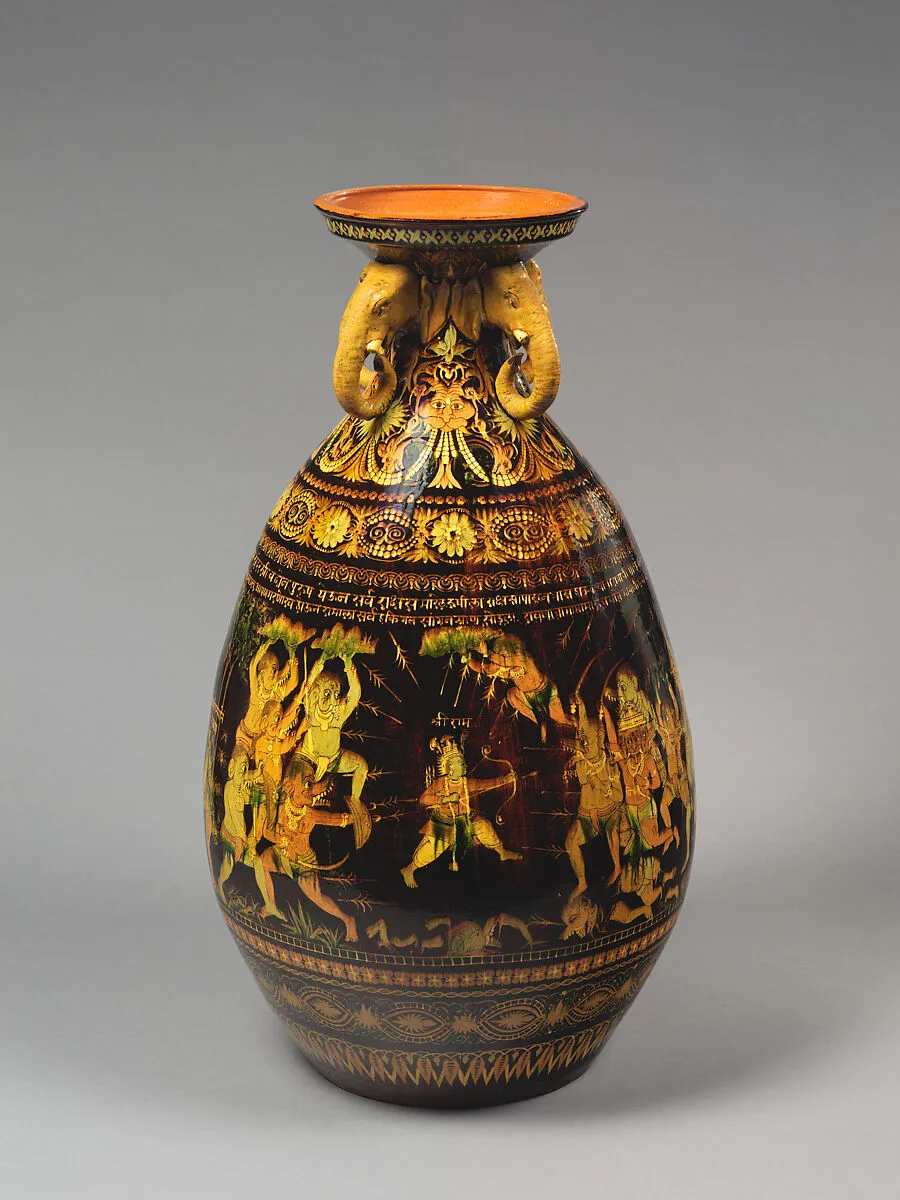
Drawn from the third book (“Aranya Kanda”) of the Ramayana, the elaborate narrative on this vessel depicts key scenes in the Dandaka forest. Created by the Bombay School of Art in an effort to preserve Indian craft, the object features many embellishing motifs drawn from the Buddhist murals of Ajanta. These features include the lotus and pearl band running around the shoulder and the monster faces (kirtimukha), set between the addorsed elephant heads, that spit out a garland of jewels. Although the vase is grounded in the Indian tradition, British neoclassical taste clearly underlies its shape and some of its geometric motifs. Given the scale and inscribed multiscene narrative, this vase may have been produced for the London Colonial and Indian Exhibition of 1886. On the other side of the object, the narrative begins with Rama firing arrows at a horde of demons who hurl rocks. Short inscriptions identify the powerful demons as Khara, Dushana, and Trishara. After hearing of the defeat of this demon army, Ravana decides to abduct Sita by transforming himself into an ascetic (this side bottom right), while Rama and Lakshmana chase a golden deer who is in fact the magically transformed demon Maricha. To the left, before the main battle, Rama and Lakshmana speak with the aged and dying vulture Jatayu, who fought Ravana, smashing his chariot and killing his charioteer (seen above). With his last words Jatayu tells of Sita’s abduction.
- Artist
- Unknown
- Date
- ca. 1880s
- Medium
- Earthenware with colored slips under a clear glaze.
- Culture
- India, Bombay School
- Department
- Asian Art
- Credit line
- Gift of Steven Kossak, The Kronos Collections, in celebration of the Museum's 150th Anniversary, 2020