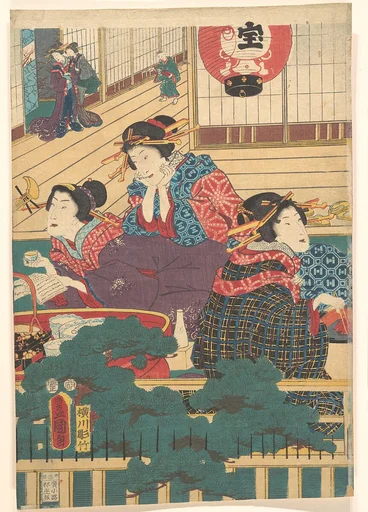
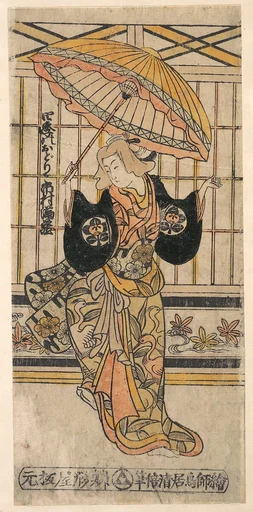
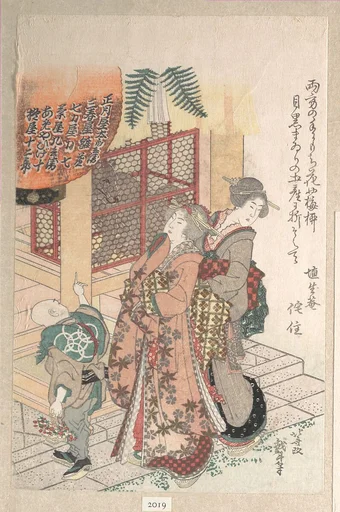
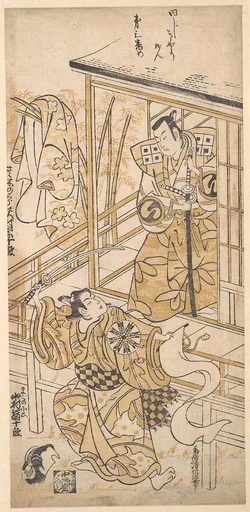
伝奥村政信画 「けいせいなよせ」回り灯籠を見る遊女と禿|A Courtesan and Her Attendants with a Revolving Shadow Lantern
Okumura Masanobu
ca. 1715–20 · Woodblock print (tan-e); ink and hand applied color on two joined sheets of paper · Asian Art
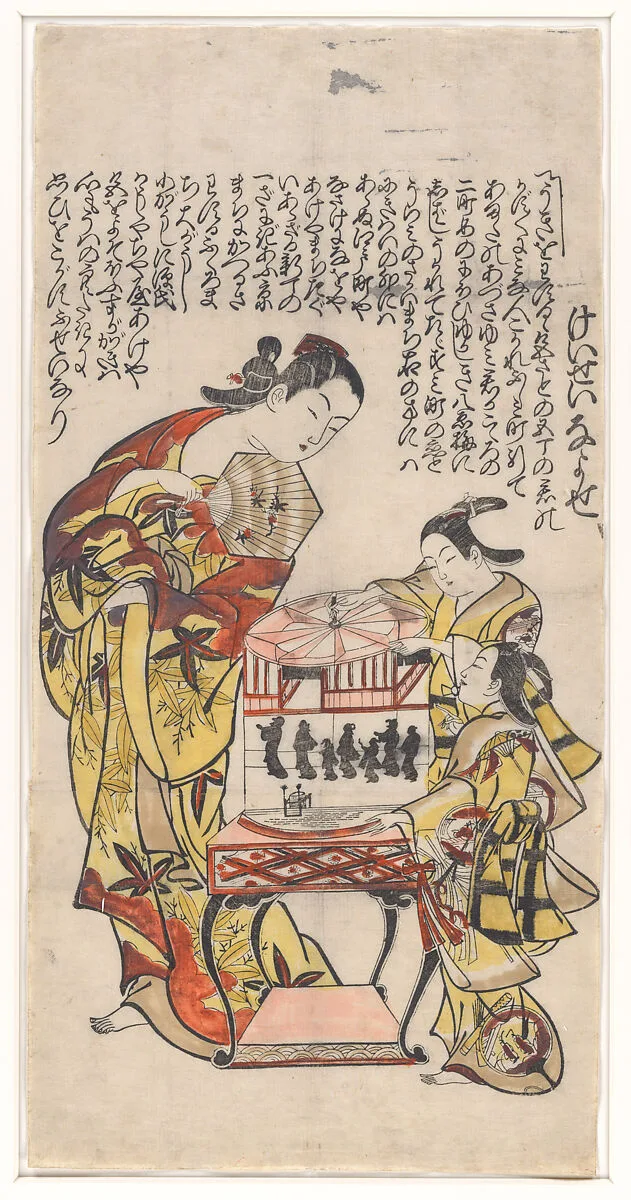
A courtesan and her two young female attendants enjoy watching a type of revolving shadow lantern (mawari dōrō). A spinning wheel was attached to a stick inserted into the middle to act as the spinner. When a candle was lit and placed inside the lantern, the rising air current caused the wheel to spin, which in turn rotated the inner frame and cast a shadow on the outer layer. The revolving lantern consists of an outer frame onto which a thin layer of paper is attached, and inside is a paper cylinder with cut-out shapes of a procession of a courtesan and her entourage. A candle illuminates the cylinder as it is rotated to create optical illusion that the figures are in motion. Here the lantern projects a parading courtesan (shinzō), child attendants (kamuro), and servants (kasha). Though the print is entitled Keisei nayose (names of courtesans), the libretto is actually a playful song incorporating the names of brothel districts. The print lacks a seal, but the distinctive figure style aligns with that of Okumura Masanobu. The courtesan’s hairstyle indicates that the print was designed in the 1710s or 1720s. This is an example of a tan-e, a type of early print that is hand-colored with an orange-red (tan) pigment as well as yellow, crimson, pale indigo, and green—popular from around 1688 to the 1710s.
- Artist
- Okumura Masanobu
- Date
- ca. 1715–20
- Medium
- Woodblock print (tan-e); ink and hand applied color on two joined sheets of paper
- Culture
- Japan
- Department
- Asian Art
- Credit line
- Gift of Lee E. Dirks, in celebration of the Museum's 150th Anniversary, 2019