Revolution (experimental proof)
Cyril E. Power
ca. 1931 · Linocut · Drawings and Prints
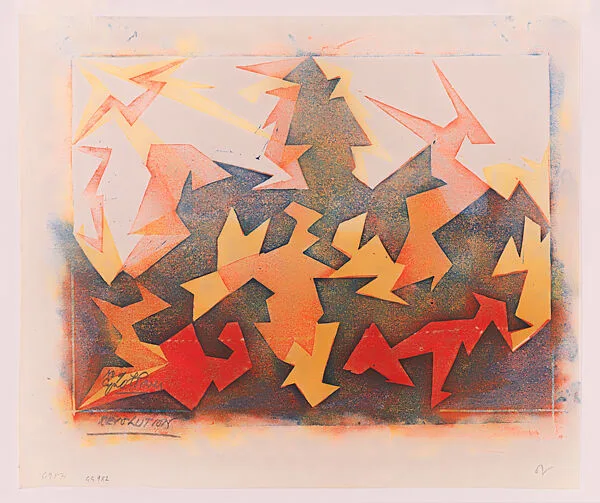
Cyril Power was a practicing architect before he left the field to study linocut with Claude Flight at London’s progressive Grosvenor School of Modern Art. Many of his prints focus on images of contemporary leisure activities (such as funfairs, concerts, sporting events, and circuses) and systems that both connoted modernity and allowed it to thrive (such as the London Underground and buses). Revolution is one of the few works in which he embraces near total abstraction. Like his print The Vortex, also made c. 1931, Revolution employs a bold palette dominated by tones of red and yellow, and dramatic angular forms. The work connotes violence and destruction both in the title and fractured imagery, which is likely a reflection of contemporary political, social, and economic events. Power used darker red tones for the two horizontal forms at the bottom of the sheet, which resemble bleeding figures in both the editioned prints and this experimental proof.
- Artist
- Cyril E. Power
- Date
- ca. 1931
- Medium
- Linocut
- Department
- Drawings and Prints
- Credit line
- Purchase, Leslie and Johanna Garfield Gift, Lila Acheson Wallace, Charles and Jessie Price, and David T Schiff Gifts, The Elisha Whittelsey Collection, The Elisha Whittelsey Fund, Dolores Valvidia Hurlburt Bequest, Peco Foundation and Friends of Drawings and Prints Gifts, and funds from various donors, 2019