棟方志功筆 蒼赫二童子図|Red and Blue, Two Attendants
Munakata Shikō
1950s · Hanging scroll; ink and color on paper · Asian Art
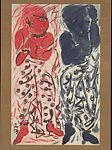
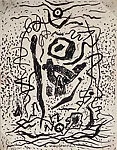
Munakata Shikō is recognized as one of the most highly acclaimed Japanese painters and woodblock print artist of the twentieth century. Munakata’s reputation was established when he was recognized the mid-1930s by the prominent art critic Yanagi Sōetsu (1889–1961). Yanagi was a fervent advocate of mingei, or “folk art,” which he saw as embodying two quintessential aspects of Japanese art: a deep respect for the materiality of the medium and a bold, direct, unselfconscious mode of expression. Munakata’s mingei approach was further enhanced by his immersion in Zen Buddhist philosophy as well as by his fascination with European experiments in Post-Impressionist art—van Gogh, whom he idolized, as well as the German Expressionists—which enabled him to create an entirely new style of Japanese woodcut and painting that propelled him to international fame. Munakata’s immersion into Buddhist philosophy and art led him to create works on themes such as this pair of boy attendants (dōji) who would have flanked Fudō Myōō or other Buddhist deities in more conventional iconography. Here the acolytes rendered in dynamic brushwork in rich blue-ink and phosphorescent orange-red. One of the acolytes has his hands in the namaskara mudra, the other with an upraised arm, a symbol of protection.
- Artist
- Munakata Shikō
- Date
- 1950s
- Medium
- Hanging scroll; ink and color on paper
- Culture
- Japan
- Department
- Asian Art
- Credit line
- Mary and Cheney Cowles Collection, Gift of Mary and Cheney Cowles, 2018