The Greek Slave
Minton and Company|Hiram Powers
1849 · Parian porcelain · The American Wing
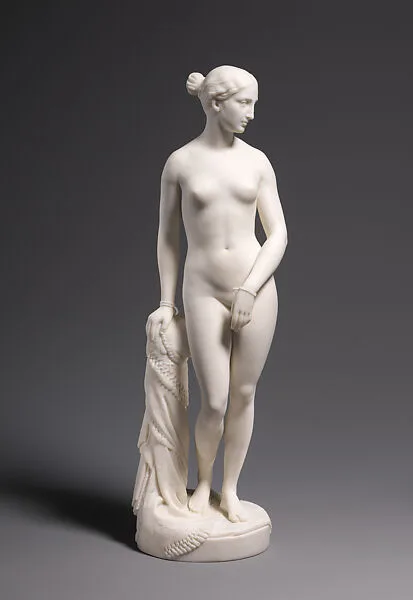
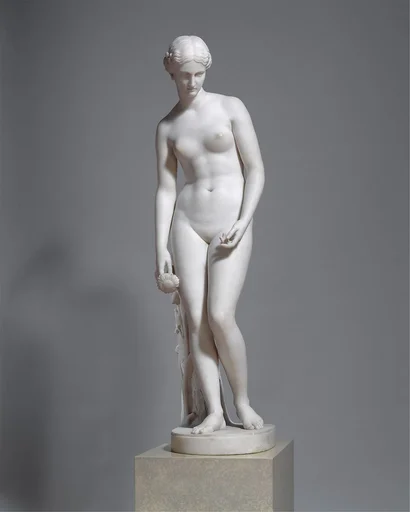
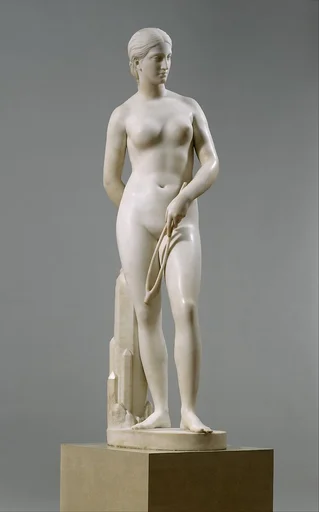
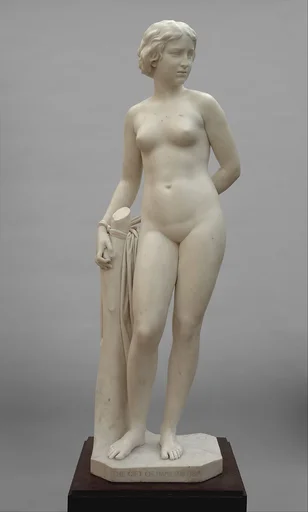
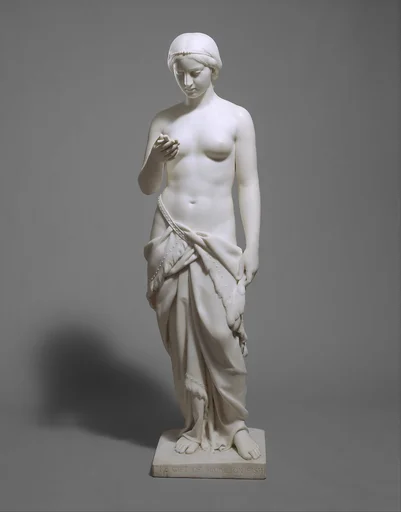
Beginning in the late 1840s, versions of Hiram Powers’s marble "Greek Slave" were publicly exhibited in both London and the United States. To many, the statue of a young Greek woman in a Turkish slave market symbolized the highest form of artistic achievement and exemplified “good” or “correct” taste. The popular appeal of the sculpture inspired an unprecedented commercial response in the form of affordable reductions in Parian porcelain, plaster, alabaster, and bronze. London-based Minton and Company issued its first Parian porcelain "Greek Slave" in 1848. It was one of several British firms, along with W. T. Copeland, that produced "Greek Slave" statuettes in varying heights for domestic ornament, the recently developed material of Parian porcelain hailed for its resemblance to white marble. The Metropolitan Museum’s example, dated August 1849, no longer has the chain links that were suspended between the figure’s bound wrists.
- Artist
- Minton and Company|Hiram Powers
- Date
- 1849
- Medium
- Parian porcelain
- Culture
- American
- Department
- The American Wing
- Credit line
- Gift of Mr. and Mrs. Russell E. Burke III, 1983