Paedagogi habitus, qui Christianam prolem in disceplinam acceperit; Proles Christiana Turcorum Imperatori tributa; Assamoglani habitus, qui ad militiam se instituit; Asmoglam vestituis qui ad agriculturam exercetur
Abraham de Bruyn|Joos de Bosscher
1580 · Engraving · Drawings and Prints
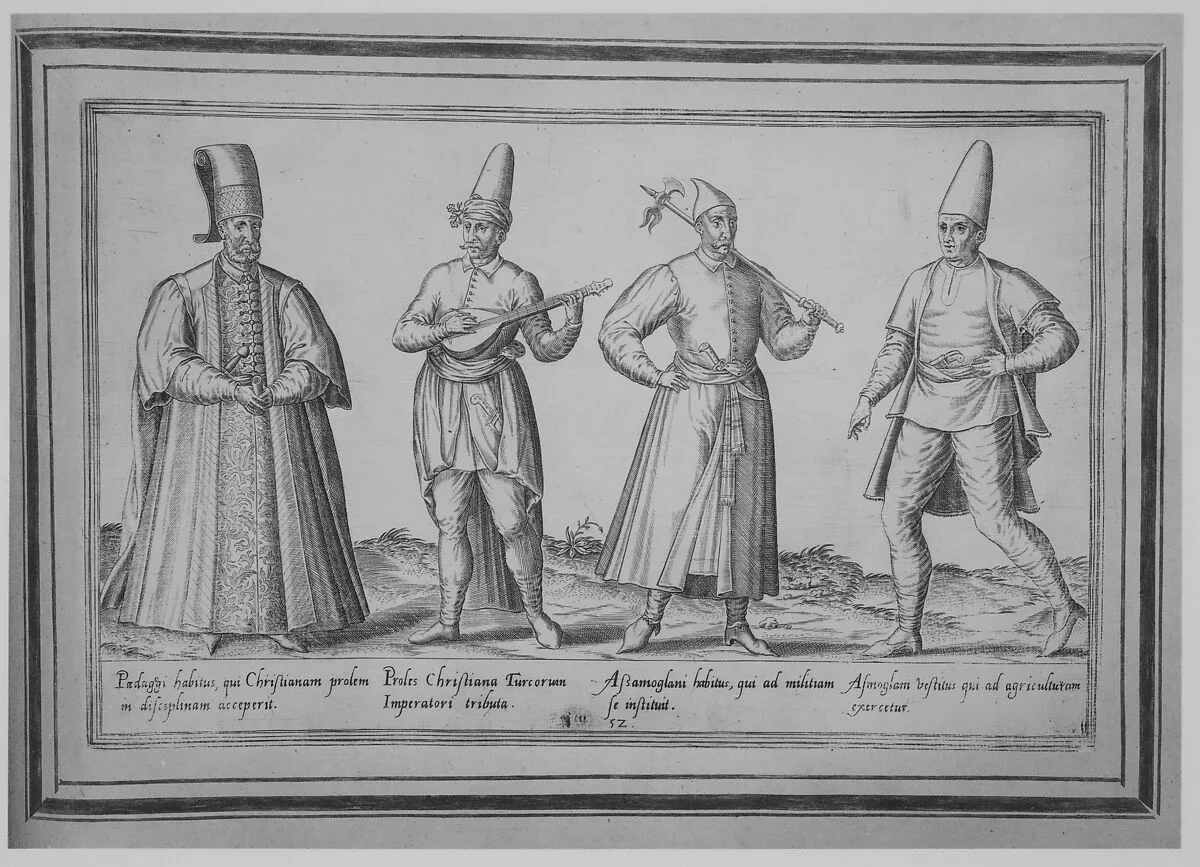
Engraving, part of 'Omnium pene Europae, Asiae, Aphricae atque Americae Gentium Habitus' (Costumes of the various nations of Europe, Asia, Africa and America), a series of prints representing figures from various parts of the world, engraved by Abraham de Bruyn and published by Joos de Bosscher in 1580. This engraving represents a pedagogue, a Turkish Christian's son, a soldier and an agricultor from Assam. On the left, the pedagogue wears a brocaded robe with arabesques under an overcoat with three-quarter sleeves and lined with thin, diagonal stripes, and a hat with a pattern of lozenges and pearls on the band, and a scrolling panel on the back. He holds a scroll of paper in his hands, and carries a sword (?) inside his overcoat. The points of his shoes peek at the bottom of the robe. The son of a Turkish Christian wears an asymmetrical jacket with long sleeves and fabric belt over long, tight trousers and flat shoes. He wears an elongated hat with a scarf around the head, with a bundle of flowers on the right side. He carries a sword on his left hip and plays a guitar. The soldier from Assam wears a long-sleeved robe and a striped belt with fringed edges, which holds a knife at his waist, and low-heeled, pointed-toe boots. He has a brimless, pointed hat on his head and mustache with scrolling tips. On his left shoulder he carries a halberd. The agricultor from Assam wears a fur-lined, short-sleeved jacket over a long-sleeved shirt with a fabric belt around the waist, tight, long trousers, and low-heeled, pointed-toe shoes. He carries a knife in his belt, and wears an elongated hat without brim.
- Artist
- Abraham de Bruyn|Joos de Bosscher
- Date
- 1580
- Medium
- Engraving
- Department
- Drawings and Prints
- Credit line
- Rogers Fund, 1921