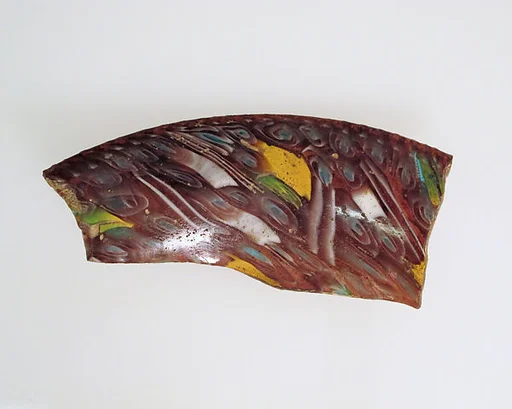
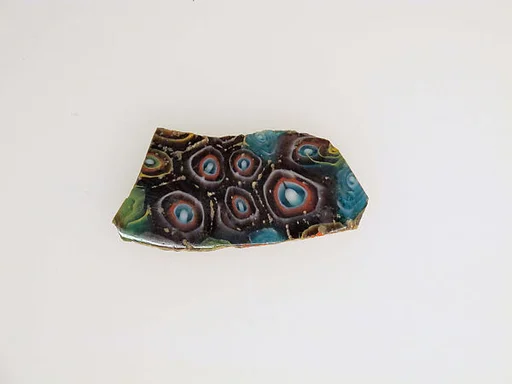
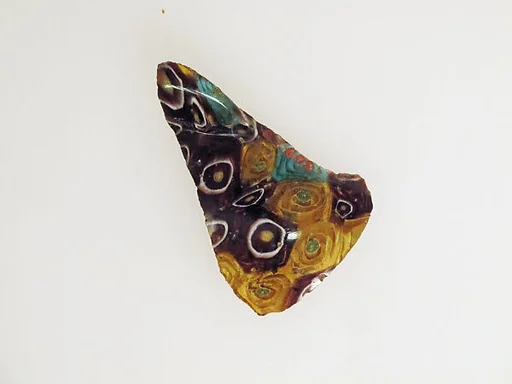
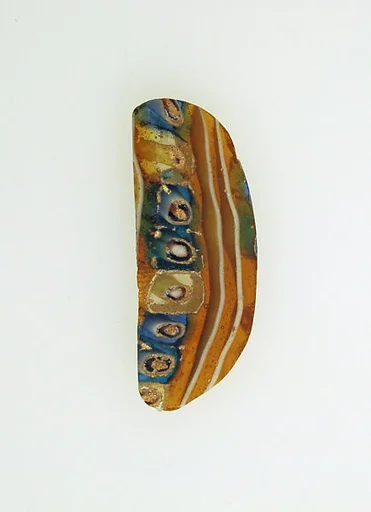
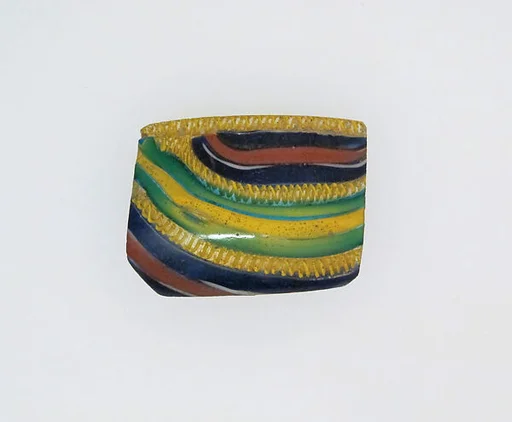
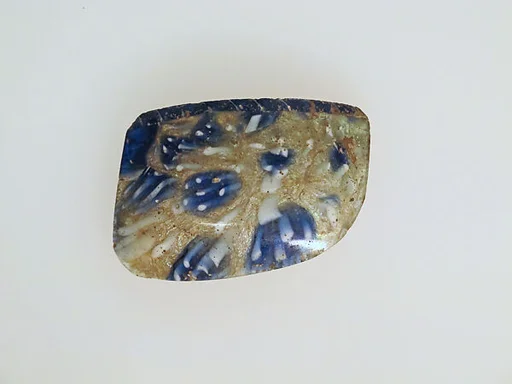
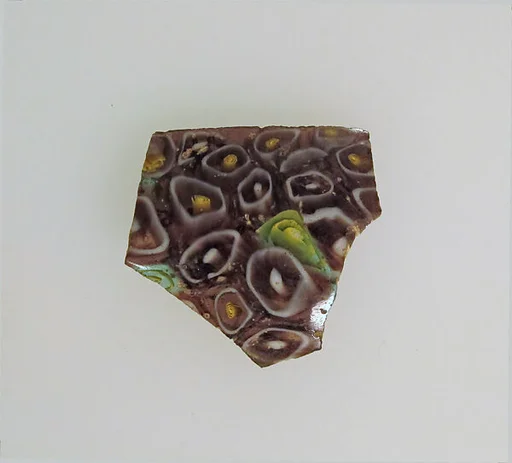
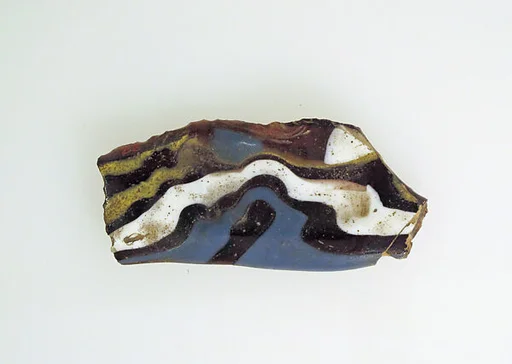
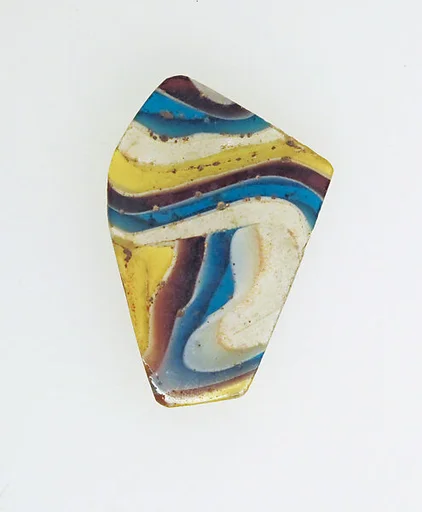
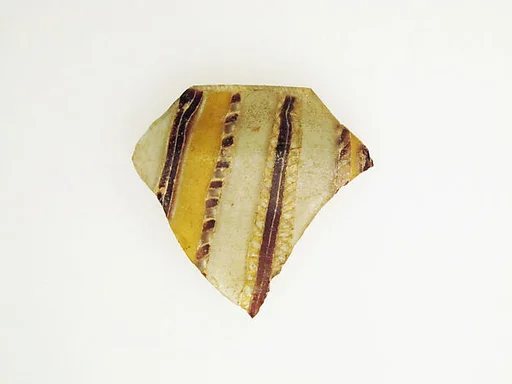
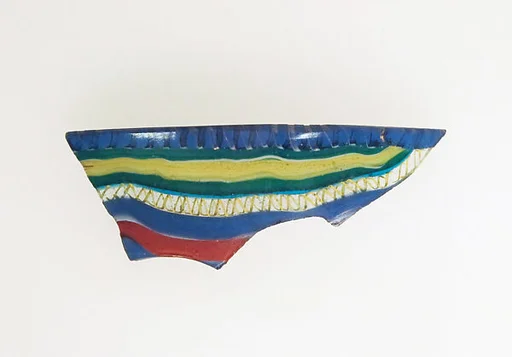
Glass mosaic shallow dish fragment
Unknown
2nd–mid-1st century BCE · Glass · Greek and Roman Art
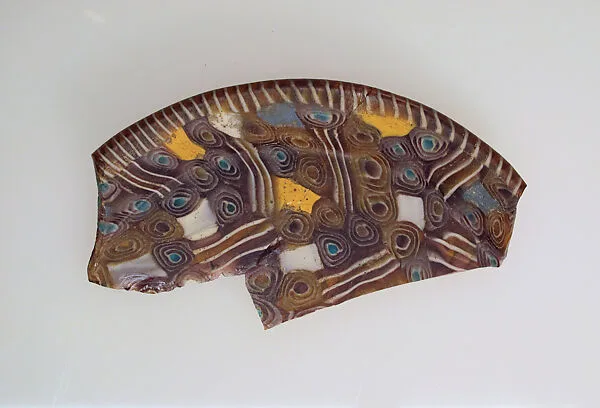
Translucent golden brown, purple, turquoise blue partially appearing green, opaque yellow, white, and greyish blue. Outsplayed, thick rim with rounded edge; shallow concave curving side, turned in at a sharp angle to flat bottom. Composite mosaic pattern formed from polygonal sections, square segments, and rectangular lengths of eight canes: the first in a brown ground with a white spiral; the second in a brown ground with a white spiral around a large central purple rod; the third in a purple ground with a white spiral around a large central brown rod; the fourth in a purple ground with a white spiral around a large central blue rod; the fifth in alternating brown and purple flanked by parallel white stripes; the sixth in squarish yellow; the seventh in squarish white; and the eighth in squarish greyish blue. Some of the square segments are only visible on the interior. A wide brown network cane wound spirally with a white thread is attached as a rim. Broken and repaired from two pieces; dulling, slight pitting of surface bubbles, and iridescence weathering on interior and exterior; some weathering on jagged edges. Rotary grinding on interior. Some irregular tooling indents on exterior of side.
- Artist
- Unknown
- Date
- 2nd–mid-1st century BCE
- Medium
- Glass
- Culture
- Greek, Eastern Mediterranean or possibly Italian
- Department
- Greek and Roman Art
- Credit line
- Gift of J. Pierpont Morgan, 1917