Sepulchrum (sic) Adriani, from a Series of 24 Depicting (Reconstructed) Buildings from Roman Antiquity
Anonymous, Italian, 16th century|Monogrammist G.A. & the Caltrop
Plate ca. 1530–50 · Engraving · Drawings and Prints
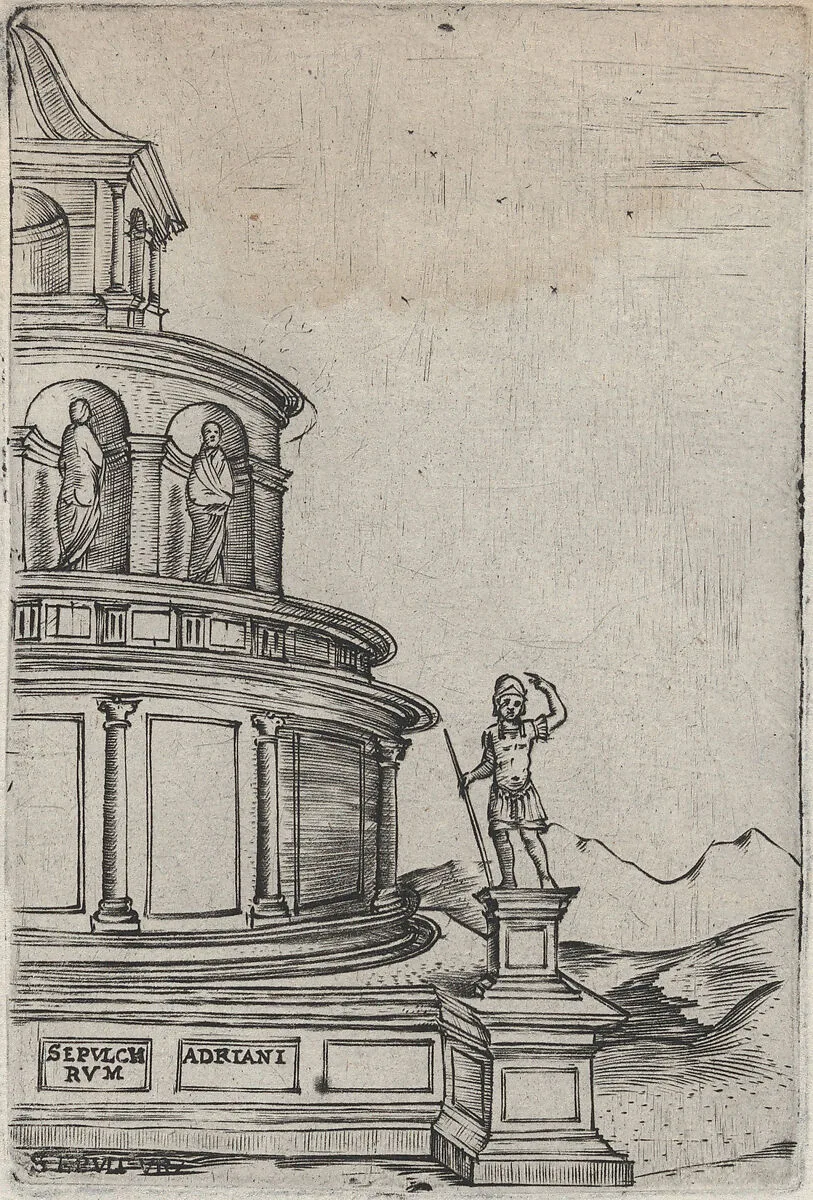
Perspectival depiction of part of the mausoleum of Emperor Hadrian referred to as the ‘Sepulchrum Adriani’. The building is characterized by its central plan consisting of two circular floors on a rectangular base. The building is crowned by a rectangular (?) lantern. A statue of a Roman soldier is placed on the right corner of the base of the building. Two other statues are placed in semi-circular niches on the second floor. While the building is meant to represent Hadrian’s Tomb, still preserved as the Castel Sant’Angelo today, this rendition was likely created as an ekphrasis, without extensive knowledge of the remains of the original. The print is part of a group of architectural prints depicting buildings from Roman Antiquity, ranging from triumphal arches to bath houses, temples and palaces in Italy, France and Spain. Some of the buildings have been artificially reconstructed based on Medieval descriptions, while others are depicted in their ruinous states. The plates are known in several (uncatalogued) states, and have undergone minor changes over time. Several titles of buildings have been changed, and the plates have been cropped as a result of plate cracks and oxidation. Most copper plates for this series have been engraved on both sides. This print is taken from the same plate as the 'Mercurii Templum'.
- Artist
- Anonymous, Italian, 16th century|Monogrammist G.A. & the Caltrop
- Date
- Plate ca. 1530–50
- Medium
- Engraving
- Department
- Drawings and Prints
- Credit line
- Purchase, Edward Pearce Casey Fund and Carolyn H. Specht Gift, 2016