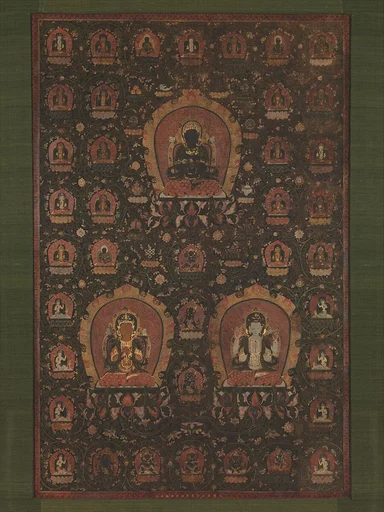
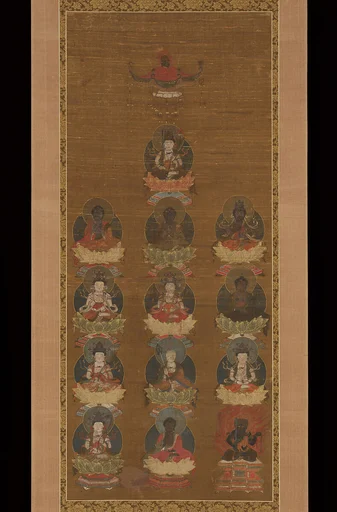
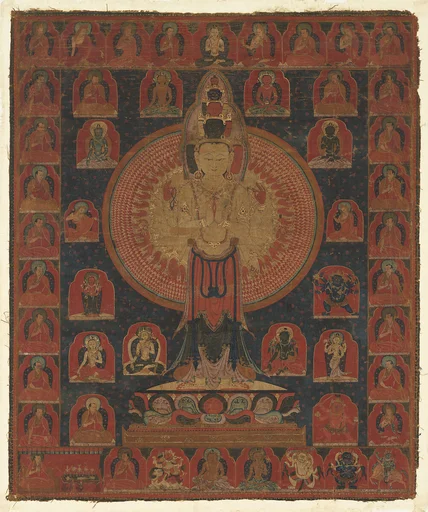
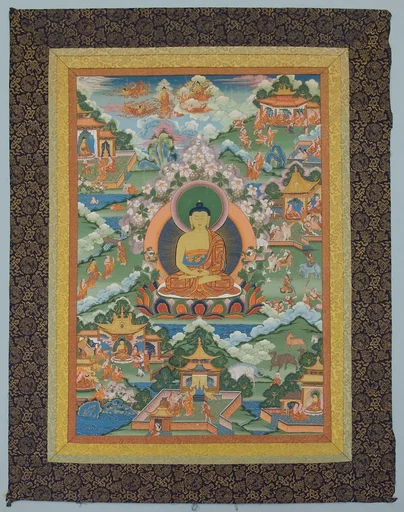
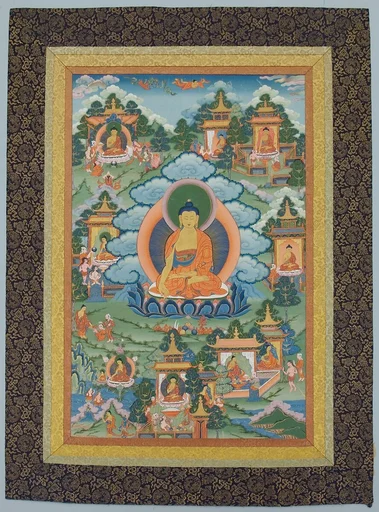
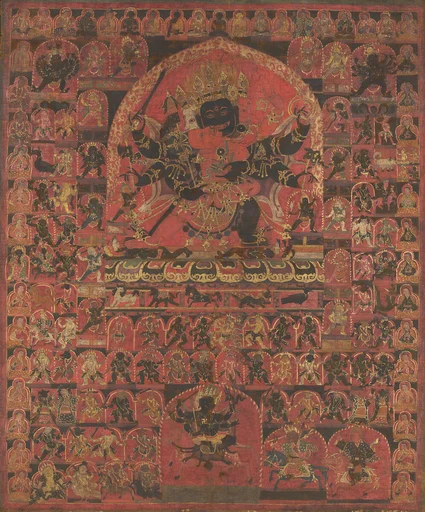
山王本地仏曼荼羅|Mandala of the Sannō Shrine Deities
Unknown
17th century · Hanging scroll; ink, and gold on silk · Asian Art
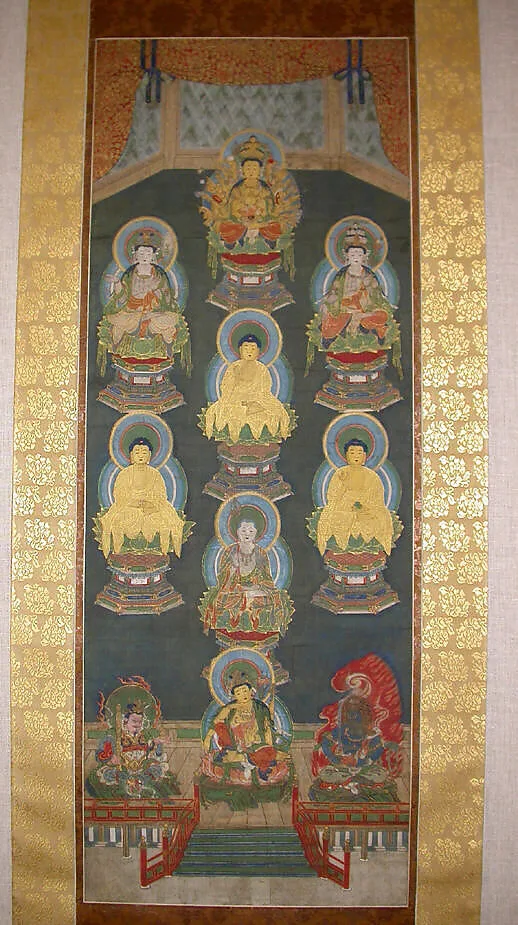
This mandala gives concrete visual expression to the Japanese Buddhist concept of “original ground and flowing traces” (honji-suijaku) in which Japanese deities, known as kami, are considered to be manifestations (“flowing traces”) of Buddhist deities (“original ground”). The concept satisfied the desire of early medieval Japanese Buddhists to reconcile preexisting kami worship with the Buddhist tradition. Here, in an early premodern iteration of the theme, the seven kami of the Upper Sannō shrines are depicted in their original Buddhist forms along with three kami from the Middle Sannō shrines along the bottom. The Sannō (literally, "mountain king") shrine complex is situated in the eastern foothills of Mt. Hiei, northeast of Kyoto, overlooking Lake Biwa. The name refers to the tutelary kami of the Enryakuji Temple on Mt. Hiei, where Saichō (767–822), founder of the Tendai School of Buddhism, established his headquarters.
- Artist
- Unknown
- Date
- 17th century
- Medium
- Hanging scroll; ink, and gold on silk
- Culture
- Japan
- Department
- Asian Art
- Credit line
- Museum Accession