刺繍種字阿弥陀三尊図|Amida Triad in the Form of Sacred Sanskrit Syllables
Unknown
13th century · Hanging scroll; silk embroidery, gold-wrapped thread, and human hair · Asian Art
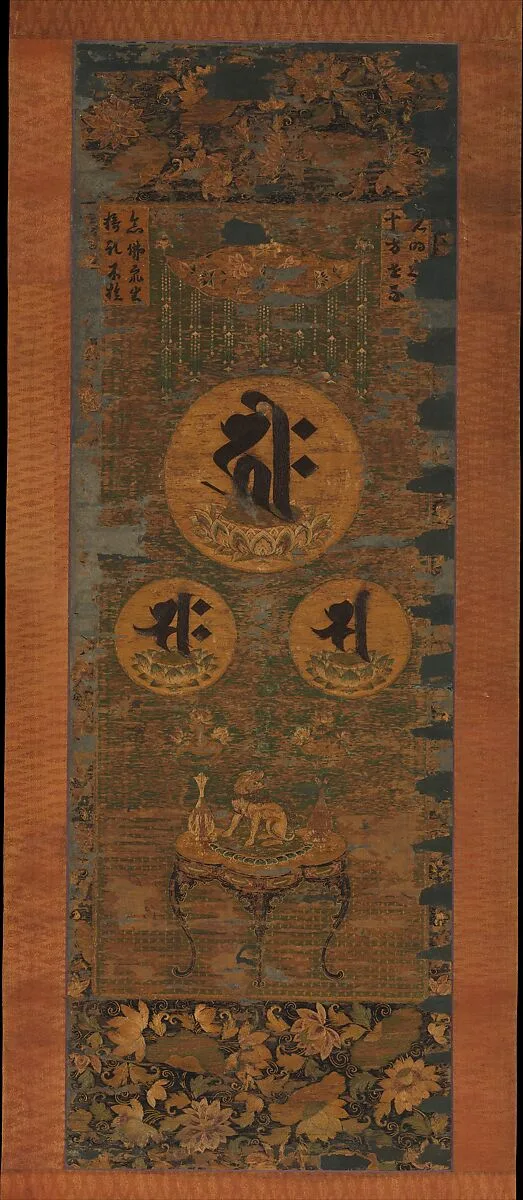
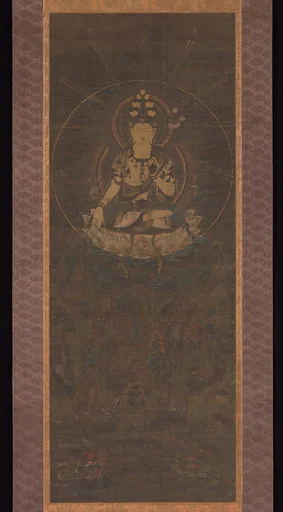
Embroidered Buddhist images were introduced to Japan from China in the sixth century. Large embroideries were prominent among icons from the sixth through the ninth century and were often hung in temple lecture halls. In the Kamakura period, practices focused on attaining birth in the Buddha Amida’s (Sanskrit: Amitābha) Western Paradise became widespread, and many small embroideries like this one were produced for individual devotional practice and deathbed ritual. In place of anthropomorphic images, the Sanskrit syllables for Amida, Kannon (Sanskrit: Avalokiteshvara), and Seishi (Sanskrit: Mahasthamaprapta) are used in this scroll. The needleworker substituted human hair for silk thread in the Sanskrit characters, a practice common in scrolls used during ceremonies following the death of a devotee, when prayers were offered for safe birth in Amida’s Pure Land. The embroidery conveniently depicts an altar set with offerings of flowers and an incense burner in the form of a lion, so one would not require an actual altar. Inscriptions at the top explain that Amida’s light illuminates the entire world, and that the recitation of his name will ensure that no one is left behind in the journey to his Pure Land.
- Artist
- Unknown
- Date
- 13th century
- Medium
- Hanging scroll; silk embroidery, gold-wrapped thread, and human hair
- Culture
- Japan
- Department
- Asian Art
- Credit line
- The Harry G. C. Packard Collection of Asian Art, Gift of Harry G. C. Packard, and Purchase, Fletcher, Rogers, Harris Brisbane Dick, and Louis V. Bell Funds, Joseph Pulitzer Bequest, and The Annenberg Fund Inc. Gift, 1975