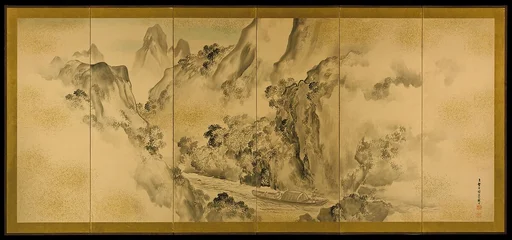
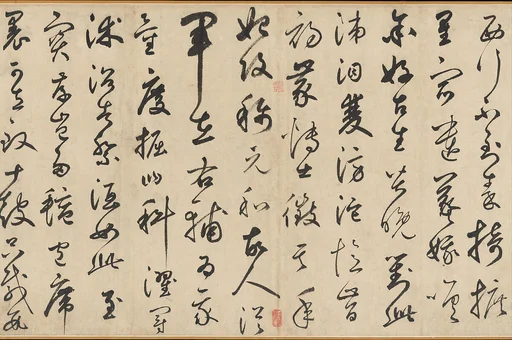
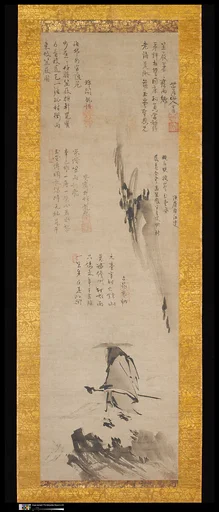
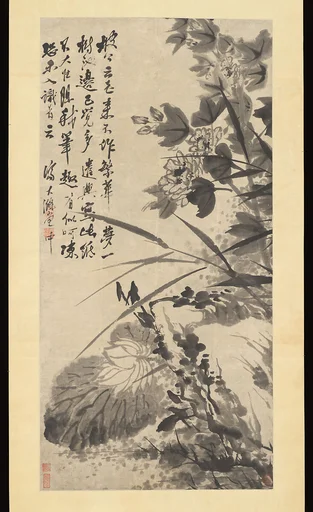
書画押絵貼屏風|Miscellaneous Paintings and Calligraphy
Nagasawa Rosetsu 長澤蘆雪|Shishin Sōgin 指津宗琅
second month, 1785 · Sheets with calligraphy and painting attached to a pair of six-panel folding screens; ink on paper · Asian Art
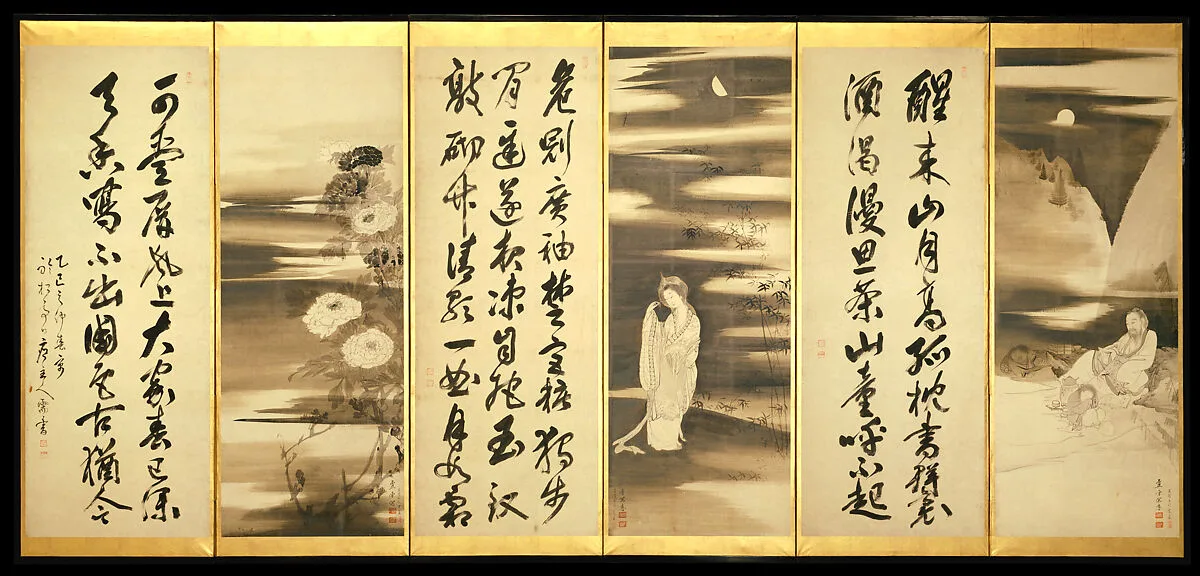
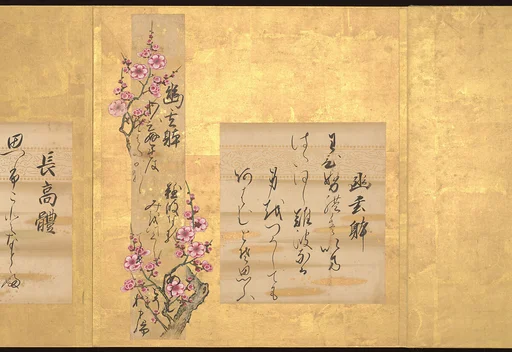
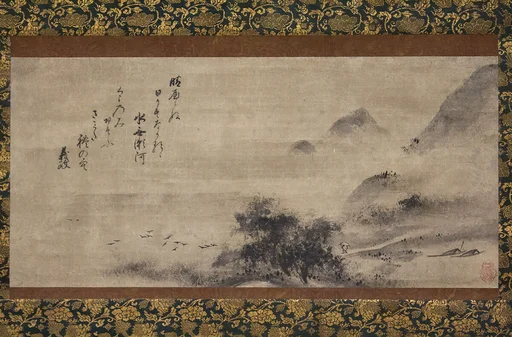
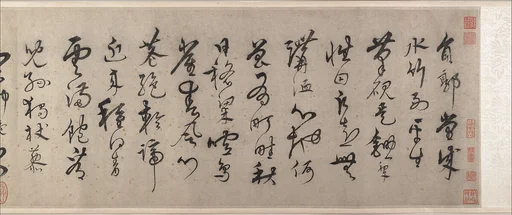
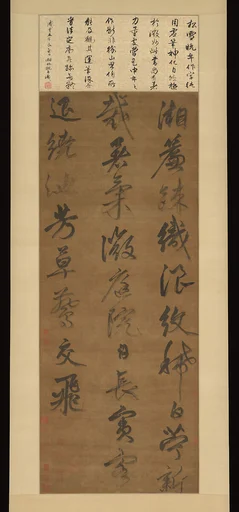
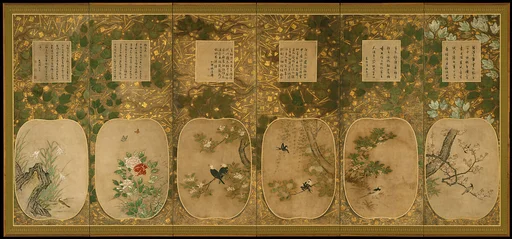
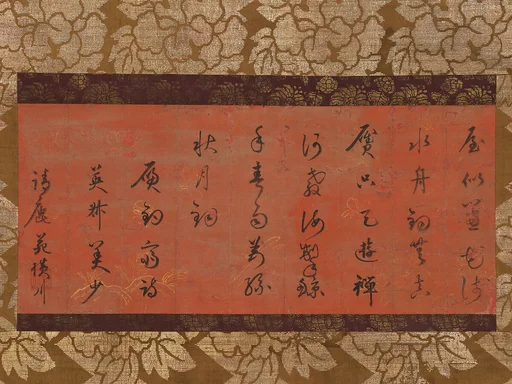
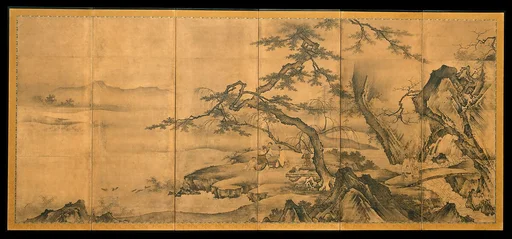
Painting and poetry have long been revered as sister arts in the East Asian cultural tradition. Painters have sought inspiration in poetry, while poets have inscribed their work on paintings. For instance, here ink paintings by the independent artist Rosetsu were attached as separate sheets to screens and complemented on the right screen by two classic Ming-dynasty poems composed by Li Panlong (1514–1570) and Wang Shizhen (1526–1590), along with a Tang-dynasty poem by Men Haoran (ca. 691–740). On the left screen are two additional Tang poems by Pi Rixiu (834–883), and Gao Shi (ca. 704–765), and a colophon by the monk-calligrapher Shishin Sōgin. The last panel, pasted next to the painting of peonies, has a cyclical date indicating the calligraphy was inscribed in the second month of 1785. Signed by Rosetsu in his early calligraphic style, this pair is the only extant work of a monumental scale dating from the artist’s early career. The calligrapher Shishin Sōgin (or Sōkon) was the eighth abbot of Hantō’in subtemple of Myōshinji, Kyoto, in the lineage of Hakuin Ekaku. He trained Maruyama Ōkyo in Zen and calligraphy, and in return learned painting from the great artist. The calligraphy on these screens was inscribed a year before he died.
- Artist
- Nagasawa Rosetsu 長澤蘆雪|Shishin Sōgin 指津宗琅
- Date
- second month, 1785
- Medium
- Sheets with calligraphy and painting attached to a pair of six-panel folding screens; ink on paper
- Culture
- Japan
- Department
- Asian Art
- Credit line
- The Harry G. C. Packard Collection of Asian Art, Gift of Harry G. C. Packard, and Purchase, Fletcher, Rogers, Harris Brisbane Dick, and Louis V. Bell Funds, Joseph Pulitzer Bequest, and The Annenberg Fund Inc. Gift, 1975