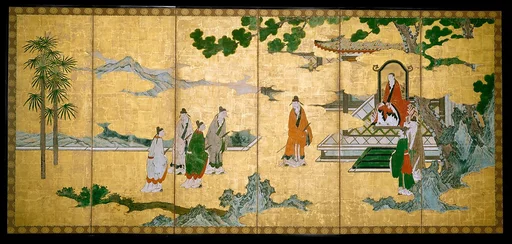
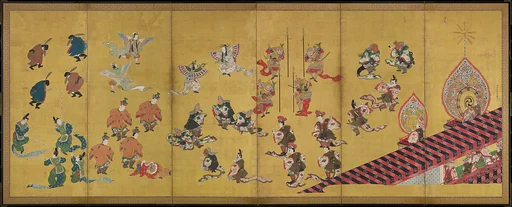
見立琴碁書画屏風|Parody of the Four Accomplishments
Shibata Zeshin
second half of the 19th century · Pair of six-panel folding screens; ink and color on gold leaf on paper · Asian Art
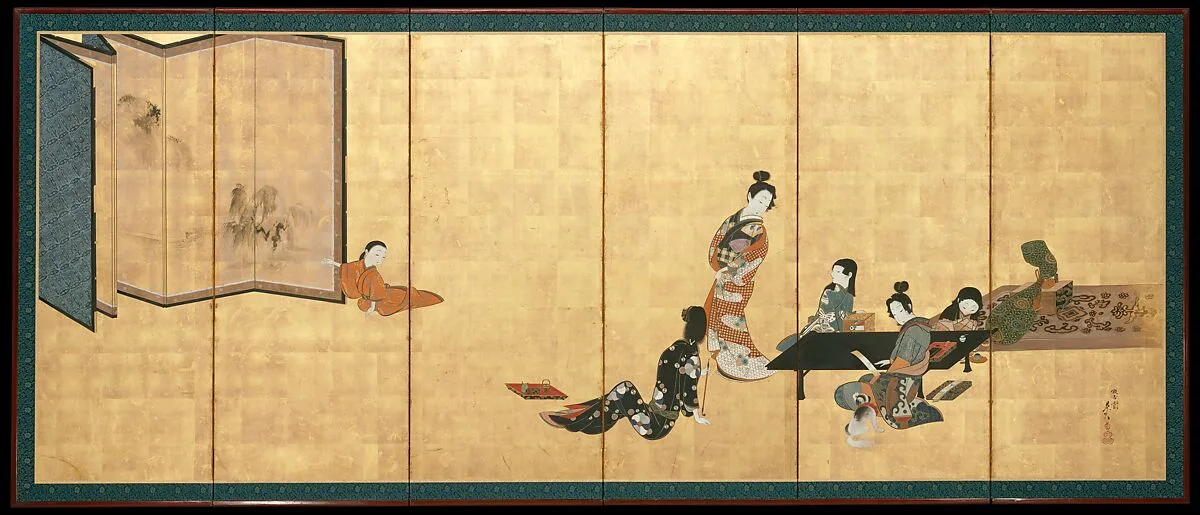
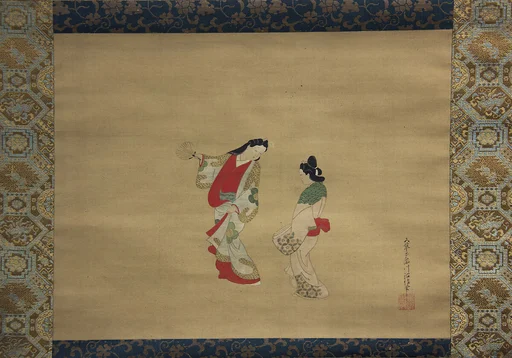
This painting is inspired by one of the most celebrated works of Japanese genre painting: a work known as the Hikone Screen. Illustrated here are the “Four Accomplishments” necessary for well-cultivated gentlemen in ancient China—the musical instrument qin (Japanese: koto), the board game weiqi (Japanese: go), calligraphy, and painting. The Four Accomplishments were a favored painting subject beginning in the Muromachi period (1392–1573) but here appears as a parody—for instance, writing a love letter (or poems) instead of calligraphy. Zeshin’s reinterpretation, more than two centuries after the original, reconstructs some of the mysterious feel of the Hikone Screen by arranging meaningful-looking figures engaged in various pursuits within the same space. Nevertheless, the eye-pleasing impression has been attained by a careful compositional arrangement in which elements are ordered in a pyramid-like shape toward the center, and by the use of a variety of colors, from vivid to subtle, contrasting with the plain gold background. A few versions of this screen by Zeshin exist, each with distinct variations of the figures and setting.
- Artist
- Shibata Zeshin
- Date
- second half of the 19th century
- Medium
- Pair of six-panel folding screens; ink and color on gold leaf on paper
- Culture
- Japan
- Department
- Asian Art
- Credit line
- Fletcher Fund, 1951