清 郎世寧 百駿圖白描稿 卷|One Hundred Horses
Giuseppe Castiglione
datable to 1723–25 · Handscroll; ink on paper · Asian Art
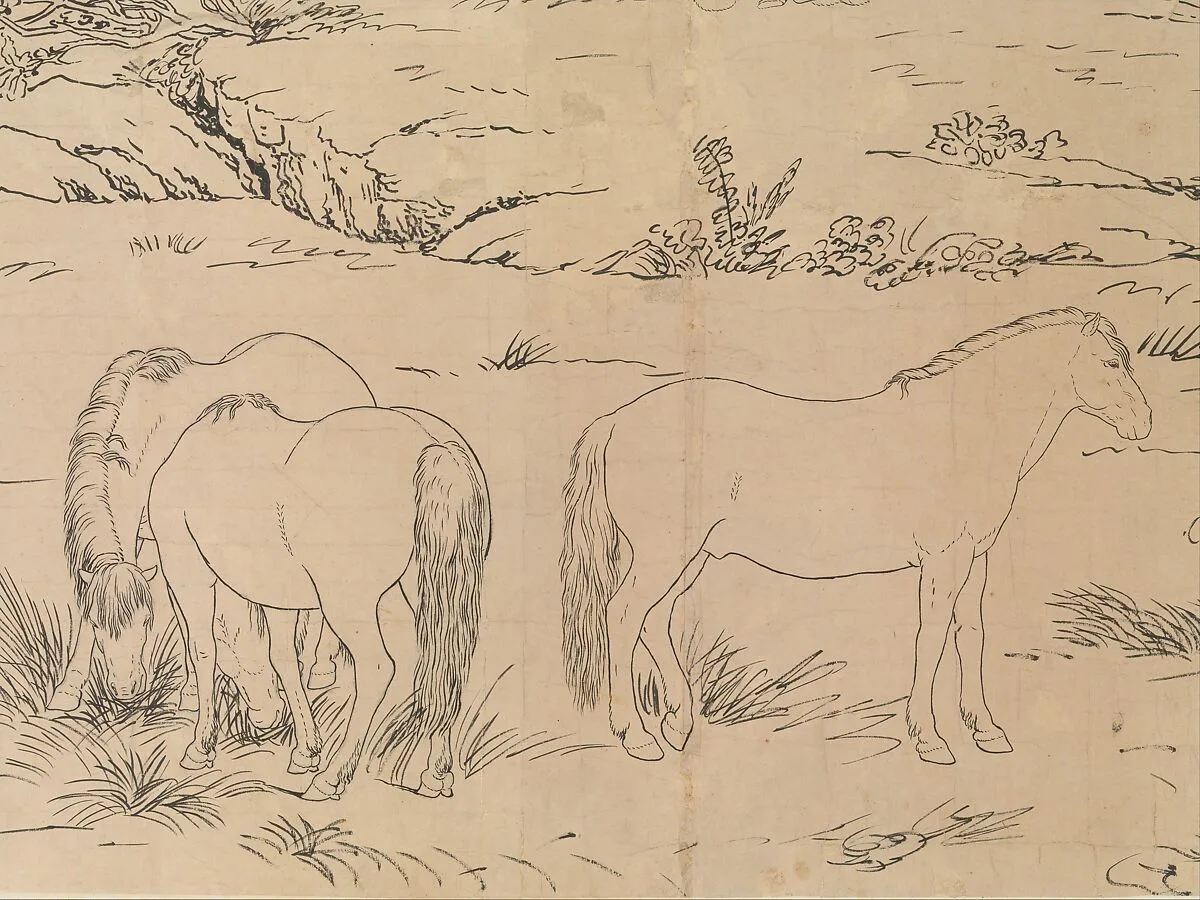
During the eighteenth century, the Manchu Qing dynasty sponsored a major revival of courtly arts, which attained a new monumental scale, technical finish, and descriptive intricacy. A key figure in establishing this new court aesthetic was the Italian Jesuit Giuseppe Castiglione. A master of vividly naturalistic draftsmanship and large-scale compositions, in Europe he worked as a muralist. Castiglione helped to create a new, hybrid style that combined Western realism with traditional Chinese conventions of composition and brushwork. This monumental scroll, a unique example of a Castiglione preparatory drawing, is the model for one of Castiglione's most famous paintings, the One Hundred Horses scroll preserved in the National Palace Museum, Taipei. The drawing, although done with a brush rather than a pen, is executed almost exclusively in the European manner. Landscape is represented using Western-style perspective, figures are often shown in dramatically foreshortened views, and vegetation is depicted with spontaneous arabesques and cross-hatching. The large scale of the painting also suggests a European influence, as if Castiglione had taken a typical Western canvas and extended its length to make an architectural frieze.
- Artist
- Giuseppe Castiglione
- Date
- datable to 1723–25
- Medium
- Handscroll; ink on paper
- Culture
- China
- Department
- Asian Art
- Credit line
- Purchase, Friends of Asian Art Gifts, 1991