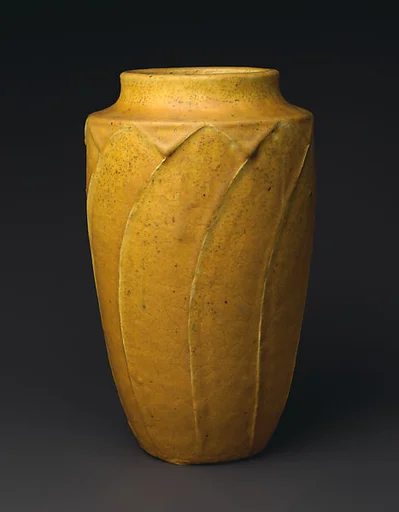
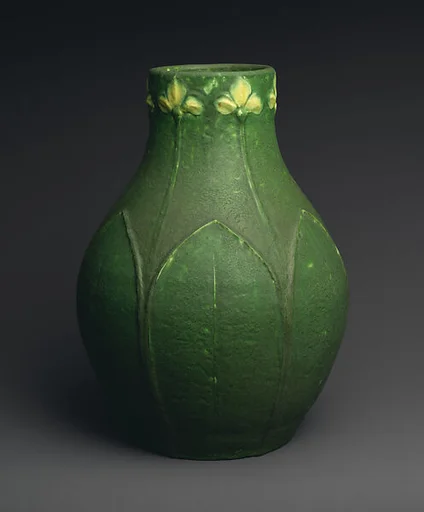
Vase with chestnut leaves
Marblehead Pottery|Arthur E. Baggs
1907 · Earthenware · The American Wing
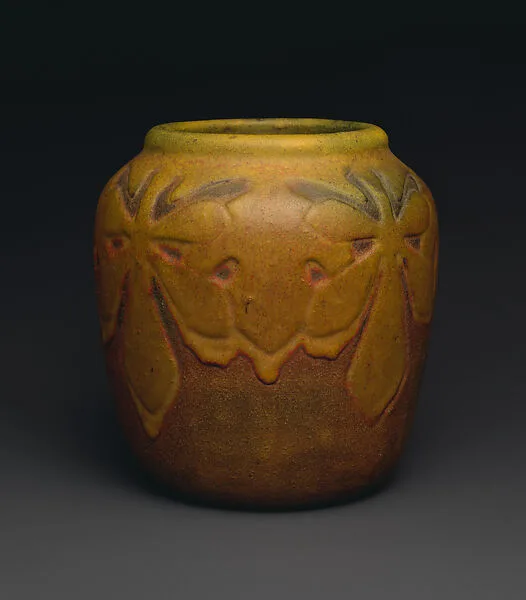
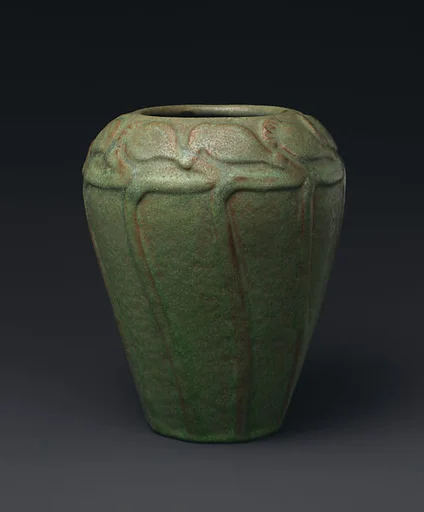
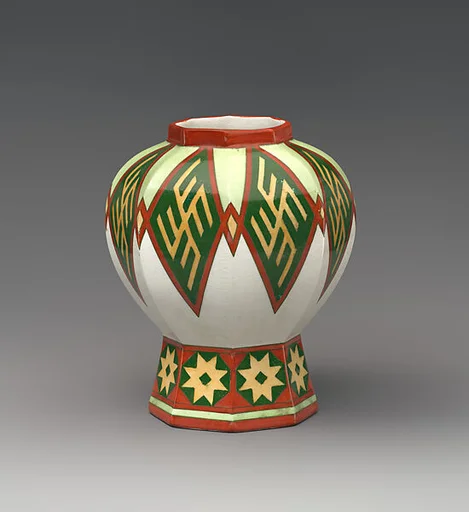
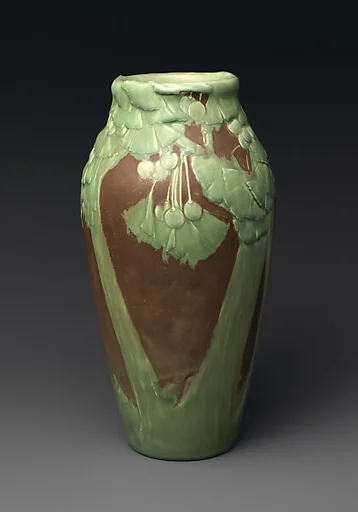
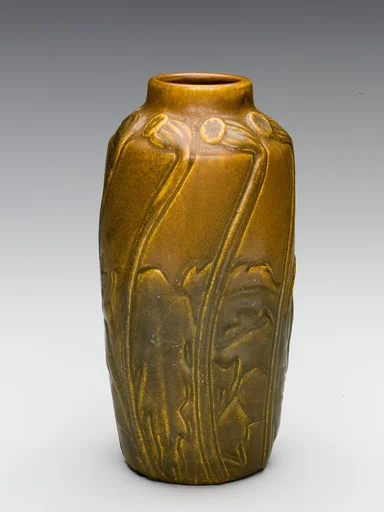
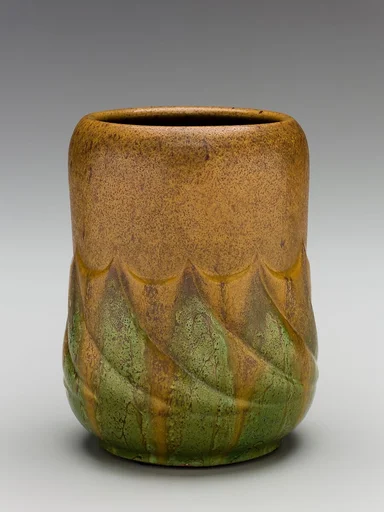
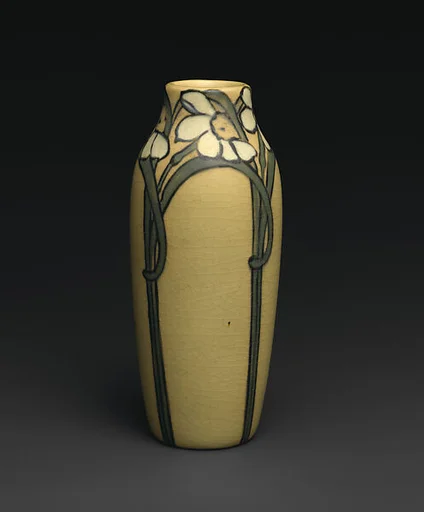
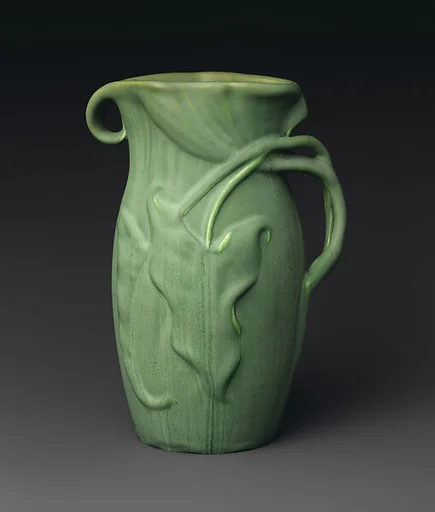
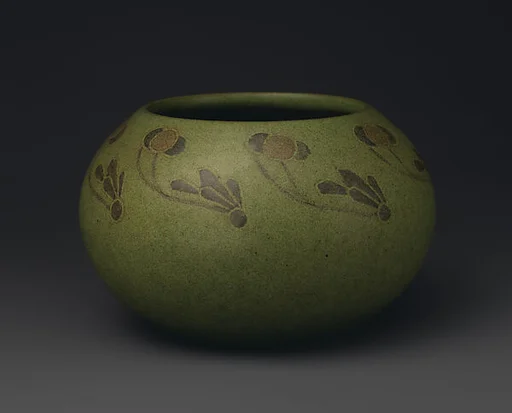
The Marblehead Pottery started out as part of a therapeutic program at a clinic for women suffering from nervous disorders, founded by Dr. Herbert J. Hall in 1905. Patients were to benefit from the practice of handwork in different media, but it was the pottery that was the longest lasting enterprise. Hall hired the young Arthur E. Baggs, a student of Charles F. Binns at the New York State School of Clay-Working and Ceramics at Alfred, to lead the ceramics operations in the coastal town. The therapeutic workshop for convalescing patients soon gave way to an independent pottery operated by Baggs. The predominant palette of the pottery tended toward grayed hues of green blue, and brown in soft, matte glazes in accord with the general tendencies of the Arts and Crafts style. The decorative motifs were often associated with images native to New England, and the designs adhered to the tenets of conventionalization then in vogue, with differing degrees of abstraction. When it debuted in Chicago and New York in 1907, it was well-received by the critics and public alike. Dated 1907, this vase is one of the earliest dated examples known from the Marblehead Pottery. It bears Baggs’ initials, indicating that he was the designer of the vase. It is unusual in its deeply-carved relief decoration and the stylized overlapping chestnut leaves which cover nearly the entire surface of the vase. Its ochre glaze infused with red and green is also unusual.
- Artist
- Marblehead Pottery|Arthur E. Baggs
- Date
- 1907
- Medium
- Earthenware
- Culture
- American
- Department
- The American Wing
- Credit line
- Gift of Martin Eidelberg, 2020