Lampas Fragment and Case
Unknown
11th–12th century · Silk · Islamic Art
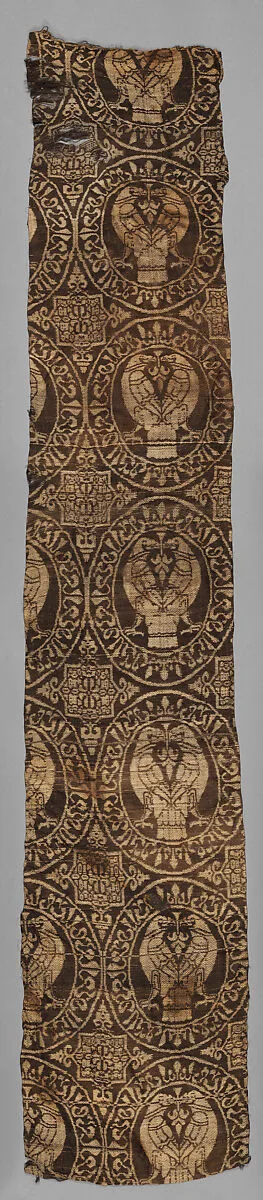
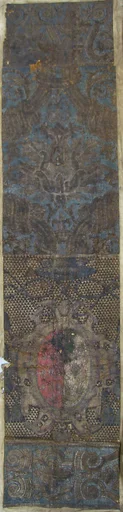
Although this textile has been identified as Seljuq, the very rounded cursive script of its inscription relates most closely to Il-Khanid tile inscriptions from the second half of the 13th century. Moreover, the use of roundels, while attested in Seljuq textiles, was equally popular under the Mongol Il-Khans. The depiction of the birds and palmettes is somewhat more simplified and stylized than those found on Seljuq textiles. This textile fragment, most likely from a robe, is decorated with a repeating pattern of a pair of addorsed regardant birds surrounded by an inscription band containing four iterations of the phrase "glory and dominion" in Arabic. The birds appear to be falcons, a symbol of power in the medieval eastern Islamic world. Following their conquests in Central Asia, Iran, and Iraq, the Mongol Il-Khans became very wealthy and developed a taste for silk garments that range from the most opulent and expensive cloths of gold to plain silk woven in various complex techniques.
- Artist
- Unknown
- Date
- 11th–12th century
- Medium
- Silk
- Department
- Islamic Art
- Credit line
- Purchase, Friends of Islamic Art Gifts, 2016