The Battle of Arcul
Charles Nicolas Cochin II|Giuseppe Castiglione|Benoit Louis Prevost
1767–74 · Etching and engraving · Drawings and Prints
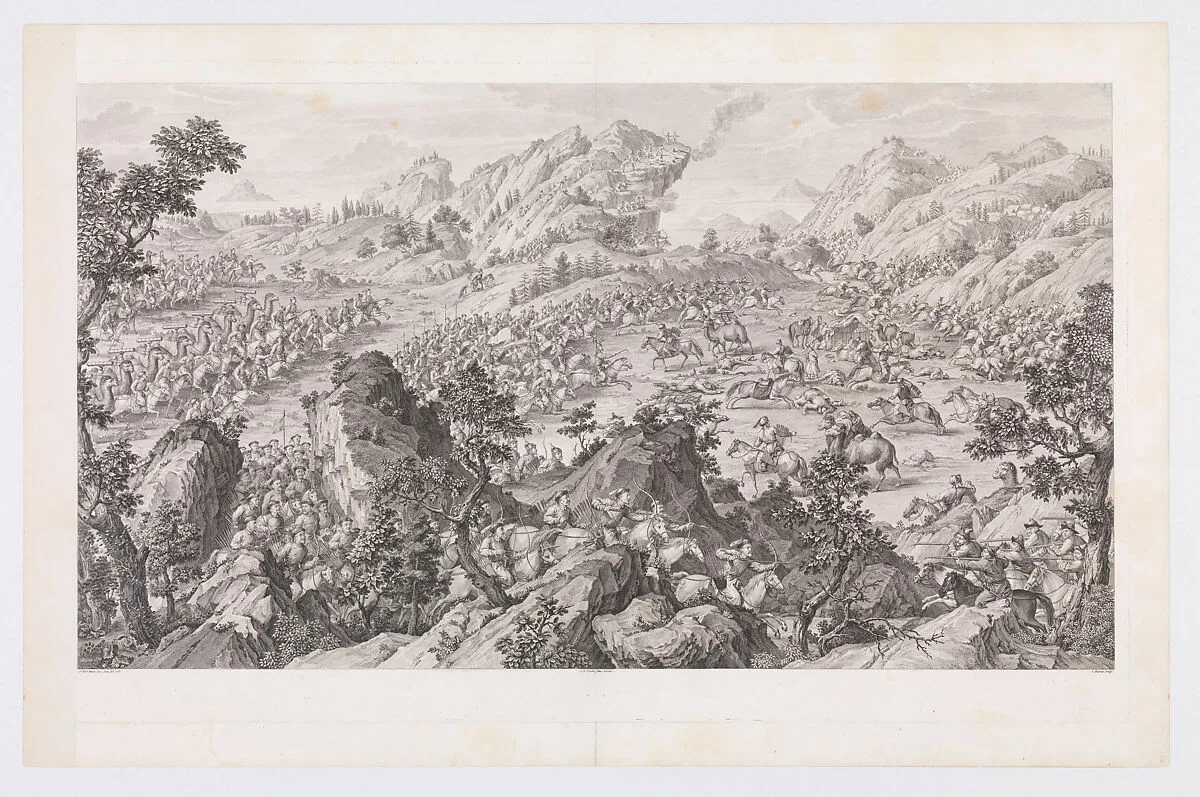
This print shows the Battle of Arcul. The Khoja, after having lost the battle of Qoš-qulaq, fled to Arcul and were once again defeated by Chinese troops, mostly cavalry, who are shown here routing the enemy. Part of a set of sixteen, "The Battle of Arcul" was commissioned by the Qianlong Emperor in 1765 to commemorate Manchu victories (1755-59) over the Eleuths, the Dzungars, and other Central Asian peoples in the present-day region of Xinjiang. Made under the direction of Charles-Nicolas Cochin (1715-1790), the prints, which follow reduced-scale copies of paintings by Jesuit artists working in Beijing, were etched and engraved in France from 1767 to 1774 by the finest printmakers at the court of Louis XV. The Chinese merchants of Canton (present-day Guangzhou) paid for the copper plates and two hundred sets of prints to be delivered to China, with only a few sets retained in Paris. The prints exemplify the fusion of Eastern and Western representational styles fostered within the Qing imperial painting academy. The European technique of chiaroscuro-the modeling of forms through the use of light and shading-has been visibly tempered, as has the use of one-point perspective. Instead, the scenes present panoramic views and strongly up-tilt ground planes. At the same time, howevery, they reflect European preferences for anatomical accuracy, a single light source, and the mathematically correct reduction of scale to create the illusion of recession.
- Artist
- Charles Nicolas Cochin II|Giuseppe Castiglione|Benoit Louis Prevost
- Date
- 1767–74
- Medium
- Etching and engraving
- Department
- Drawings and Prints
- Credit line
- Harris Brisbane Dick Fund, 1945