Costume Design for a Eunuch in Scheherazade
Léon Bakst
ca. 1910 · Gouache and graphite, heightened with gold paint · Drawings and Prints
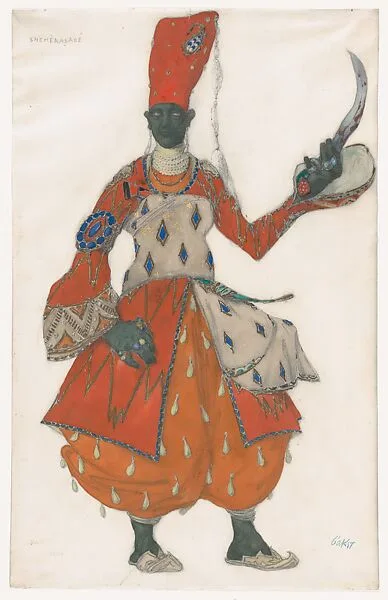
Drawing with a costume study for the first Eunuch in the ballet 'Schéhérazade,' by Léon Bakst. Schéhérazade, first performed in Paris in 1910, was the first real creation of the Ballets Russes, directed by Serge Diaghilev, totally original in concept and performance, and establishing the distinct visual style and form of entertainment that came to characterize the creations of the company. Schéhérazade was also the first of Bakst's international triumphs, showcasing the sensational style so singular of his designs for costumes and stage sets. His use of bold, excessive colors, the inspiration on orientalist styles, and the sensuality with which they highlighted the dancers' bodies became an essential part of the Ballet Russes and the modern ballet scene in Paris in the early teens. This drawing presents a dark-skinned male figure, dressed with an oriental costume with bell sleeves, a wide belt tied around the torso, and baggy 'harem' pants covered with square layers of fabric, executed with yellow, orange and red. The costume is decorated with zig-zagging lines, lozenge motifs, and hanging teardrops of yellow color that hang from the pants. The head is topped by a long, red hat with golden beads, decorated with a paisley-shaped brooch, and with a long, white strip with tassels and pearls hanging from one side. Matching long, pearl earrings frame his face, and a layered pearl choker is tied around his neck. He holds a curved knife, splattered with dark red blood, on one hand, his fingers adorned with rings of colorful stones. The feet are shod with golden, pointed, oriental slippers. The orientalist inspiration of Schéhérazade, with characters dressed in costumes of this style, played a unique role in changing the popular taste, popularizing oriental fashions and a new craze for bold colors, which were soon adopted, among others, by Paul Poiret and the house of Paquin.
- Artist
- Léon Bakst
- Date
- ca. 1910
- Medium
- Gouache and graphite, heightened with gold paint
- Department
- Drawings and Prints
- Credit line
- Bequest of Sallie Blumenthal, 2015