Prayer desk
Augustus Welby Northmore Pugin|George Myers
ca. 1844 · Oak · European Sculpture and Decorative Arts
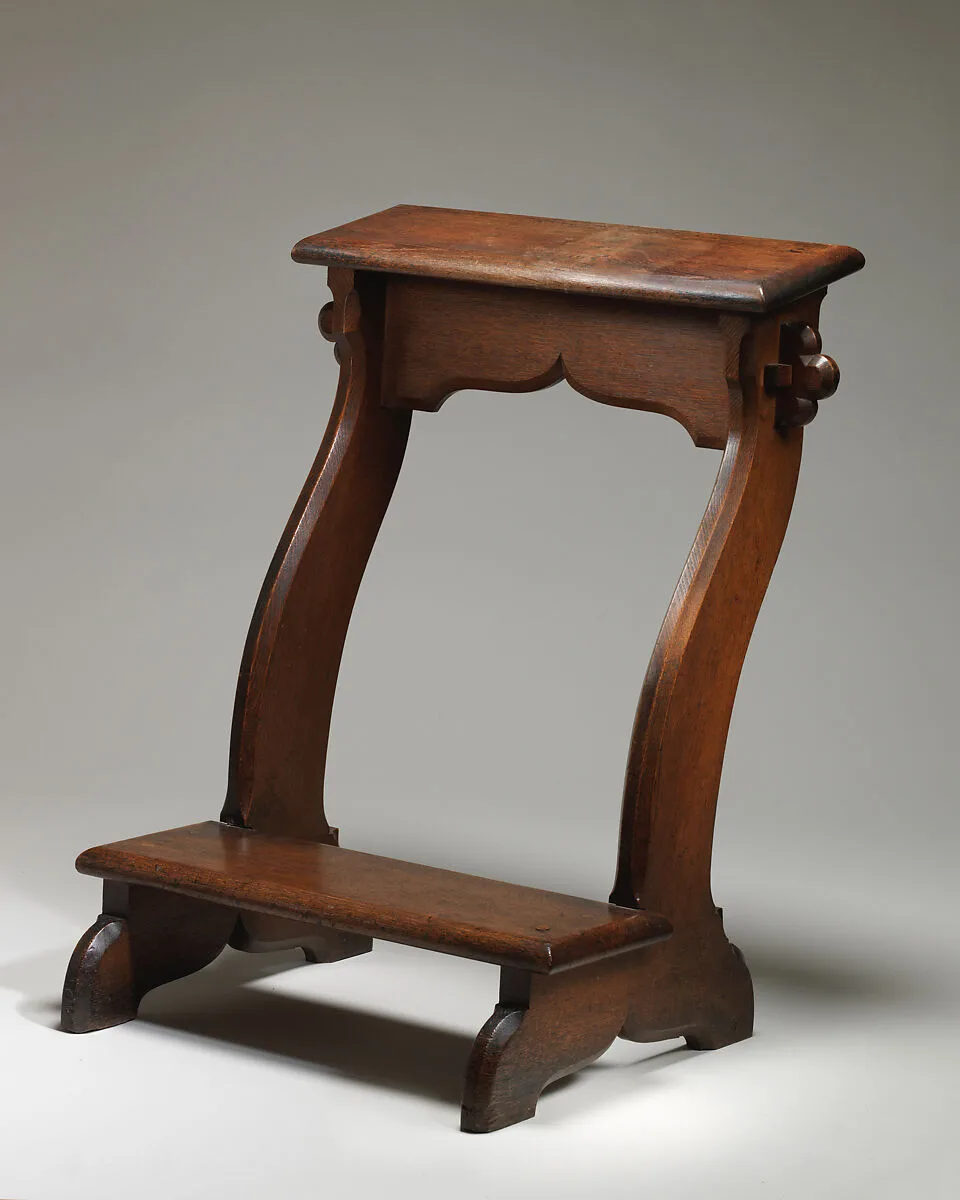
After the architect and designer A. W. N. Pugin converted to Catholicism in 1835, his work was strongly influenced by his ideas of life in pre-Reformation England. The Grange, the house Pugin built for himself in Ramsgate (1843–44), was a perfect example of this romantic medieval vision. This prie-dieu was designed for Pugin’s own use in the chapel at The Grange, which although small in size was completely outfitted for celebrating Mass with organ, sacristy, vestments, church plate etc.: a watercolor of the chapel from around 1844 shows the shadowy outline of a similar prayer bench in front of the altar. Pugin’s furniture, intended mostly for the houses he designed, is relatively simple, somewhat severe and ecclesiastical in nature of which this prie-dieu is an excellent example. Yet this rather plain prayer bench, which has a minimum of ornamental features and no upholstery or padding, has its own natural grace. This is expressed in the elegant curves of the two chamfered uprights, the ogival arch-shaped lower edge of the cross piece underneath the elbow rest and also under the trestle feet. Although the trefoil-shaped tusked tenons might look purely decorative they are part of the so-called "revealed construction" which was later widely used by Arts and Crafts designers.
- Artist
- Augustus Welby Northmore Pugin|George Myers
- Date
- ca. 1844
- Medium
- Oak
- Culture
- British
- Department
- European Sculpture and Decorative Arts
- Credit line
- Purchase, Gift of Irwin Untermyer, by exchange, 2015