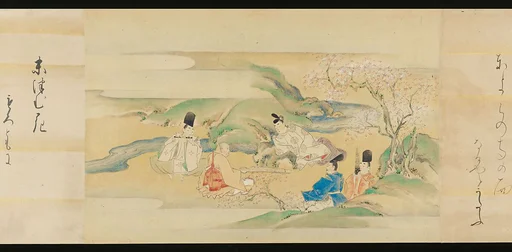
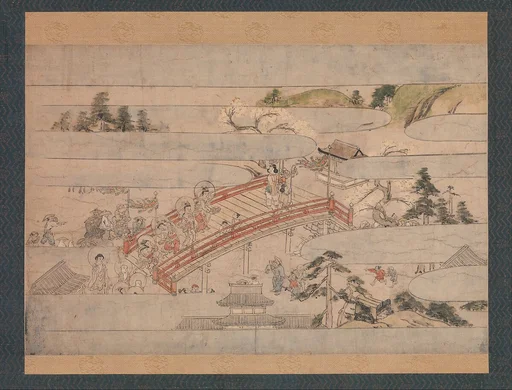
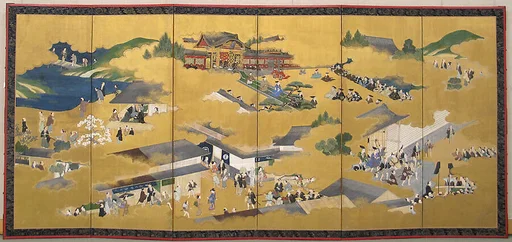
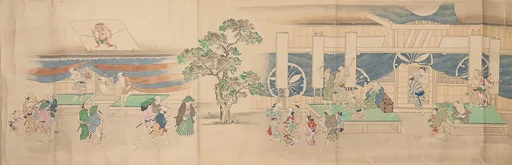
月波の遊び・「四月中の申の 日山王日吉祭」; 「八月朔日松尾に相撲あり」|Festivities of the Twelve Months: “Sannō Hiyoshi Festivals Held on the Day of the Monkey in the Mid-Fourth Month”; Festivities of the Twelve Months: “Sumō Wrestling at Matsuno’o Shrine during the Hassaku Festival on the First Day of the Eighth Month”
Unknown
early 18th century · Two handscrolls; ink, color and gold on paper · Asian Art
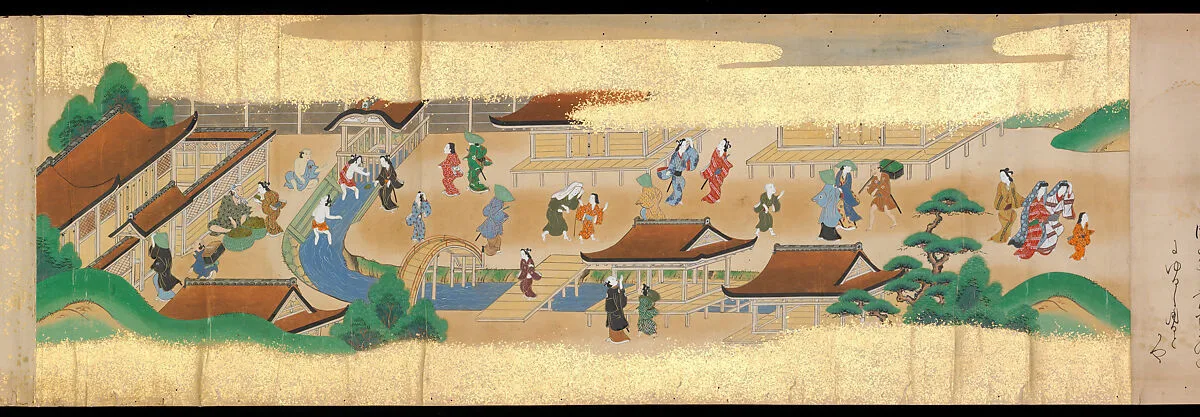
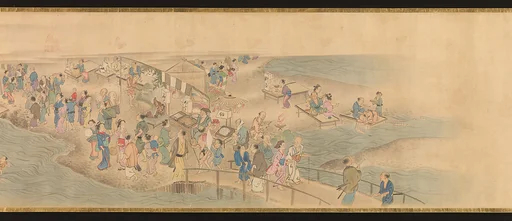
Hiyoshi (or Hie) Taisha is the head shrine of nearly forty thousand Sannō (“Mountain King”) branch shrines throughout Japan, which are associated with the great templeshrine complex of Enryakuji on Mount Hiei. The festival honoring the guardian, or tutelary, deity Sannō Gongen was held annually at the shrine on or around the day of the monkey (saru no hi) in the middle of the fourth month of the lunar calendar (the beginning of summer). The Hiyoshi (or Hie) Sannō Festival originated during the late eleventh century and is still celebrated today. This scene captures the climax of the festival, which consists of a race of boats carrying portable shrines (mikoshi) of the seven upper shrines across Lake Biwa to Karasaki. The Festival on the First Day of the Eighth Month (Hassakusai), now celebrated in September, has been held since ancient times at Matsuno’o Taisha, or Matsuno’o Shrine, in western Kyoto. Revellers pray for wind and rain in order to ensure a bountiful crop of the “five grains” (rice, wheat, beans, and two kinds of millet). The shrine is said to have been founded in 701 by the Hata clan to enshrine the local deity (kami) of the nearby mountain. Because the Hata family, originally from Korea, introduced a new sake-brewing technique to Japan, the local deity is also worshiped as the deity of brewing, and drinking sake is an essential component of the festivities. As seen in this section of the scroll, amateur sumō wrestling matches were also part of the day’s entertainments.
- Artist
- Unknown
- Date
- early 18th century
- Medium
- Two handscrolls; ink, color and gold on paper
- Culture
- Japan
- Department
- Asian Art
- Credit line
- Mary Griggs Burke Collection, Gift of the Mary and Jackson Burke Foundation, 2015