Tortilla Cover
Unknown
20th century · Cotton · Arts of Africa, Oceania, and the Americas
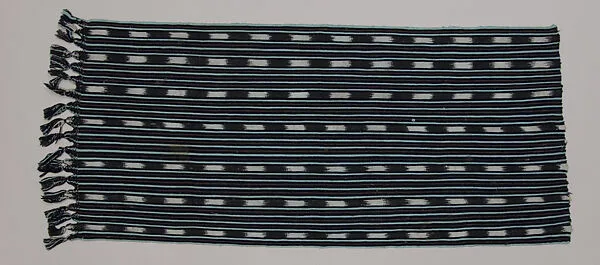
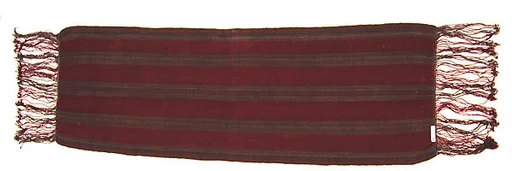
This tortilla cover is composed of tapestry woven cotton cloth of different colors of yarn, creating weft-direction stripes of browns, whites, and blues with a decorative fringe at one edge. It represents the importance of weaving in indigenous communities as social activities and as expressions of group identity. In the Guatemalan Highlands, the color patterns and designs woven into clothing signified a cultural and linguistic affiliation, in a mountainous landscape where over 15 different Mayan languages are still spoken today. In other words, one could recognize immediately where someone, either male or female, was from by the particular clothes they wore. As globalization and civil conflict has fractured communities around Santiago Atitlan, traditional textiles such as this are not being produced or worn at the same frequencies as before the 1950s. The type of yarn and intensity of dyes used are helpful in illustrating the pre-production of traditional Guatemalan cloth. The technique used to produce the cloth, the use of a backstrap loom, is an ancient tradition that is seen in the Classic Maya (ca. 250-900) artwork, and is increasingly falling out of use in lieu of industrial weaving techniques. The evidence of use underscores the social importance of cloth in everyday dining and special feasts. Tortilla coversare not the type of objects typically produced for tourist markets, thus representing the designs and expression of talented Highland Maya artists, who were most likely women.
- Artist
- Unknown
- Date
- 20th century
- Medium
- Cotton
- Culture
- Tzutihil Maya
- Department
- Arts of Africa, Oceania, and the Americas
- Credit line
- Gift of Alfred L. Bush, 2015
![Shoulder Cloth (Ulos Padang Rusak [?])](https://d2pvxr3eb77vb4.cloudfront.net/assets/v1/7e/7e9446427ed96ca9782bd209de2f3daa7ae92cceca8aff69fca9b5b61a40d64a/graph.webp)