The Destruction of the Royal Statue at New York on July 9, 1776
Basset|Franz Xavier Habermann
after July 1776 · Hand-colored etching and engraving · Drawings and Prints
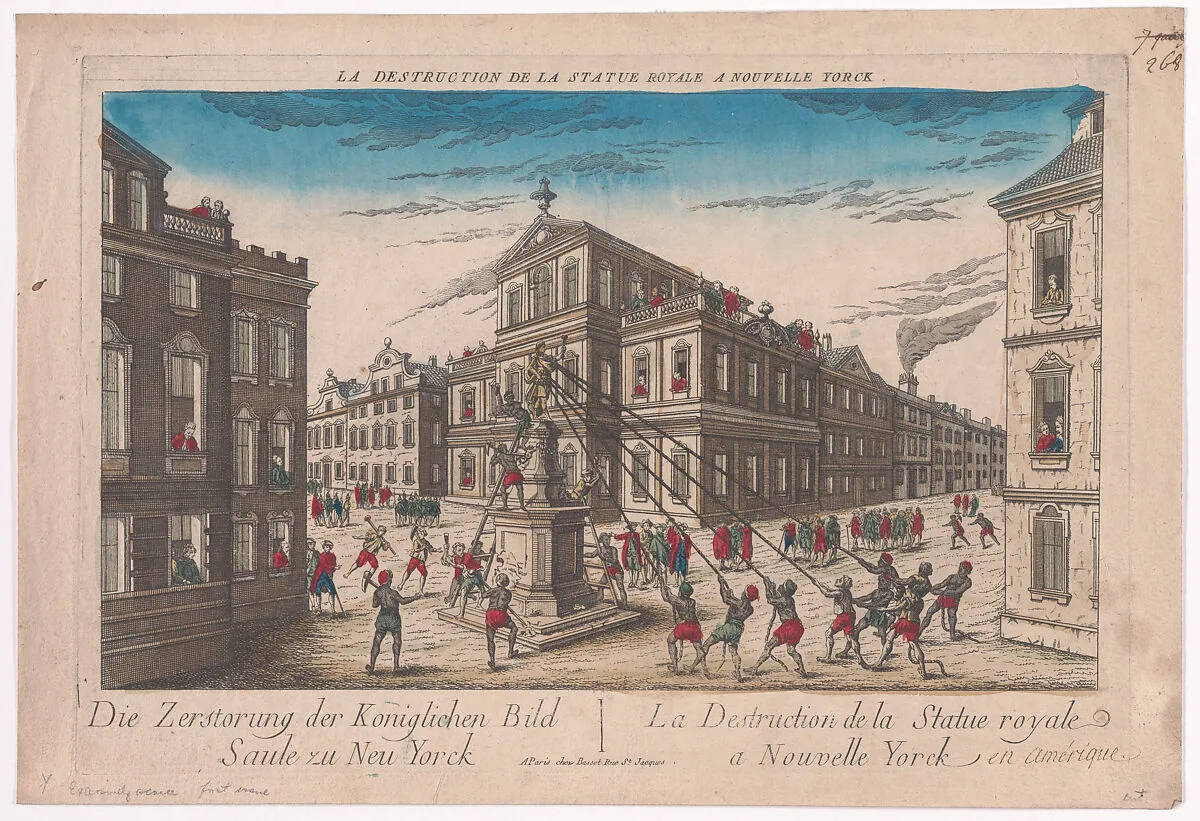
Five days after the Declaration of Independence was signed in Philadelphia, a pro-revolutionary group known as the New York Sons of Liberty tore down a statue of George III standing at Broadway and Bowling Green. This imaginative recreation of that event correctly shows enslaved and free Black men performing most of the labor, but dresses them in fanciful Turkish attire—a costume often worn by Black men in European art that refers to the legality of slavery in the Ottoman Empire. The Baroque architecture is more characteristic of a large European city from that era than Anglo-Dutch colonial New York, and the actual statue showed the king on horseback. Published in Paris, but based on a print issued slightly before in Augsburg and demonstrates broad European interest in the dramatic events taking place across the Atlantic. It was intended to be shown on a wall or screen using a "magic lantern", an optical device that projected the image by means of candles and mirrors, and often called a "Vue d'Optique.
- Artist
- Basset|Franz Xavier Habermann
- Date
- after July 1776
- Medium
- Hand-colored etching and engraving
- Department
- Drawings and Prints
- Credit line
- The Edward W. C. Arnold Collection of New York Prints, Maps and Pictures, Bequest of Edward W. C. Arnold, 1954