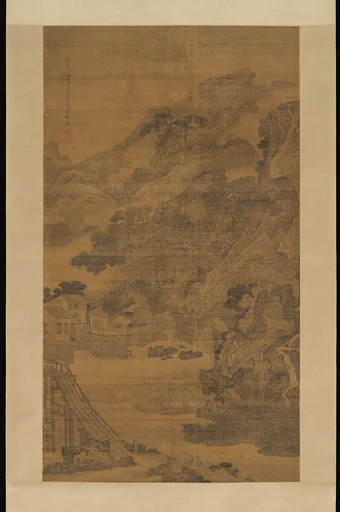
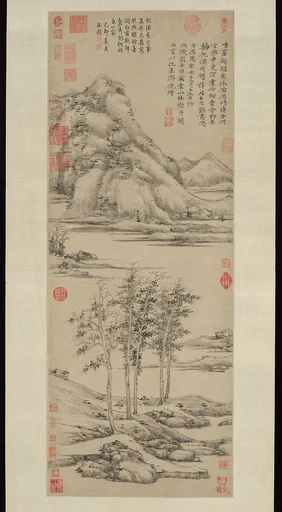
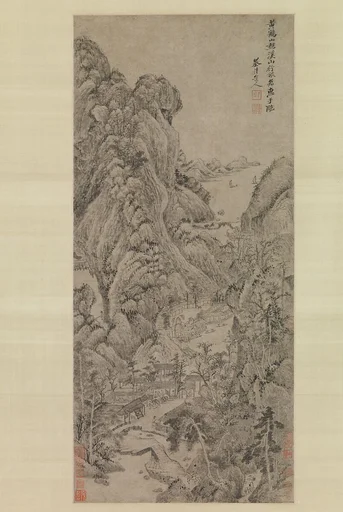
清 王鑑 倣巨然《溪山高士圖》 軸|Lofty Scholar among Streams and Mountains, in the manner of Juran
Wang Jian
late 17th century · Hanging scroll; ink on paper · Asian Art
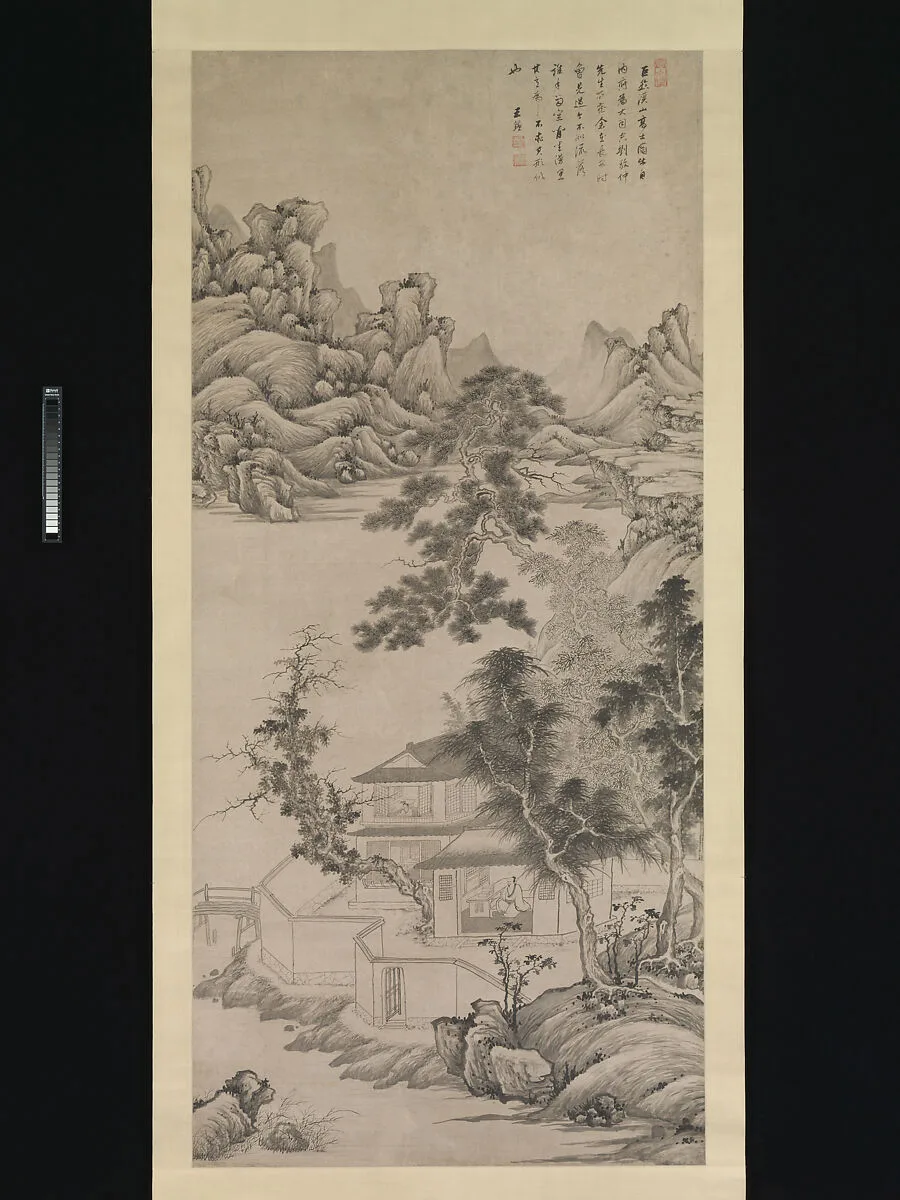
The Orthodox school master Wang Jian seldom painted figures or architecture. In this painting, however, Wang, who claims in his inscription to have been inspired by a work of the same title by Juran (act. ca. 960–95), has depicted a scholar seated in a handsome two-story studio overlooking an expanse of river. The idea of a mountain retreat also recalls Wang Wei's (699–759) Wangchuan Villa. The mountain forms, made with round "hemp-fiber" texture strokes and rich "alum-head" moss dots, are characteristic of the Juran brush idiom as interpreted by the Yuan master Wu Zhen (1280–1354). By executing the round arcs of these strokes in a rhythmical manner, Wang Jian invented the undulating compositional movements that his pupil Wang Hui (1632–1717) developed into the so-called dragon-vein principle.
- Artist
- Wang Jian
- Date
- late 17th century
- Medium
- Hanging scroll; ink on paper
- Culture
- China
- Department
- Asian Art
- Credit line
- Gift of Douglas Dillon, 1991