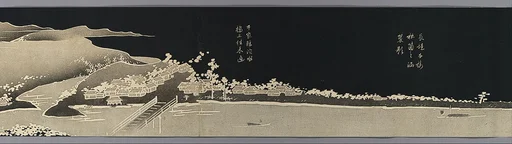
元/明 倣錢選 鮮于樞 歸去來辭 卷|Ode on Returning Home
Qian Xuan
14th–15th century · Handscroll; ink, color, and gold on paper · Asian Art
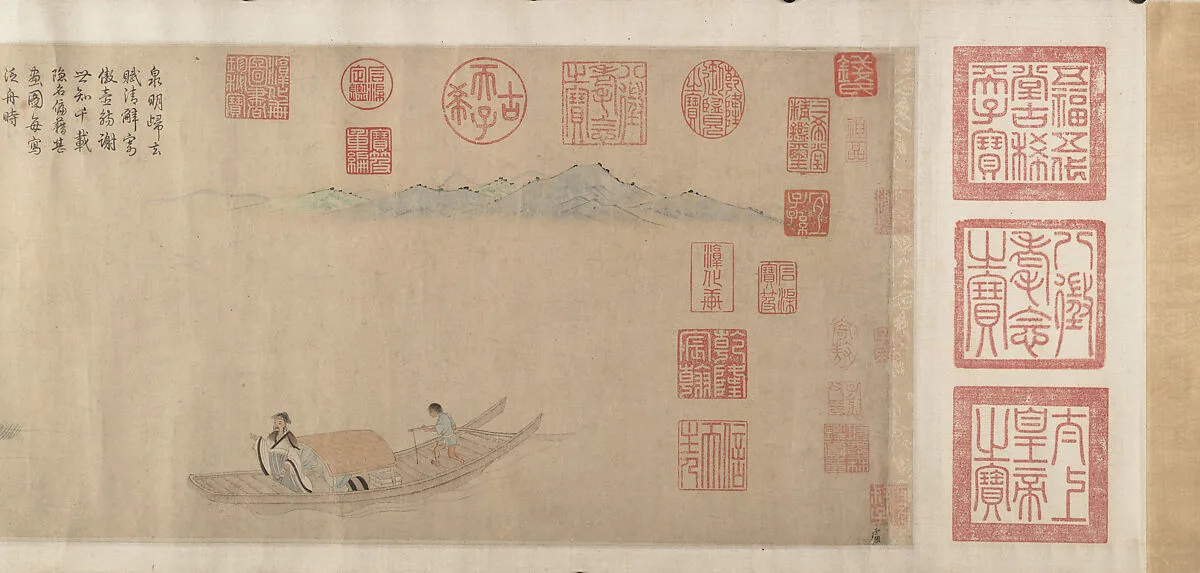
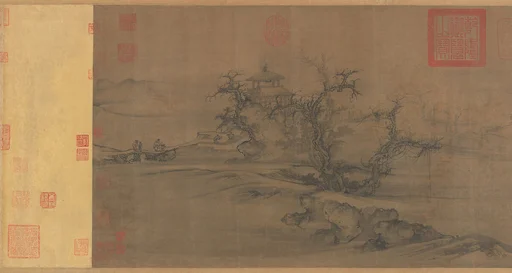
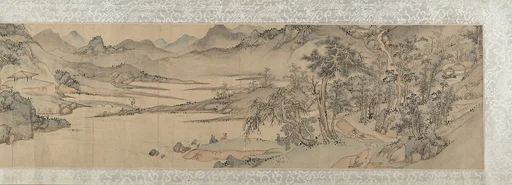
Qian Xuan was a celebrated Song loyalist who, following the Mongol conquest, supported himself through painting. Toward the end of his life, however, he complained that his works were being forged. Here, both the calligraphy and painting are modeled closely on Qian's style, suggesting that the work is a faithful copy. Qian's composition was inspired by Tao Qian's (365–427) poem "Returning Home," written in 405 after Tao resigned from public office. In it, Tao expresses his preference for poverty over the compromises and constraints of official life, establishing forever the ideal of the home and garden as a personal retreat. Clearly, Qian saw Tao's poem as a reflection of his own life in reclusion. Using the archaic "blue-and-green" style in a new, purposefully naive manner, he created a dreamlike environment that exists outside the realm of temporal troubles. His poem, written to the left of the picture, is both an appreciation of Tao and an expression of his state of mind: In front of his gate he plants five willows, By the eastern fence, he picked chrysanthemums. In his long chant is a lingering purity, There is never enough wine to sustain him. To live in this world it is necessary to become deeply drunk, To take office would only bring shame. In a moment of inspiration he composes "Returning Home" The poem of one thousand years.
- Artist
- Qian Xuan
- Date
- 14th–15th century
- Medium
- Handscroll; ink, color, and gold on paper
- Culture
- China
- Department
- Asian Art
- Credit line
- John Stewart Kennedy Fund, 1913