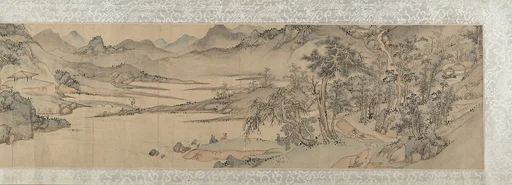
南宋 馬和之 詩經小雅鴻雁之什六篇圖 卷|Courtly Odes, Beginning with "Wild Geese"
Ma Hezhi
12th century · Handscroll in six sections; ink and color on silk · Asian Art
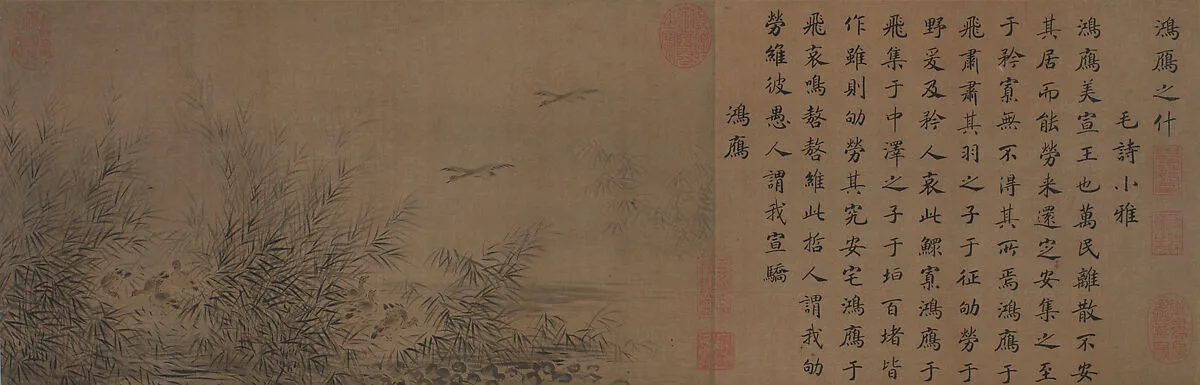
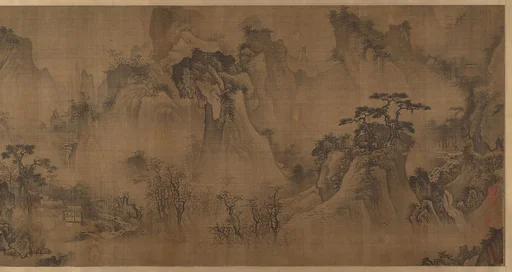
In 1127 the Song northern capital was sacked by the Jurchen Jin; Emperor Huizong and members of his family were carried off, only to die later in captivity. The emperor’s ninth son, who was proclaimed Emperor Gaozong (r. 1127–62), escaped and established the Southern Song court at Lin‘an (Hangzhou) in 1138. As emperor, Gaozong sponsored a number of painting and calligraphy projects that extolled the virtues and legitimacy of his “dynastic revival.” The largest of these undertakings was illustrating the more than three hundred poems of the Classic of Poetry, a work traditionally believed to have been compiled by Confucius (551–479 B.C.). Courtly Odes, Beginning with “Wild Geese,” from the Xiaoya section of the Classic, is part of this ambitious program. The text of each poem is written in Gaozong’s regular-script style, probably by a scribe or consort. The accompanying illustrations are the work of Ma Hezhi, a court artist known for his calligrphic “orchid-leaf” brush line, which clearly derived from the scholar-painting tradition of Li Gonglin (ca. 1049–1106). Ma’s deliberately archaistic and simplified drawing style is perfectly in keeping with the great antiquity of the Classic.
- Artist
- Ma Hezhi
- Date
- 12th century
- Medium
- Handscroll in six sections; ink and color on silk
- Culture
- China
- Department
- Asian Art
- Credit line
- Edward Elliott Family Collection, Gift of Douglas Dillon, 1984