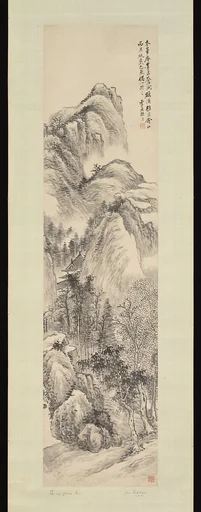
清 倣弘仁 幽谷泉聲圖 軸|The Sound of Spring in a Lonely Valley
Hongren
1661 · Hanging scroll; ink on paper · Asian Art
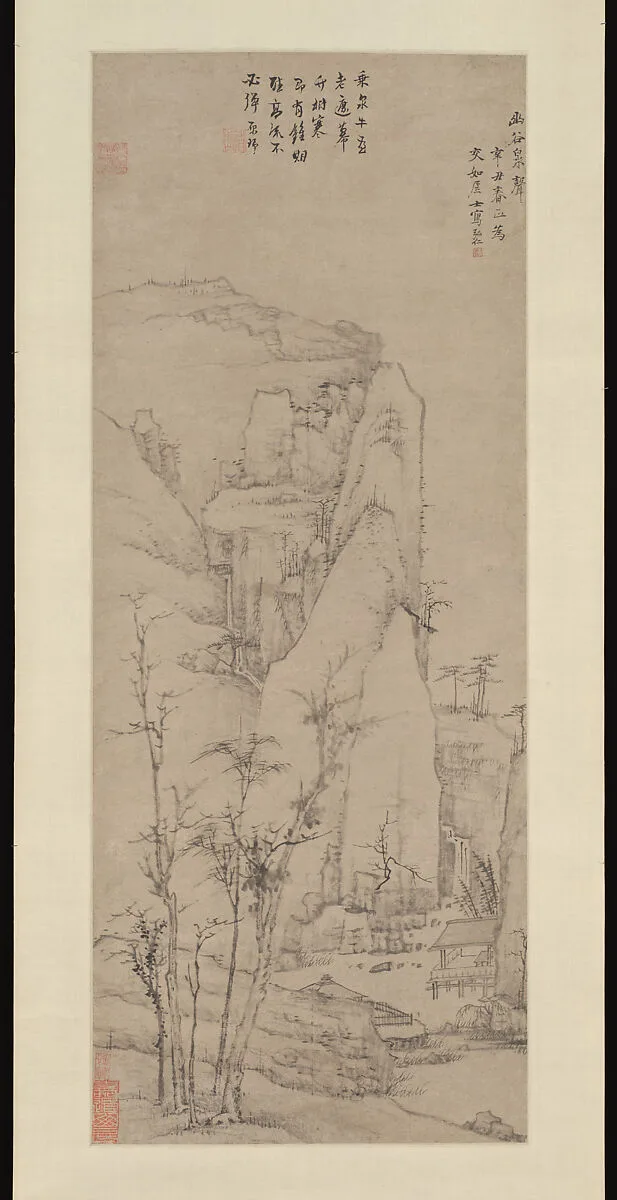
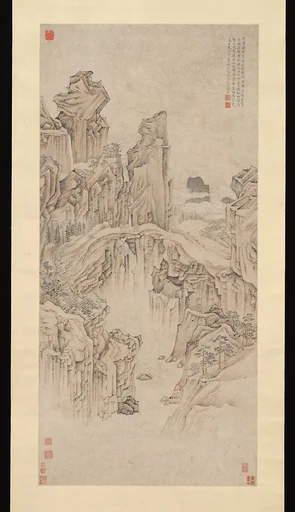
Inscriptions after the artist (right): "The Sound of Spring in a Lonely Valley, the first lunar month of spring in the xinchou year [January 30–February 28, 1661], painted for the gentleman Jiaoru, Hongren" and after Chen Shu [jinshi degree, 1649, left] Hongren, a filial son who helped support his mother after his father's premature death, passed the local civil-service examination during the late Ming period but ended his pursuit of an official career after the fall of the dynasty in 1644. Becoming a Buddhist monk as a way of avoiding service under the Manchus, Hongren spent the rest of his life in his native Anhui Province, where he became the central figure in the so-called Anhui School of painters, whose common bond was their fascination with the rugged scenery of Yellow Mountain (Mount Huang). Hongren favored a dry linear technique that echoes the style of the Yuan dynasty recluse-painter Ni Zan (1306–1374). In this scroll Ni's influence is apparent in the spindly foreground trees and angular rock formations. The diminishing scale of the trees helps define recession and emphasizes the overwhelming size of the towering cliff at center, which dominates the composition and imparts a monumentality similar to that of the grandly scaled peaks of Northern Song (960–1127) works. While the painting has long been admired as an original Hongren, weaknesses in the brushwork of the calligraphy and landscape forms suggest that it is actually a close copy.
- Artist
- Hongren
- Date
- 1661
- Medium
- Hanging scroll; ink on paper
- Culture
- China
- Department
- Asian Art
- Credit line
- Bequest of John M. Crawford Jr., 1988