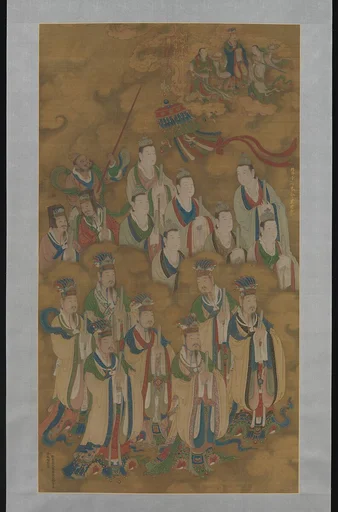
작자미상 범천왕을 중심으로 한 신중도 조선|作者未詳 神衆圖 朝鮮|Brahma with Attendants and Musicians
Unidentified artist
late 16th century · Hanging scroll; ink and color on hemp · Asian Art
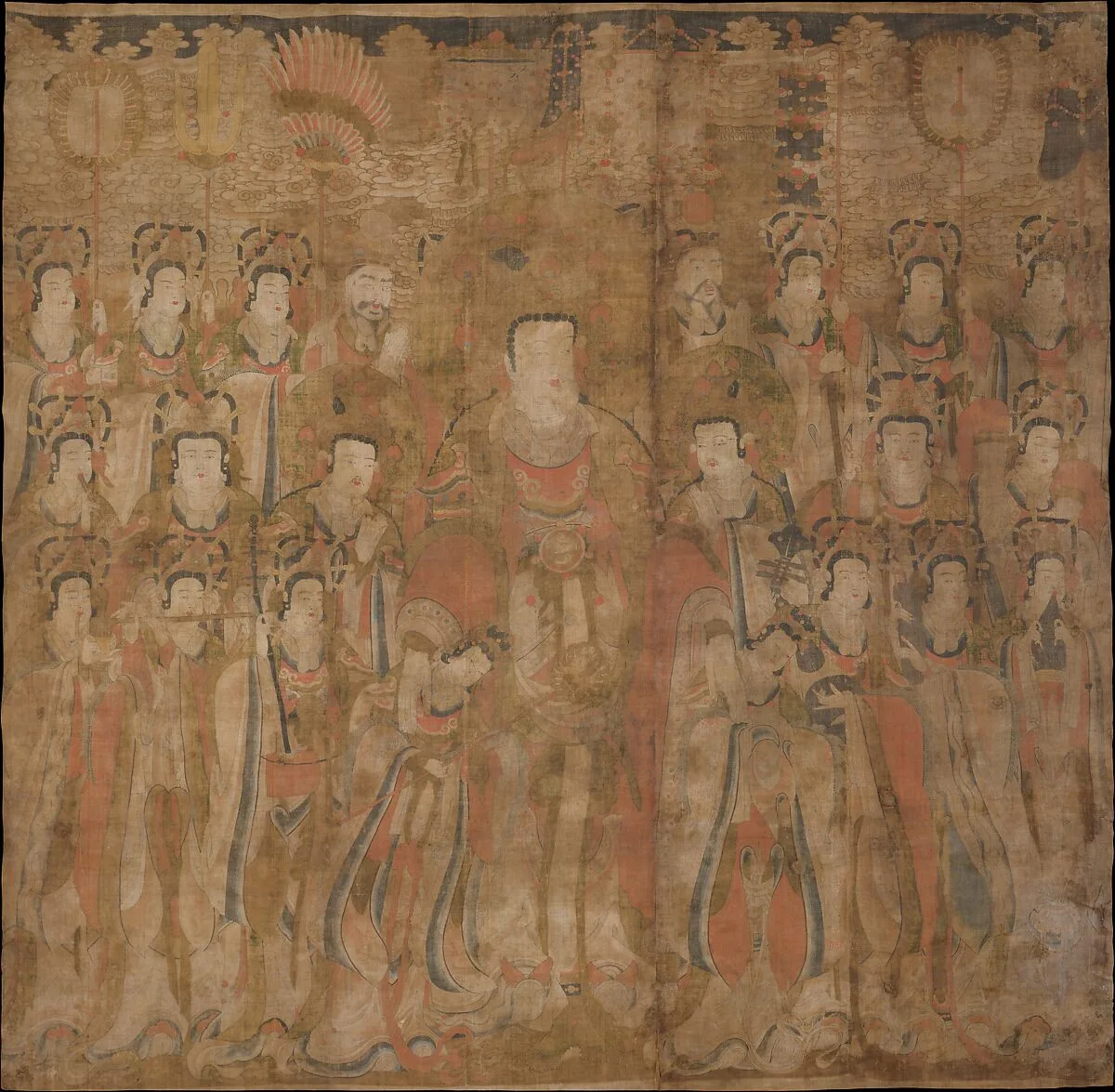
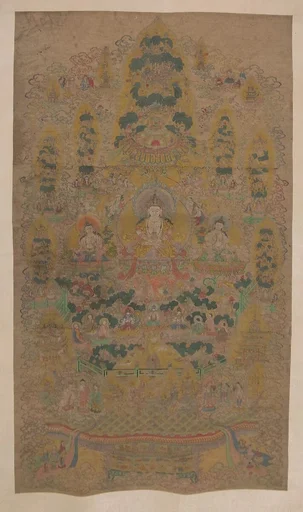
Originally a Hindu deity, Brahma (Korean: Beomcheon) was incorporated into the Buddhist pantheon and, along with the Hindu god Indra (Korean: Jeseok), became the protector of Buddhist teachings. The Brahma heaven was interpreted as a place of pleasure filled with entertainers and musicians. In this work, lithe figures playing instruments, such as a mouth organ, a long transverse flute, a two-stringed violin, a four-stringed lute with a crooked neck, wood clappers, and a triangular wind instrument made of clay, surround the towering Brahma at center. Ceremonial fans and bejeweled canopies held by assistants in the top row float above the festive scene. Buddhist paintings on hemp were commissioned by non-royals, while members of the elite favored silk. Regardless of material, Buddhist paintings from the early Joseon period are rare because of the official suppression of Buddhism and promotion of neo-Confucian ideology. When Mrs. Harkness gave this work to the Met in 1921, it was thought to be either Chinese or Korean. Mr. and Mrs. Edward S. Harkness also collected and donated European decorative art and Egyptian art.
- Artist
- Unidentified artist
- Date
- late 16th century
- Medium
- Hanging scroll; ink and color on hemp
- Culture
- Korea
- Department
- Asian Art
- Credit line
- Gift of Mrs. Edward S. Harkness, 1921