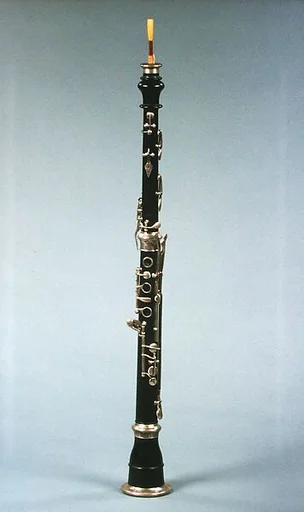
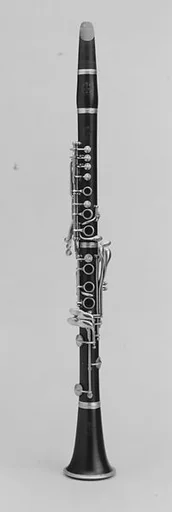
Clarinet in A
Charles Bertin
second half of 19th Century · Cocus, nickel-silver · Musical Instruments
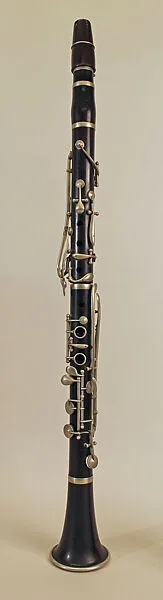
This clarinet is clearly made for the British market. ‘Charles Bertin’ is probably a trade name. Overall size: 688 Bore: c-hole 14.8; f-hole 14.8 Conical part: 170 Technical description: Cocus wood with German silver ferrules and keywork. Five pieces: mouthpiece, barrel, upper section, lower section, bell. Cocus wood mouthpiece to be used with a ligature. Long barrel. Speaker liner does not project into the bore, but has a chimney on the front of the instrument. Curved speaker. Long tailed A*b key indicates that the instrument was made for the British market. C sharp mechanism. Shaped thumb rest. 13 keys plus spectacle key. L0: T; speaker. L1: T; throat A♮. L2: T; throat A♭. L3: T; cross E♭4/B♭5. L4: C♯4/G♯5; E3/B♮4; F♯3/C♯5. R1: T; side F4/ C6; side E♭4/B♭5; side trill key for throat A-B♮ and B♭-C. R2: T + spectacle. R3: T + spectacle (forked B♭3/F♮5); cross B♭3/F♮5. R4: G♯3/E♭5; F3/C5. Keyhead type: modern. Keymount type: between pillars. Inscribed on upper and lower section: "CHARLES BERTIN / PARIS"; on mouthpiece "JTL" [Jérôme Thibouville-Lamy]. Playing accessories: one reed, ligature, and reed-cap. (Heike Fricke, 2014)
- Artist
- Charles Bertin
- Date
- second half of 19th Century
- Medium
- Cocus, nickel-silver
- Culture
- French
- Department
- Musical Instruments
- Credit line
- The Crosby Brown Collection of Musical Instruments, 1889