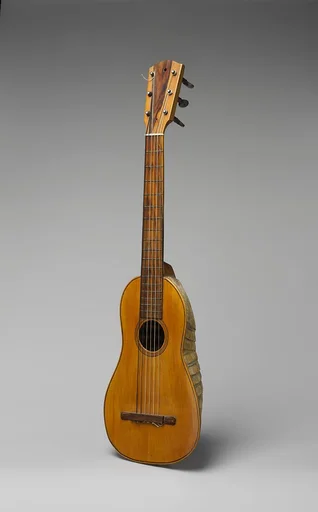
Guitar
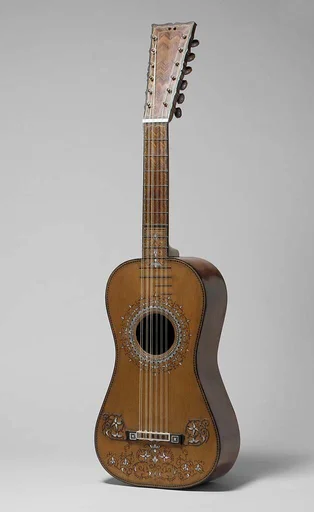
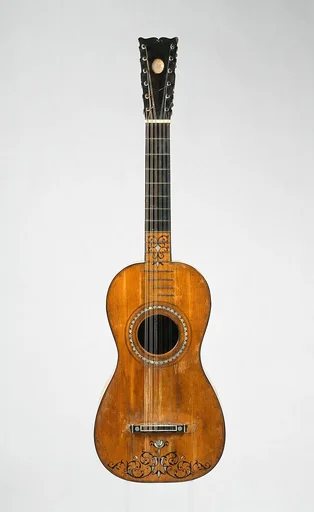
Benito Sanchez de Aguilera
1797 · Spruce or fir top, cypress back and ribs, mahogany neck, rosewood fingerboard and frets, ebony nut, gut strings · Musical Instruments
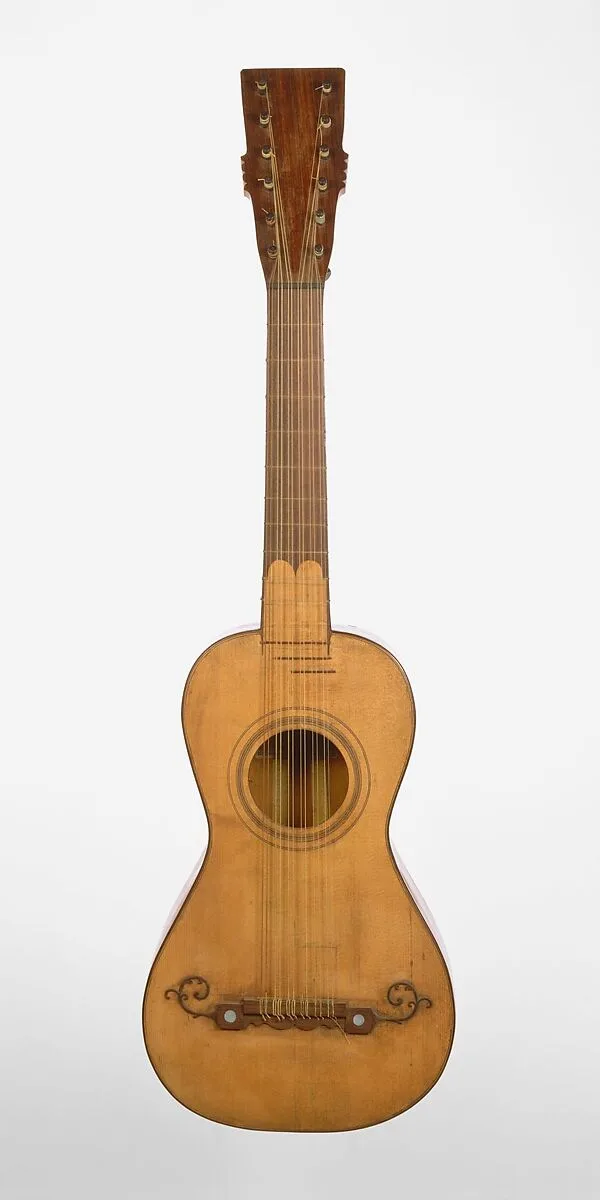
This instrument was made by Benito Sanchez in Madrid in 1797. Towards the end of the 18th century most Spanish guitars had longer necks relative to the scale-length, in this case the guitar has a shorter body, accentuating the curves of the sides as a consequence. These accentuated curves would become an increasingly popular feature in early 19th-century guitar making in Madrid. Although the head and bridge are replacements, there is no reason to suppose that this was ever anything other than a six-course guitar. (Daniel Wheeldon, 2016) Technical description: Twelve string (six double course) guitar; two-piece pine top with rosewood binding and purfling of pine/rosewood/p/r, sound hole diameter of 83.55 mm with a binding of rosewood/pine/r/p/R/p/R/p/r/p/r r/p/r, rosewood mustachio tie bridge (probably not original); three-piece cypress back with rosewood spacers and binding; two-piece cypress ribs with rosewood spacer; mahogany (Spanish cedar) neck (likely not original); rosewood fingerboard, fourteen frets including ten gut frets tied to the neck and four inlaid rosewood frets (one missing); two-piece headstock (not original), twelve friction pegs. (Daniel Wheeldon, 2016)
- Artist
- Benito Sanchez de Aguilera
- Date
- 1797
- Medium
- Spruce or fir top, cypress back and ribs, mahogany neck, rosewood fingerboard and frets, ebony nut, gut strings
- Culture
- Spanish
- Department
- Musical Instruments
- Credit line
- Purchase, Clara Mertens Bequest, in memory of André Mertens, 1990