Book Harmonium
Unknown
19th century · Wood, various materials · Musical Instruments
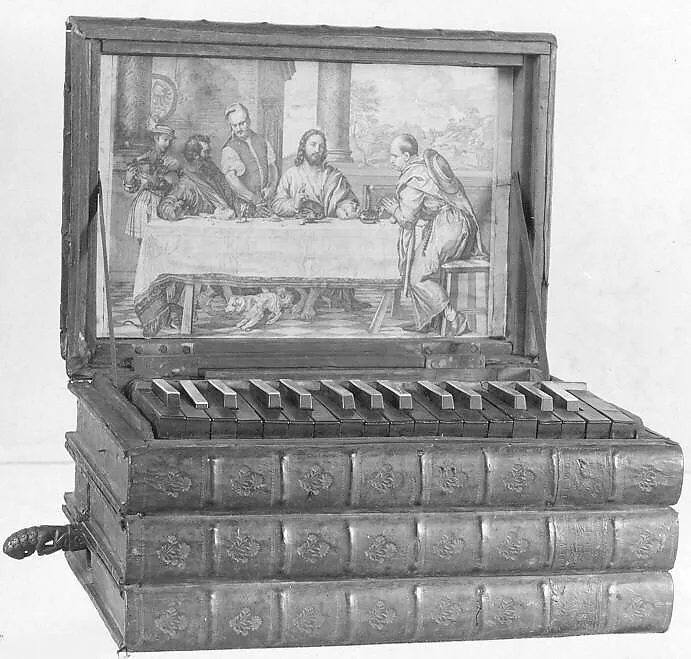
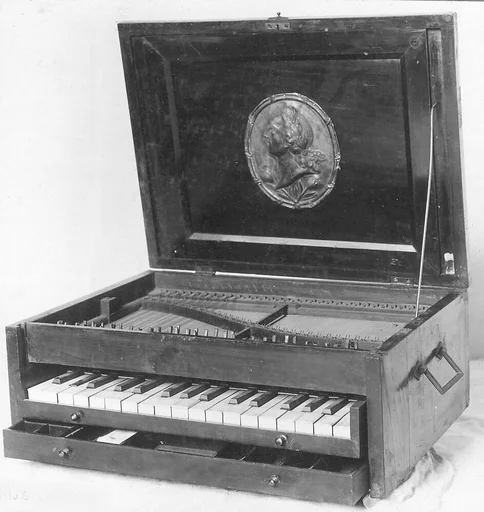
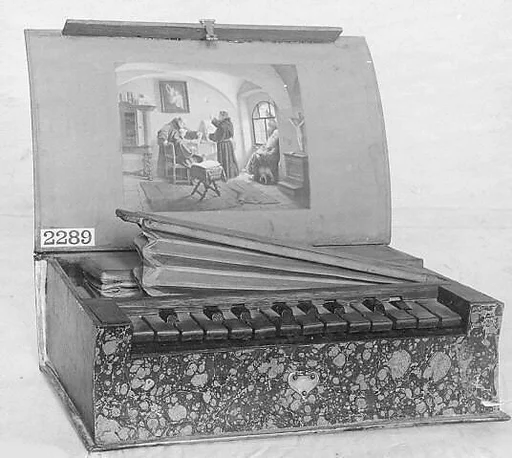
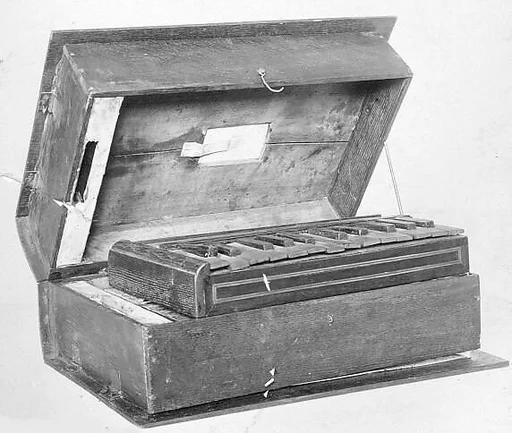
A book organ (or bible regal) was a popular type of small pipe organ that when folded up took the shape of a large book. This instrument takes that much older idea and updates it with a free reed harmonium in the 19th century. Technical description: Softwood case in form of four leather-bound folio size books, the cover and spines stamped with gold floral designs, and labeled on the spines: Traite des Pais Bas Tom I (II, III, IV); volume one hinges upward, revealing an engraving of the Supper at Emmaus glued beneath the lid; inside, a keyboard (oak levers, ebony naturals, ivory accidentals; compass F-c2) is at the front of the compartment, separated by a partition from a leather-covered (painted pink) reservoir behind, the reservoir (compressed by two springs and bearing a safety valve on top) mounted above a single fold feeder operated by a handle extending through the lower left rear side of the case; the boxwood handle terminates in the form of a seated lion holding a shield on which is carved an adz; a wind chest at the case bottom below the keyboard bears 32 flat-sided oak "bottles," the necks pointing down and serving as windways; on the left side of each "bottle" a single free reed riveted to a metal frame glued over an opening on the side, the bottles numbered consecutively in ink, no. 20 also stamped IX; wire stickers below the keys pierce a rack and enter the windchest to depress valves; the key dip is limited by a green fabric padded batten below the key fronts, but the keys also have leather bushed front pin holes, indicating that the cutdown keys originated in another instrument; the truncated key tails are individually parchment hinged to a back rail, and are numbered consecutively on the tail ends, and many bear non-consecutive Roman numerals stamped on the sides; the entire mechanism may be lifted out of the case, which may be older.
- Artist
- Unknown
- Date
- 19th century
- Medium
- Wood, various materials
- Culture
- French or German
- Department
- Musical Instruments
- Credit line
- The Crosby Brown Collection of Musical Instruments, 1889