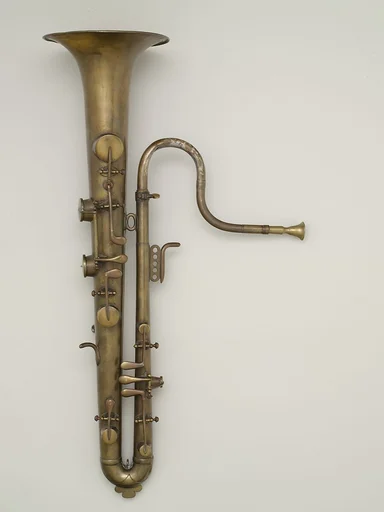
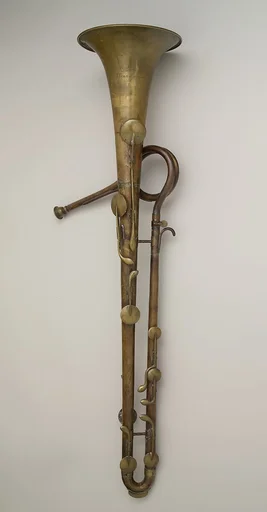
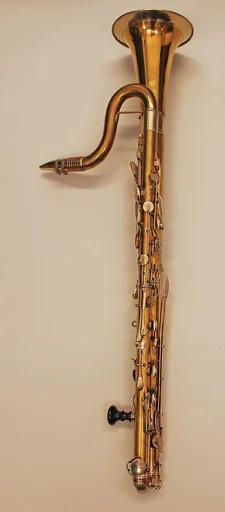
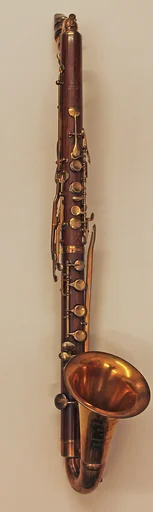
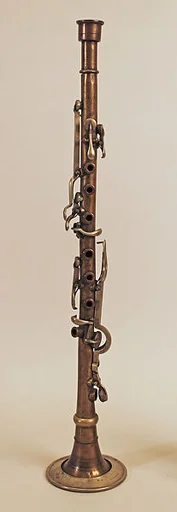
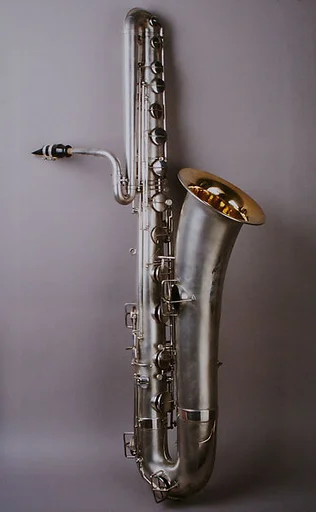
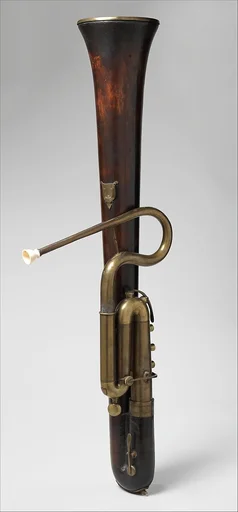
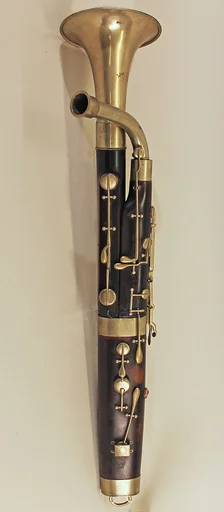
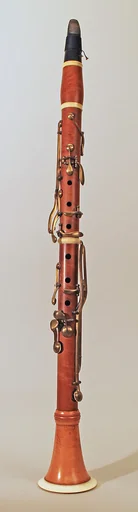
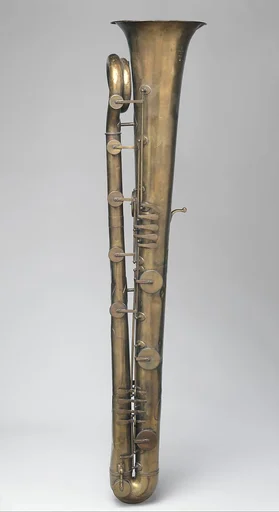
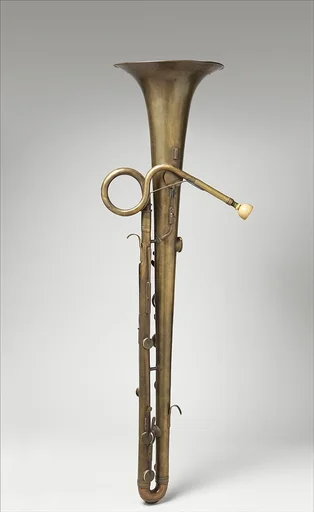
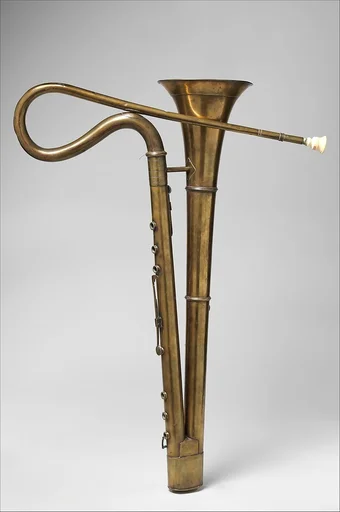
Bass Clarinet in C?
Unknown
second half of the 19th century · Wood, brass, nickel-silver · Musical Instruments
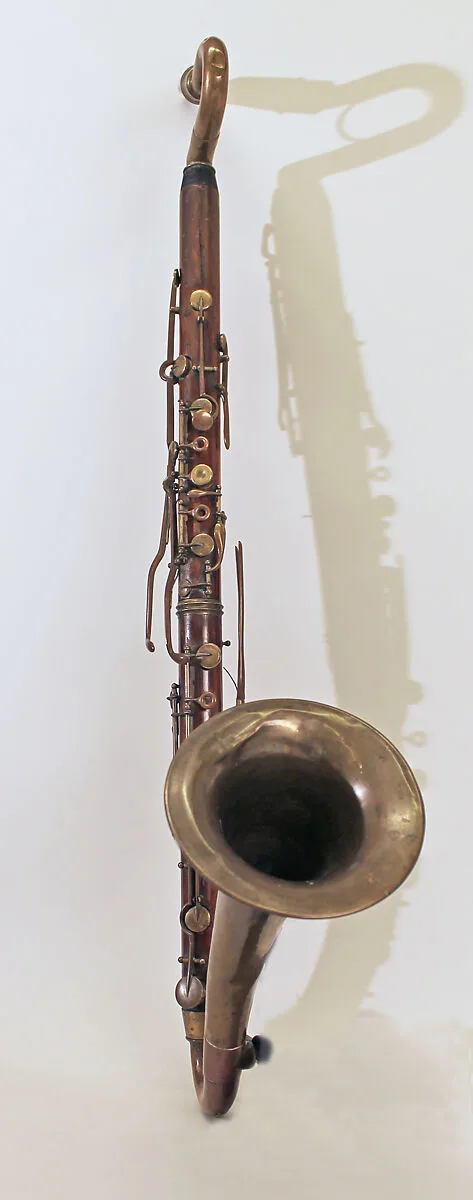
Overall size: ca. 870 Sounding length: 1457 Bore: c-hole 18.9 Technical description: Rosewood with brass keywork, ferrules and bell. Five pieces: mouthpiece, crook, upper section, lower section, and bell. Rosewood mouthpiece not grooved for cord. German silver tenon soldered to brass crook. Brass ferrule between crook and upper section, visible on photos from the archive (Mus.1296), seems to have been removed in order to repair the upper section. Two speaker keys: One used to overblow, one used for a proper throat b♭. Thumb hole on front of the instrument, ring key for L0 to operate this key. Shaped brass thumb rest with sling-ring. No tone holes, but rings instead to operate the keys. L4 levers mounted on a plate. F♯3/C♯5 guided on a rod and in a saddle. Tone holes for L4 levers on brass bell. L0: Ring; speaker 1; speaker 2. L1: Ring; throat A♮; throat A♭. L2: Plate. L3: Ring; E♭4/B♭5. L4: C♯4/G♯5; E3/B♮4; F♯3/C♯5. R1: Ring; side F4/ C6; side trill key for throat A-B♮ and B♭-C. R2: Plate. R3: Ring; B♭3/F♮5. R4: F3/C5; G♯3/E♭5. Keyhead type: modern. Keymount type: screwed in pillars with pins. No inscriptions. Playing accessories: a cord and a reed-cap. (Heike Fricke, 2014)
- Artist
- Unknown
- Date
- second half of the 19th century
- Medium
- Wood, brass, nickel-silver
- Culture
- Italian
- Department
- Musical Instruments
- Credit line
- The Crosby Brown Collection of Musical Instruments, 1889