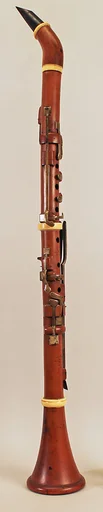
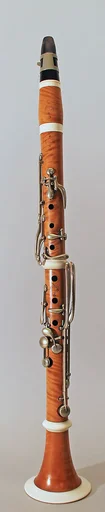
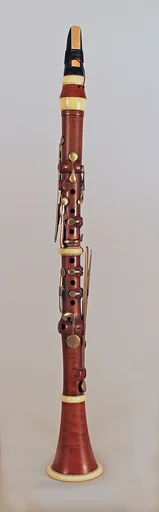
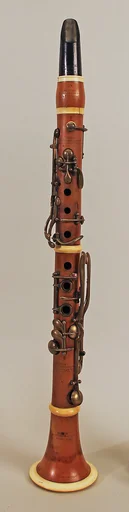
Clarinet in E-flat
C. H. Sulz
ca. 1855 · Brass, nickel-silver · Musical Instruments
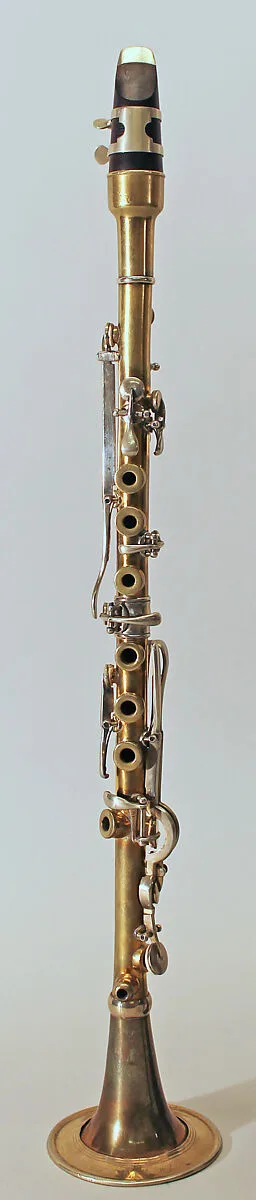
Clarinets of brass were first put to use in Austrian military bands about 1850. Overall size: 476 Bore: c-hole 11.4; f-hole 11.4. Technical description: Brass 'skeleton' body with German silver keywork. Four pieces: mouthpiece, barrel, one-piece-body, bell. Rosewood mouthpiece with a metal tip and facing grooved for cord. Funnel shaped barrel. Straight short speaker on the back of the instrument. Speaker liner projects almost to the centre of the bore. German silver ferrule in the middle of the section carries the key for C♯4/G♯5. Shaped German silver thumb rest soldered to the back of the instrument. Integral music card holder indicates that this instrument is used in marching or military band. Bell fixed to body with thread of screw. No key for F4/ C6. L0: T; speaker. L1: T; throat A♮; throat A♭. L2: T. L3: T; E♭4/B♭5. L4: C♯4/G♯5; E3/B♮4; F♯3/C♯5. R1: T; side trill key for throat A-B♮ and B♭-C. R2: T. R3: T; side B♮3/F♯5. R4: T; G♯3/E♭5. Keyhead type: shallow cups. Keymount type: between pillars on plates. Inscribed on bell garland "Sulz E S Wien" Playing accessories: one reed and a ligature. (Heike Fricke, 2014)
- Artist
- C. H. Sulz
- Date
- ca. 1855
- Medium
- Brass, nickel-silver
- Culture
- Austrian
- Department
- Musical Instruments
- Credit line
- The Crosby Brown Collection of Musical Instruments, 1889