Nail Violin
Unknown
early 19th century · Wood, metal · Musical Instruments
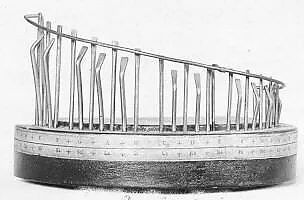
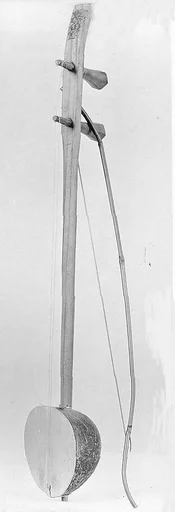
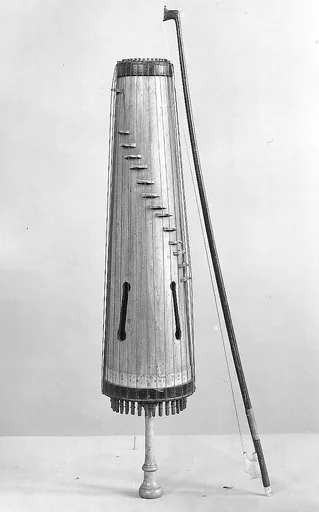
The German violinist Johann Wilde invented the nail violin around 1740. The instrument consists of a wooden soundbox (circular or semicircular) and metal nails. Sound is produced by drawing a violin bow across the nails, creating bell-like tones. While it has limited capabilities, the instrument was popular in the eighteenth century and other makers built similar instruments in various forms. The body of this example is a half circle, with a blackened wooden frame and a varnished wooden soundboard. Technical description: A C-shaped open arc of blackened, varnished wood with a varnished spruce "soundboard" attached over one side with 14 brass nails; between the edge of the soundboard and the outer circumference of the arc, 30 pins are driven to graduated heights, their flattened tops protected by a semicircular brass wire; a printed paper label glued around the side of the arc identifies each pin with a pitch letter and solfège syllable; natural pitches have straight vertical steel pins, accidental pins are brass, driven at a slight outward angle and bent inward just below the flattened tops. Played with a bow (missing). Range (not confirmed) C-F. (Linda Moot, 1978)
- Artist
- Unknown
- Date
- early 19th century
- Medium
- Wood, metal
- Culture
- German
- Department
- Musical Instruments
- Credit line
- The Crosby Brown Collection of Musical Instruments, 1889