Nail Violin
Unknown
after ca. 1780 · Wood, metal · Musical Instruments
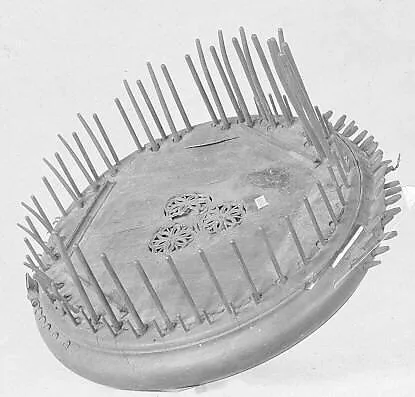
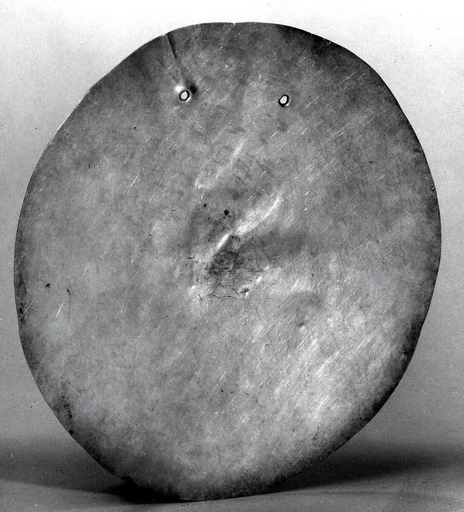
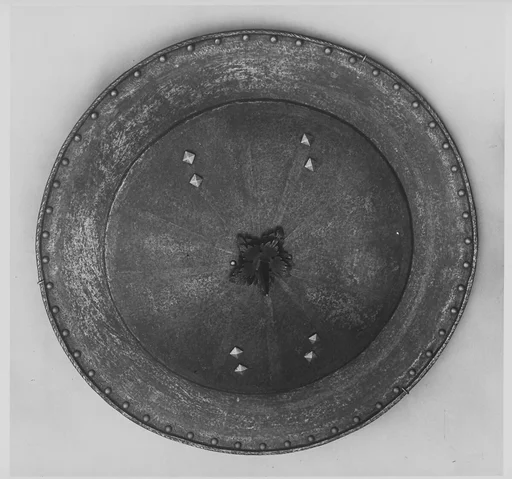
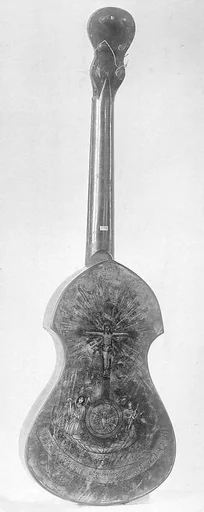
The German violinist Johann Wilde invented the nail violin around 1740. The instrument consists of a wooden soundbox (circular or semicircular) and metal nails. Sound is produced by drawing a violin bow across the nails, creating bell-like tones. While it has limited capabilities, the instrument was popular in the eighteenth century and other makers built similar instruments in various forms. Technical description: Flat circular wooden soundbox, the top surface of which is a thin spruce soundboard pierced by three carved rosettes; around the edge of the soundboard are driven two overlapping rows of steel pins, one row of 44 pins (the larger ones staggered chromatically) giving a chromatic compass of three octaves starting on a C, and a 4th diatonic octave above, the other row of 23 pins make a diatonic scale starting on an F; accidental pins are bent slightly outward near their tops, naturals are straight; four short wire-topped bridges on the soundboard form two opposing Vs, with two smaller bridges off the soundboard below the open point of the Vs; pairs of sympathetic wire strings crossed these bridges from a double row of 32 tuning pins on one side of the circle to 13 hooked hitchpins on the opposite side, the strings passing between the vertical pins; in the solid bottom of the circle, a central hole extending into a knob-like protrusion within the soundbox. Played with a bow (missing). (Linda Moot, 1978)
- Artist
- Unknown
- Date
- after ca. 1780
- Medium
- Wood, metal
- Culture
- European
- Department
- Musical Instruments
- Credit line
- The Crosby Brown Collection of Musical Instruments, 1889