Volynka
Unknown
19th century · Wood, brass, horn, sheepskin, glass · Musical Instruments
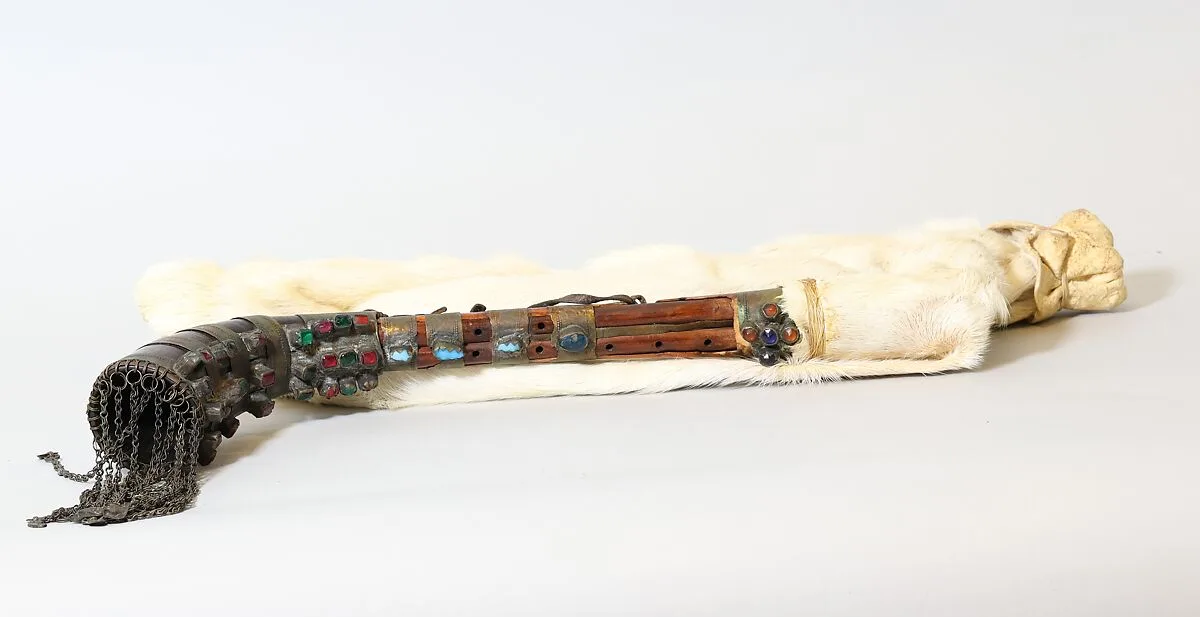
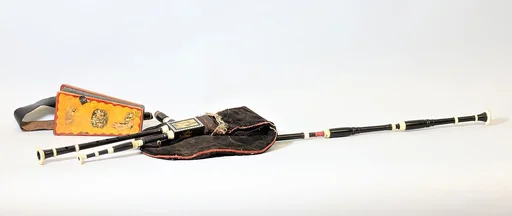
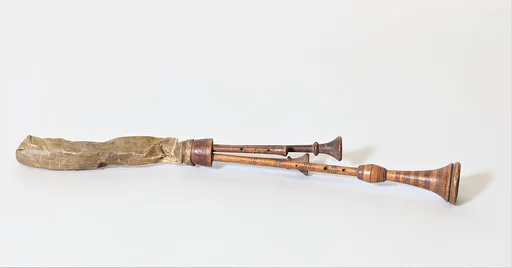
The gudastviri is a bagpipe found in Western Georgia. It is a mouthblown instrument with two parallel pipes, one melodic, and one semi-melodic. The instrument is richly decorated according to the desires of the musician, and is often covered with a velvet bag, traditionally red. The gudastviri was traditionally played by itinerant musicians who used the bagpipe to accompany their solo-recitative singing (Gabisonia 2009:420). This gudastviri has two cylindrical wooden pipes encased in a wooden yoke. The parallel pipes have five and two holes (traditionally, these have 6+3 holes, but the lower holes are not visible on this instrument). The double chanter is fitted into a horn, which is attached to the yoke with a thin strip of leather. The chanter and horn are encircled with metal braces, which are decorated with glass jewels. The top of the chanter features jewels organized in a cross-like shape. The end of the horn is decorated with nineteen small chains, at the end of which are small metal amulets, with two different designs: a bird and a paisley-like pattern. The insufflation pipe is bound with metal wire. The bag is made from goatskin and has the hair on the exterior. The original bag (also with hair on the exterior) was replaced with a new bag in the twentieth century. This instrument was part of the original 270 instruments donated to the collection in 1889 by Mary Elizabeth Brown, and was illustrated in her 1888 catalogue, "Musical Instruments and Their Homes" (Balosso-Bardin 2023). (Cassandre Balosso-Bardin, 2023) Technical Description Reddish wood or cane double chanters 260 mm (570 mm including single upturned horn bell and wooden yoke), cylindrical bores; fingerholes: R 3/0 (?), L 6/0 (?), no ventholes; reeds inaccessible (typically, single cane reeds); brass and wood blowpipe (160 mm) tied directly into bag, no evidence of valve; undressed sheepskin bag with red hair and white wool outside, with blowpipe in foreleg and chanter in neck; stocks integral with pipes, the chanter yoke serving as stock as does wooden end of blowpipe; chanters bound into yoke with engraved brass bands decorated with colored stones or glass; chanter bell bound with brass bands furnished with 19 small hanging chains tipped with brass pendants; wooden part of blowpipe with carved chevron and diamond designs, the wood highly finished. References Gabisonia, Tamaz, 2009. Forms of the Georgian folk instrumental polyphony. In The Fourth International Symposium on Traditional Polyphony, Proceedings (Vol. 4, pp. 417-424). The International Research Center for Traditional Polyphony.
- Artist
- Unknown
- Date
- 19th century
- Medium
- Wood, brass, horn, sheepskin, glass
- Culture
- Georgian
- Department
- Musical Instruments
- Credit line
- The Crosby Brown Collection of Musical Instruments, 1889