Mechanical Elements
Fernand Léger
1920 · Oil on canvas · Modern and Contemporary Art
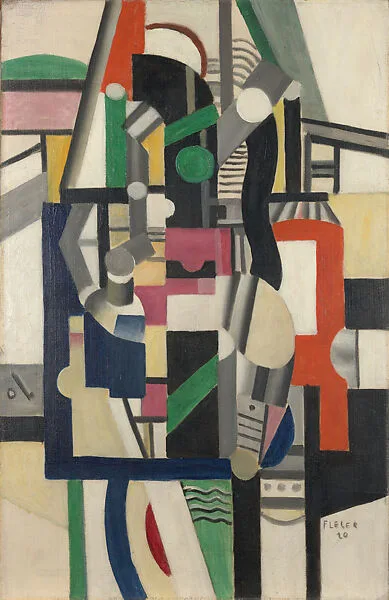
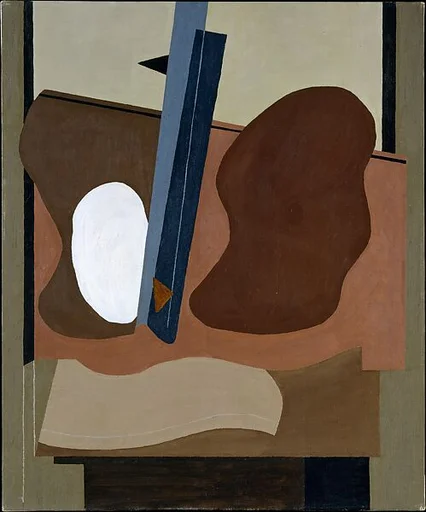
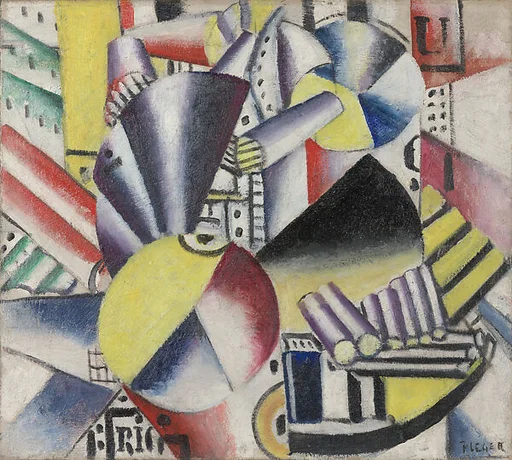
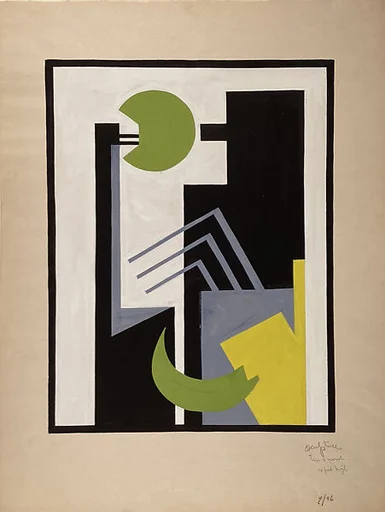
Léger was one of the most prominent and prolific artists working in Paris in the first half of the twentieth century. He was first associated with the avant-garde in 1909, when he exhibited his work at the Salon d'Automne in the company of artists such as Marcel Duchamp and Constantin Brancusi. His early mature work was strongly influenced by Cubism and, after serving in World War I, he developed a personal style of abstraction that further manifested the speed and dynamism of contemporary society. Léger's "mechanical period," which lasted from about 1918 to 1923, reflects his infatuation with the machine and with modern technology. Works from this period are characterized by recurring interchangeable geometric elements—among them, the cone, the cylinder, and the disk—that seem suspended in a completely flat or shallow, relief-like space. Actually, none of these works depicts identifiable mechanical parts, but, instead, each is meant to evoke the impersonality of a new machine age. In this picture, we are confronted with a rather cheerful and decorative mechanized world of abstracted joints, pistons, and levers. Set against a framework of thick, black horizontal and vertical lines, Léger's "mechanical elements" are composed of tightly interlocking circles, ellipses, curves, diagonals, rectangles, dots, and groups of parallel wavy lines. In their syncopated arrangement, these brightly colored forms bring to mind the urban architecture, new modes of transportation, and time-saving technologies that were transforming the modern world.
- Artist
- Fernand Léger
- Date
- 1920
- Medium
- Oil on canvas
- Department
- Modern and Contemporary Art
- Credit line
- Jacques and Natasha Gelman Collection, 1998