風流七小町|Visiting
Suzuki Harunobu
ca. 1769 · Woodblock print; ink and color on paper · Asian Art
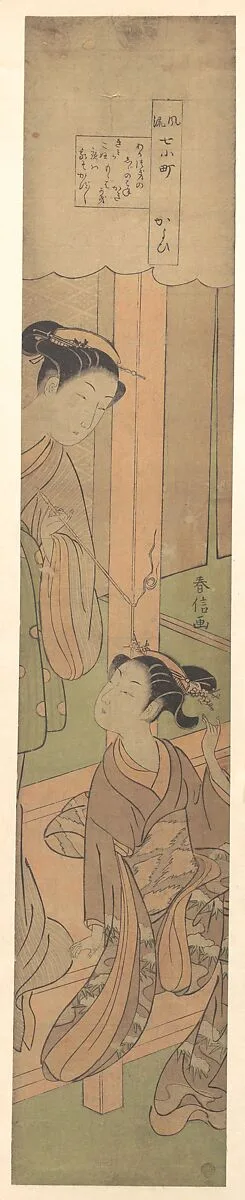
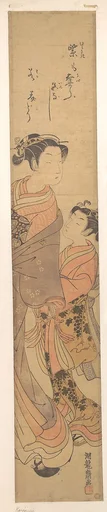
The twelfth-century Mumyōzōshi (The Untitled Book), a book of literary criticism written by women, pronounced the legendary Komachi a love poet unequaled: "Although there have been many enamored of love who wrote poems, Ono no Komachi, beginning with her appearance, her good looks, manners, and personality, in every way she is considered the epitome (of the passionate woman poet)." The Komachi legend sparked the popular imagination and inspired tales (kajin setsuwa) and Noh plays for many generations. In the fourteenth century a series of seven plays about Komachi and her doomed lover Fukakusa were created as a part of the Kanze repertory. One of the seven, Kayoi Komachi, is a Noh play by Kan'ami (1333–1384) revised by his son, Zeami (1363–1443). The plays were adapted to Edo jorūri ballads and puppet theater as well as to the Kabuki stage. Besides being popular in theatrical settings, Komachi was a natural subject for prints: a classic persona easily assumed by the beautiful, literary courtesans inhabiting the ukiyo-e world. The bird design in the noren curtains behind the young women alludes to the imagery in the Komachi poem in the square cartouche: Akatsuki no shigi no hane kaki momo ha kaki kimi ga konu yo w waga zo kazu kazu Agitated like the wings of the snipe at dawn, beating and beating, on the night you do not come, endlessly beating.
- Artist
- Suzuki Harunobu
- Date
- ca. 1769
- Medium
- Woodblock print; ink and color on paper
- Culture
- Japan
- Department
- Asian Art
- Credit line
- The Francis Lathrop Collection, Purchase, Frederick C. Hewitt Fund, 1911