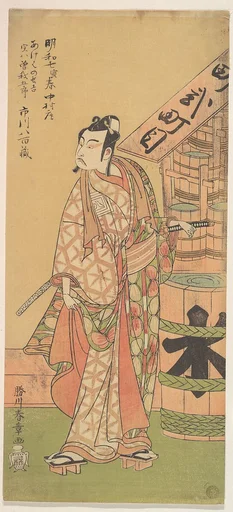
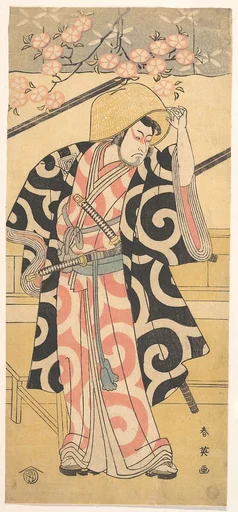
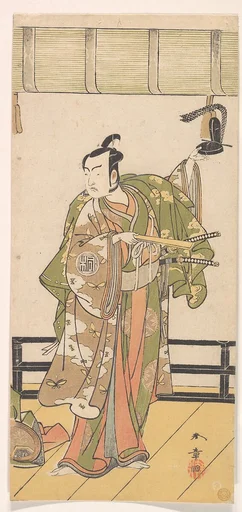
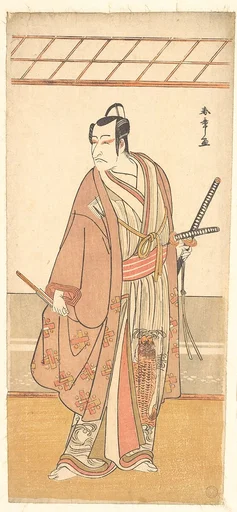
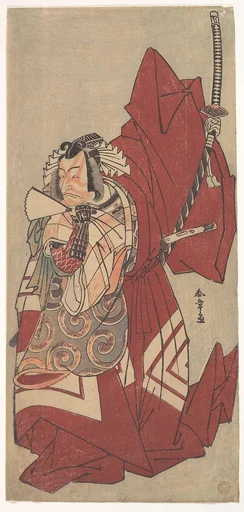
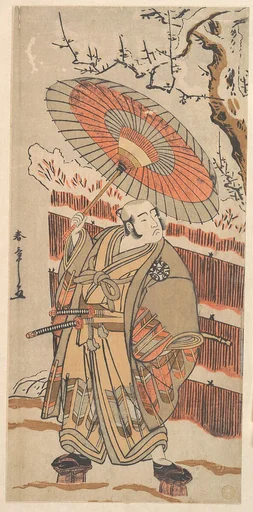
初代中村中蔵の髭の伊久|The Actor Nakamura Nakazō I as the Elderly Samurai Hige no Ikyū
Katsukawa Shunshō 勝川春章
1782 (Tenmei 2), 5th month · Middle sheet of a triptych of woodblock prints (nishiki-e); ink and color on paper · Asian Art
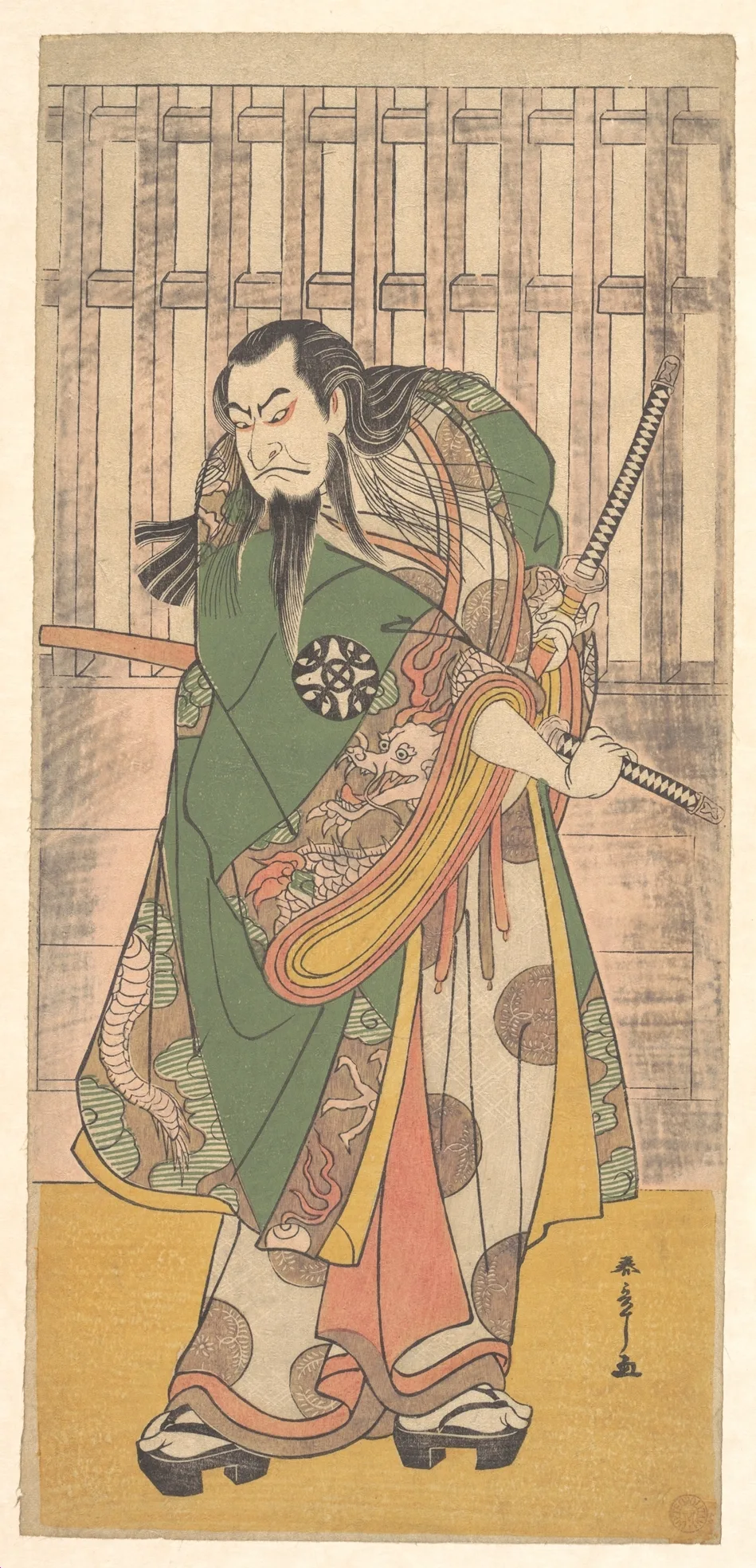
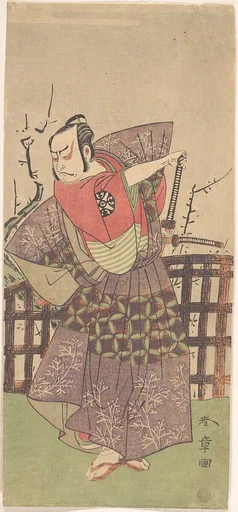
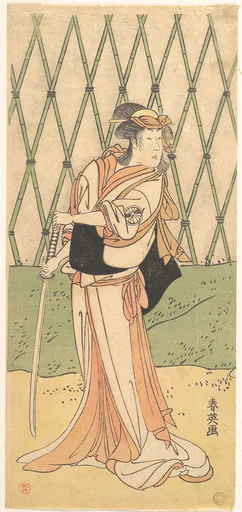
The role of Hige no Ikyū (literally, the whiskered Ikyū) features in the popular plays on the theme of the young, amorous hero Sukeroku, set in pleasure quarters of Yoshiwara, but with plots interwoven with the story of the Soga brothers. Ikyū is the wealthy client of the courtesan Agemaki, but she remains in love with the dashing and courageous young samurai Sukeroku. Ikyū is presented as a vain and pompous elderly samurai, representing the power of the status quo. In contrast to the usual white beard and hair associated with the role, Nakazō here is portrayed with greying black wig and beard, as well as with dramatic red makeup to accentuate his eyes. The adaptation represented here was entitled “Sukeroku: Peony of the Pleasure Quarters” (Sukeroku kuruwa no natori-gusai 助六曲輪名取草), which comprised the last scene of Act II of the play “The Seven Guises of Soga” (Nanakusa yosooi Soga 七種粧曽我), performed at the Nakamuraza Theater in the fifth month of 1782 (Tenmei 2). The complete triptych—depicting from the right Nakamura Rikō I as Agemaki, Nakamura Nakazō I as Hige no Ikyū, and Ichikawa Danjūrō V as Sukeroku—is in the collection of the Museum of Fine Arts, Boston (acc. no. 21.7149-51).
- Artist
- Katsukawa Shunshō 勝川春章
- Date
- 1782 (Tenmei 2), 5th month
- Medium
- Middle sheet of a triptych of woodblock prints (nishiki-e); ink and color on paper
- Culture
- Japan
- Department
- Asian Art
- Credit line
- Rogers Fund, 1914