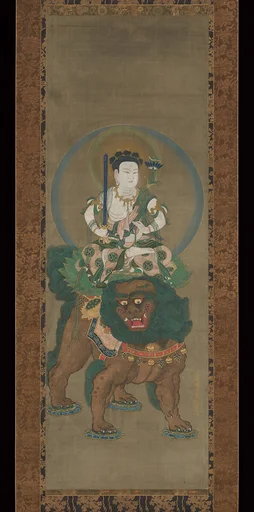
清 佚名 大勢至菩薩像 軸|Mahasthamaprapta Bodhisattva
Unidentified artist
late 17th–early 18th century · Hanging scroll; ink and color on silk · Asian Art
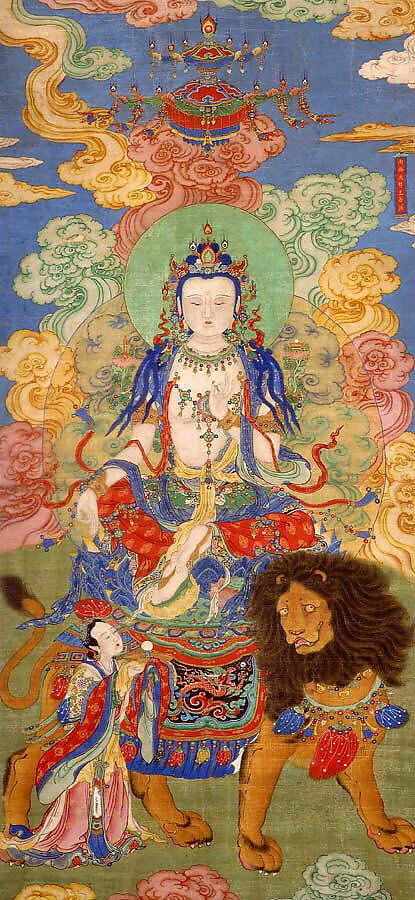
About 1900 the French Sinologist Paul Pelliot acquired a large group of paintings in Beijing that had come from a Qing imperial repository. Included in that group was a partial set of paintings that were created for the Water-Land ritual, a Buddhist mortuary ceremony conducted for the salvation of all the souls of the dead, whether on land or at sea. This painting may have come from the same set. A cartouche in the upper right corner of the composition identifies the deity portrayed here as Mahasthamaprapta (Dashizhi, in Chinese), a bodhisattva or enlightened being whose name means "one who has attained great power." Seated on a strikingly realistic lion mount and accompanied by a female attendant bearing a pearl, the bodhisattva holds the stem of a lotus with two blossoms that appear above his shoulders, one supporting a pearl, the other a thunderbolt-like implement (vajra). His right hand forms the mudra for charity. Most likely, this painting would have been displayed as part of a triptych together with an image of the Bodhisattva Avalokiteshvara (Guanyin) and a central image of the Amitabha (Miluo) Buddha.
- Artist
- Unidentified artist
- Date
- late 17th–early 18th century
- Medium
- Hanging scroll; ink and color on silk
- Culture
- China
- Department
- Asian Art
- Credit line
- Gift of the Estate of Lillian Genth, 1953