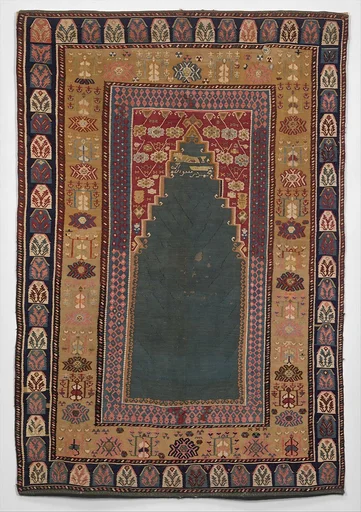
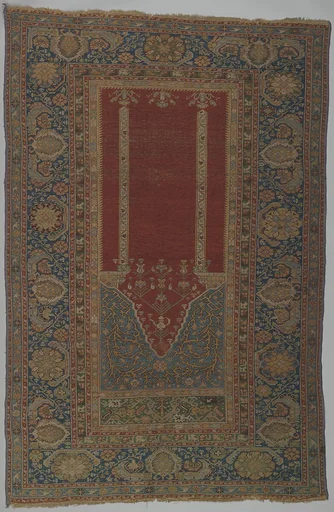
Prayer Rug with Niche Design
Unknown
late 18th–early 19th century · Wool (warp, weft, and pile), cotton (pile); symmetrically knotted pile · Islamic Art
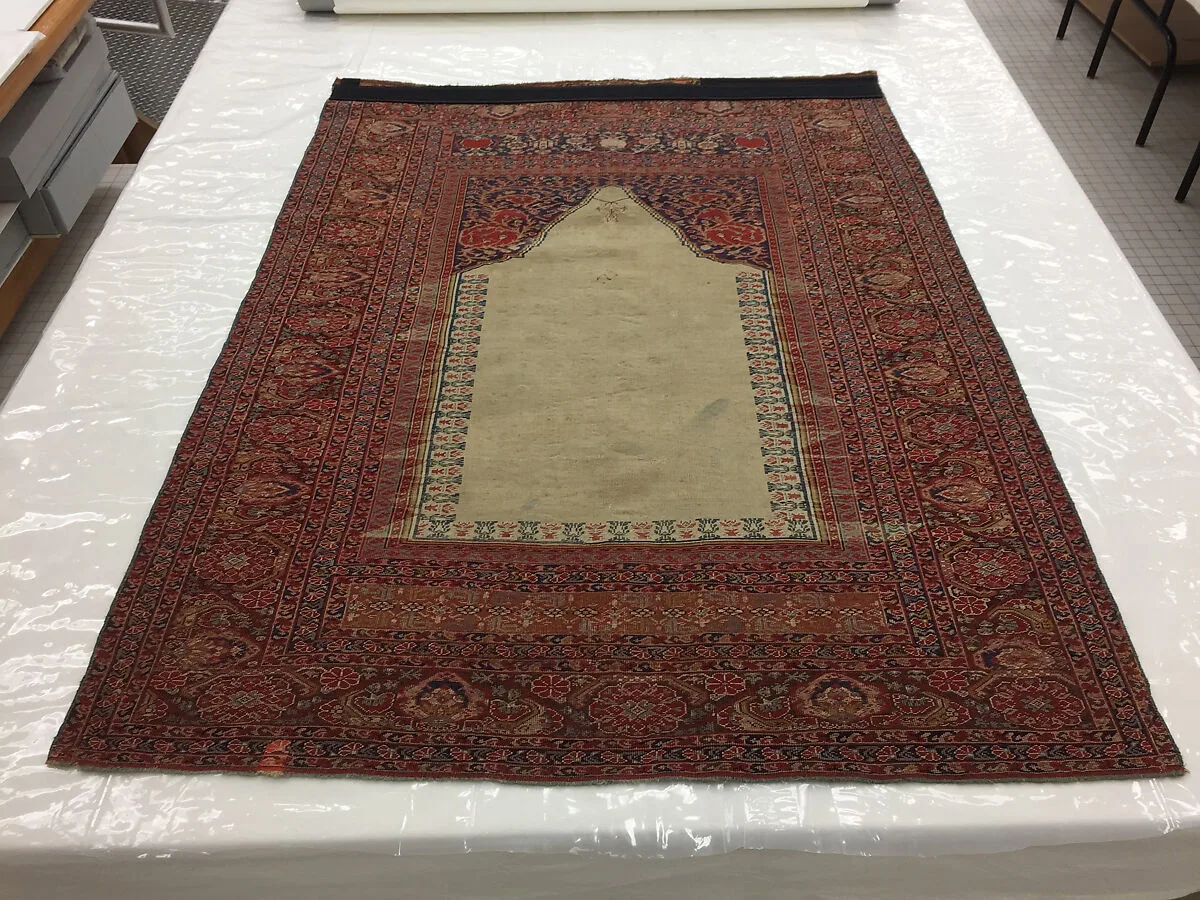
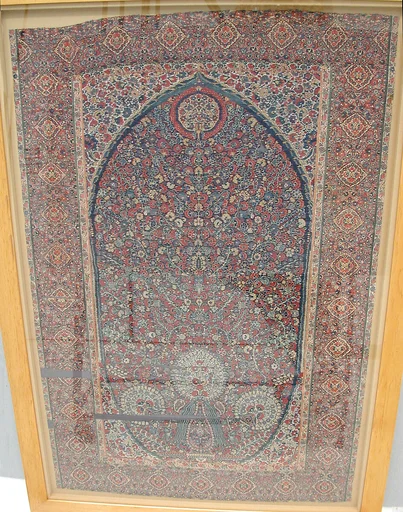
This prayer rug was woven in Gördes, a famous carpet weaving center located in Western Turkey on the Aegean cost. Typical for prayer rugs, it is of small size and is dominated by a niche-design, evoking a mihrab, an Islamic prayer niche indicating the direction of Mecca. Characteristic for Gördes is a series of borders – larger and smaller ones – showing alternating patterns made of colorful flowers and medallion-like motifs surrounding the niche, which is against a white background. The pattern and motifs follow those of classical Ottoman art. Hence, we find rosettes, palmettes, carnations, tulips, pomegranates, as well as spandrels on the sides of the triangular arch of the niche, which are reminiscent of Ottoman tiles, carpets and other media. The possible comparison with classical Ottoman art points to a rather early date in the workshop production of Gördes, which was particularly active in the nineteenth and twentieth centuries.
- Artist
- Unknown
- Date
- late 18th–early 19th century
- Medium
- Wool (warp, weft, and pile), cotton (pile); symmetrically knotted pile
- Department
- Islamic Art
- Credit line
- Gift of Thomas Colville, 2019