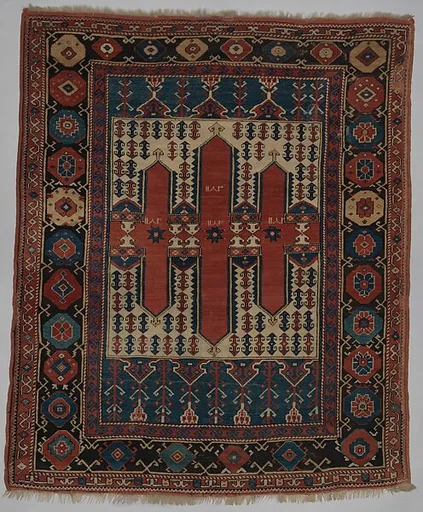
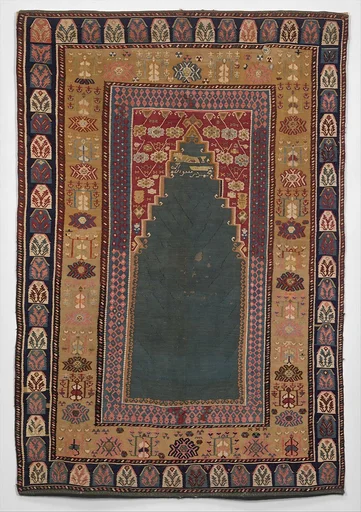
Prayer Rug with Coupled Columns
Unknown
early 18th century · Wool (warp, weft and pile); symmetrically knotted pile · Islamic Art
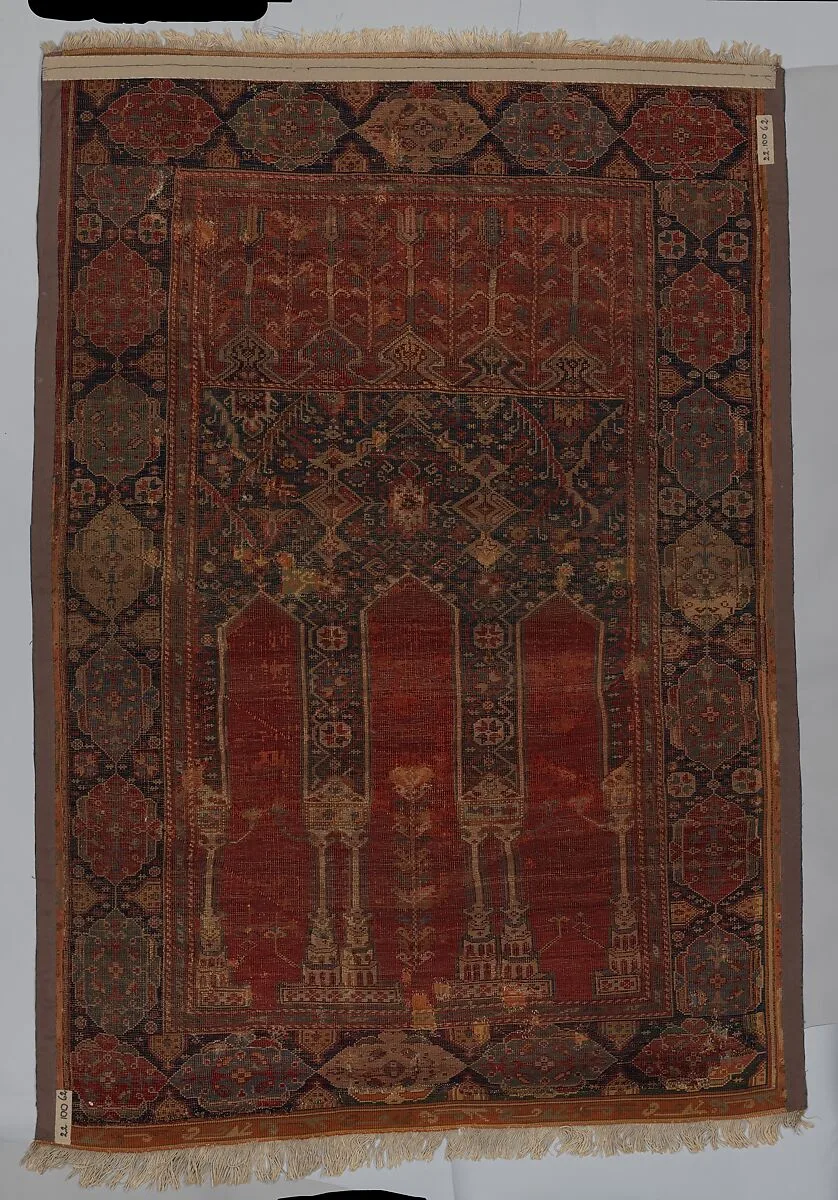
The rich polychrome palette, dominated by deep red and including purple, shades of blue, green, yellow, white, and dark brown, is typical for carpets woven in Ladik during the later Ottoman period. However, the triple arch supported by sets of slim double columns and the tulips above and inside the medallions of the border both recall a famous sixteenth-century Ottoman court prayer rug (the Ballard double-column prayer rug also in The Met collection). The architectural feature is not common in Ottoman buildings. Recent scholarship suggests that the coupled-columns design on Anatolian prayer rugs may have originated in Nasrid Spain and traveled east to Cairo and Istanbul with the emigration of Sephardic Jews beginning in the late fifteenth century; they used a similar motif on parokhets (curtains that cover Torah arks in synagogues).
- Artist
- Unknown
- Date
- early 18th century
- Medium
- Wool (warp, weft and pile); symmetrically knotted pile
- Department
- Islamic Art
- Credit line
- The James F. Ballard Collection, Gift of James F. Ballard, 1922