The Palisades (No. 19 of The Hudson River Portfolio)
John Hill|William Guy Wall|Henry J. Megarey
1823–24 · Aquatint printed in color with hand-coloring; first state of two (Koke) · Drawings and Prints
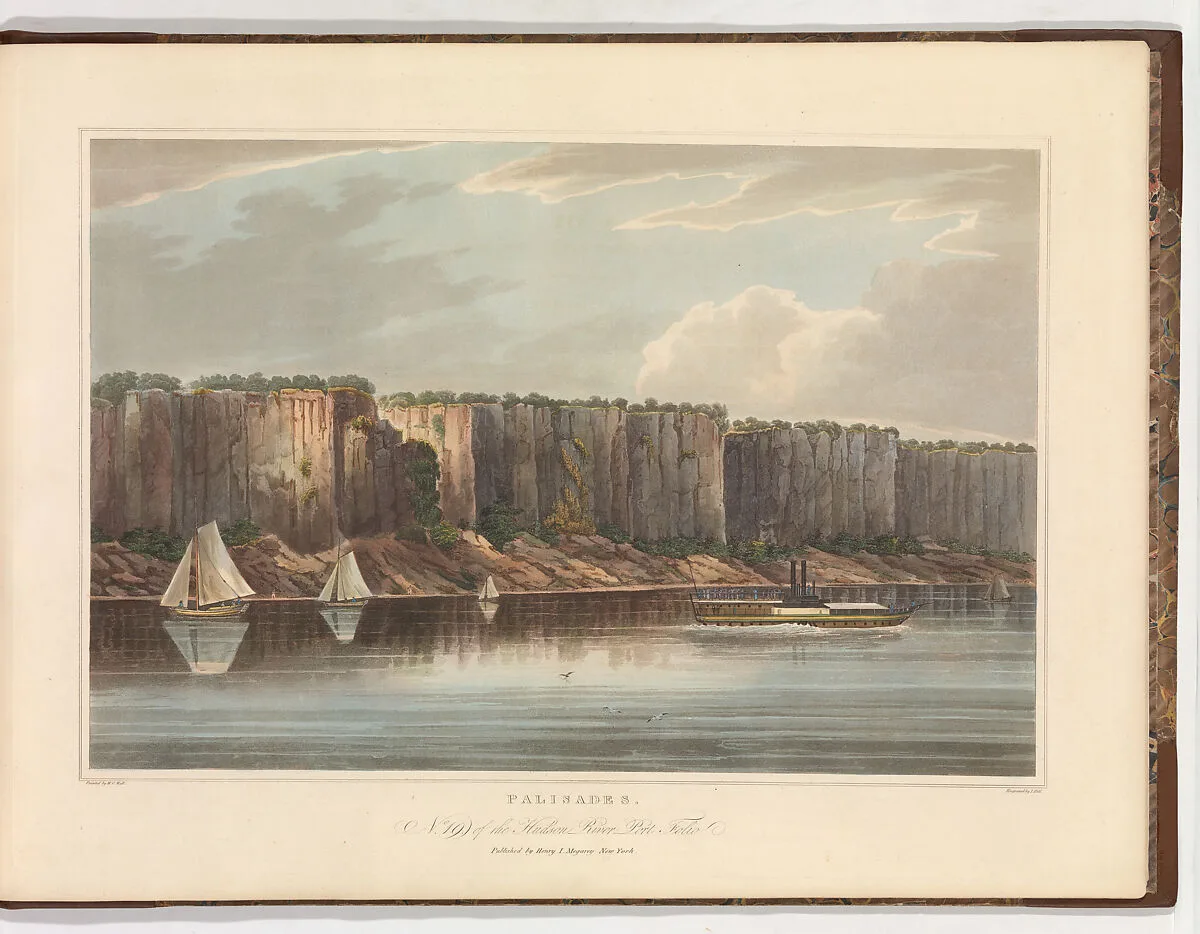
John Agg's related text tells us that, "the Pallisadoes consist of a line of rugged and perpendicular bluffs, which at a few miles distance from the city of New-York, margin for a considerable distance and overlook the bed of the Hudson river...Rising in savage grandeur, and stretching their tree-crowned summits far as the vision can compass, these rocks are too prominent a feature in the scenery of the Hudson to be overlooked. The shore...is abrupt, and the water sufficiently deep to allow vessels, even of considerable burthen, to approach within a short distance...The height of these bluffs....rising from 400 to 800 feet, exhibiting...steep and solid masses of stupendous stone, and presenting here and there deep cavities, where the eagle builds his nest among the cliffs." The print comes from the Hudson River Portfolio, a monument of American printmaking produced through the collaboration of artists, a writer, and publishers. In the summer of 1820, the Irish-born Wall toured and sketched along the Hudson, then painted a series of large watercolors. Prints of equal scale were proposed—to be issued to subscribers in sets of four—and John Rubens Smith hired to work the plates. Almost immediately, Smith was replaced by the skilled London-trained aquatint engraver John Hill, who finished the first four plates, and produced sixteen more by 1825. Over the next decade, the popularity of the Portfolio stimulated new appreciation for American landscape, and prepared the way for the Hudson River School.
- Artist
- John Hill|William Guy Wall|Henry J. Megarey
- Date
- 1823–24
- Medium
- Aquatint printed in color with hand-coloring; first state of two (Koke)
- Department
- Drawings and Prints
- Credit line
- The Edward W. C. Arnold Collection of New York Prints, Maps and Pictures, Bequest of Edward W. C. Arnold, 1954