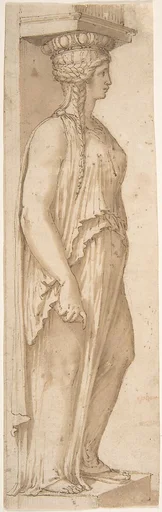
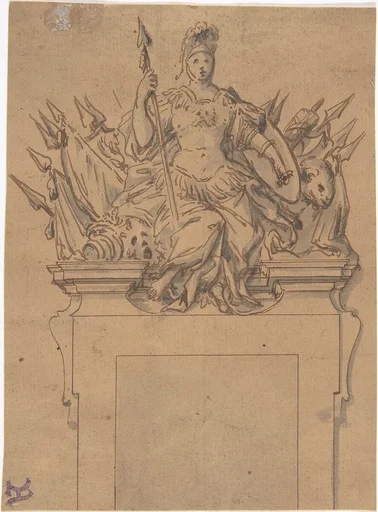
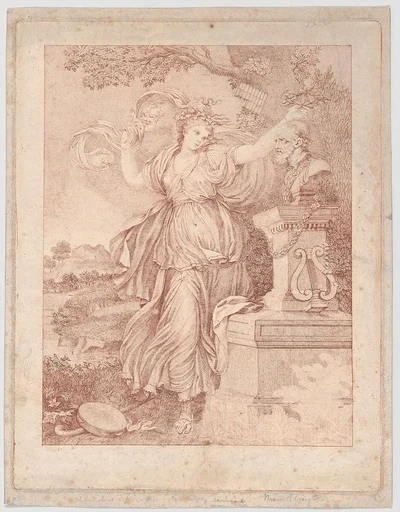
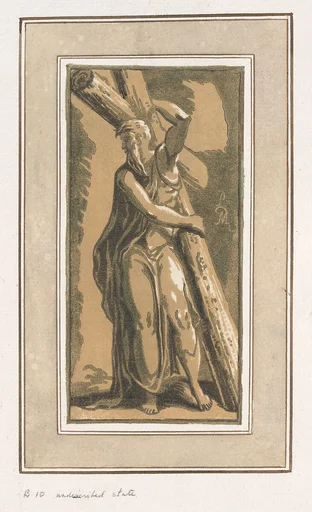
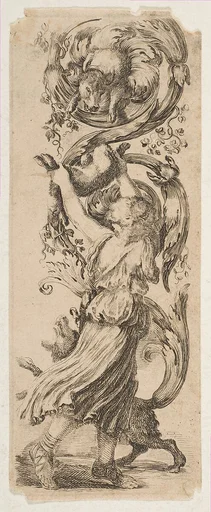
Female Allegorical Figure of Benignitas (Goodness), with Attributes of Abundance Standing in a Niche (recto); Architectural Sketches (verso)
Giorgio Vasari
1550–70 · Pen and brown ink, brush and brown wash, over an underdrawing done with traces of black chalk, ruling, and compass-work in pen and brown ink (recto); black chalk (verso) · Drawings and Prints
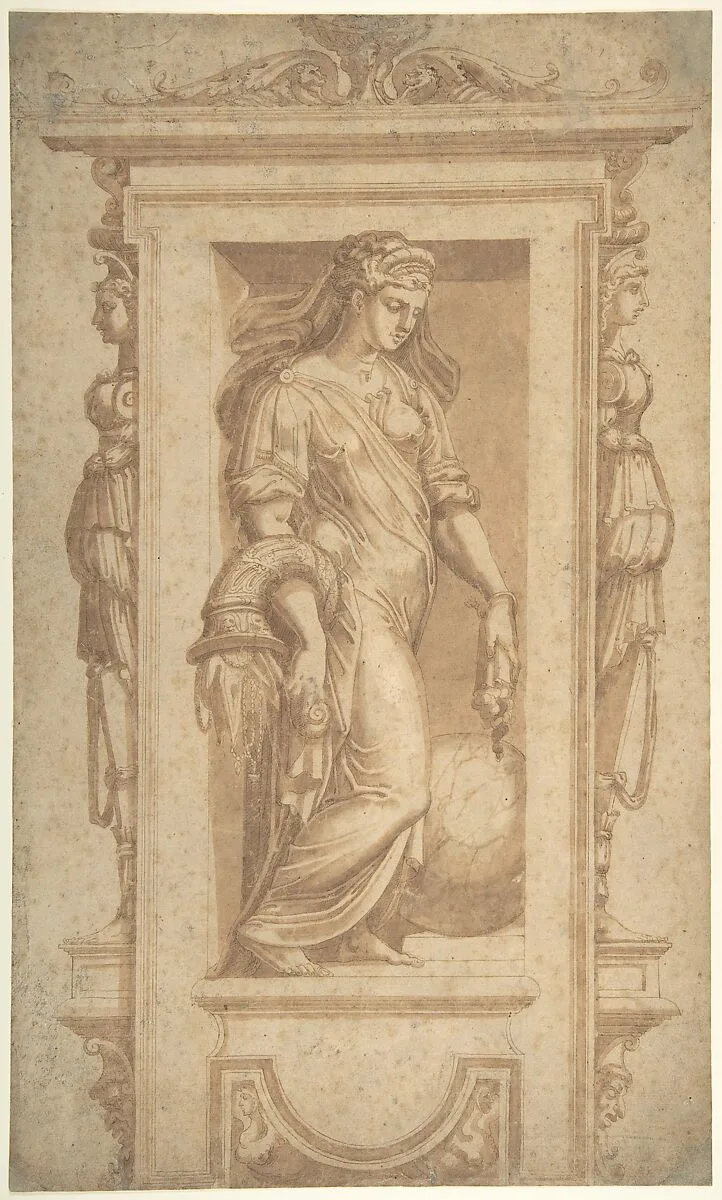
This bold, elegantly finished drawing is a careful copy after the Allegorical figure of the virtue Goodness, entitled "Benignitas," in the fresco by Giorgio Vasari that adorns a wall of the Sala dei Cento Giorni in the Palazzo della Cancelleria in Rome. Vasari painted this large reception hall in 100 days (hence the name of the room) for Cardinal Ranuccio Farnese in 1546, and relied on the heavy collaboration of assistants. The allegorical figure in the fresco is meant to represent a sculpture, painted therefore in monochrome. This drawing had been previously attributed to the circle of Francesco Salviati by Philip Pouncey (his note on the mount of the drawing, April 1965), before the connection to Vasari's fresco had come to light. Pouncey's preliminary suggestion of attribution was a reasonable hypothesis, given the artistic reciprocities between Vasari and Salviati in the 1540s when both artists were in Rome. Pouncey had also noted the close resemblances of the drawing with Polidoro da Caravaggio's manner of designing the pattern of folds in the draperies. The watermark (Woodward "Arrows crossed C", Venice 1567) establishes a date around 1567.
- Artist
- Giorgio Vasari
- Date
- 1550–70
- Medium
- Pen and brown ink, brush and brown wash, over an underdrawing done with traces of black chalk, ruling, and compass-work in pen and brown ink (recto); black chalk (verso)
- Department
- Drawings and Prints
- Credit line
- Gift of Harry G. Friedman, 1958