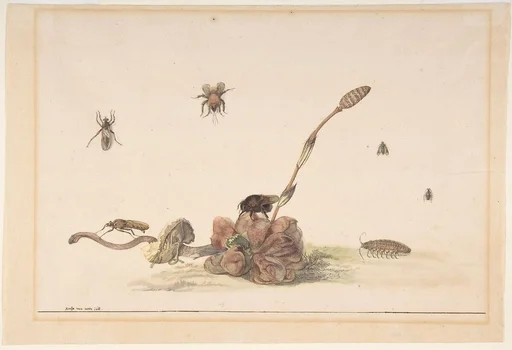
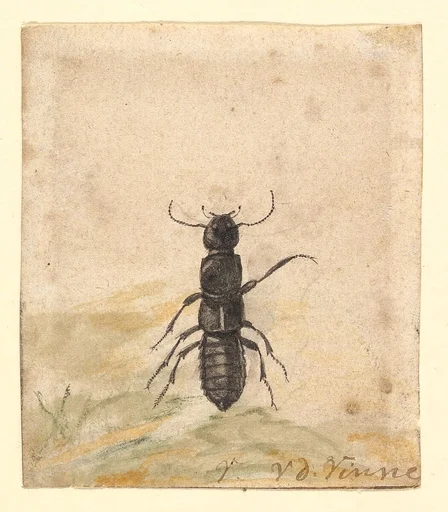
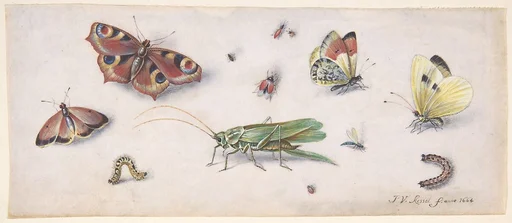
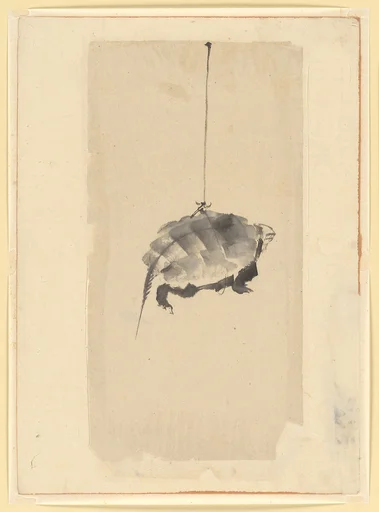
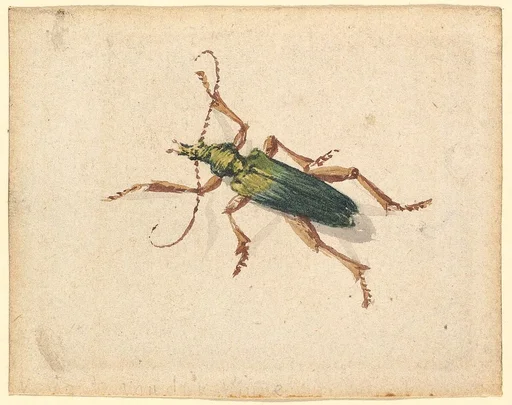
Studies of a Blue Beetle and Insects
Anonymous, Dutch, 17th century|Rochus van Veen
17th century (?) · Gouache and watercolor · Drawings and Prints
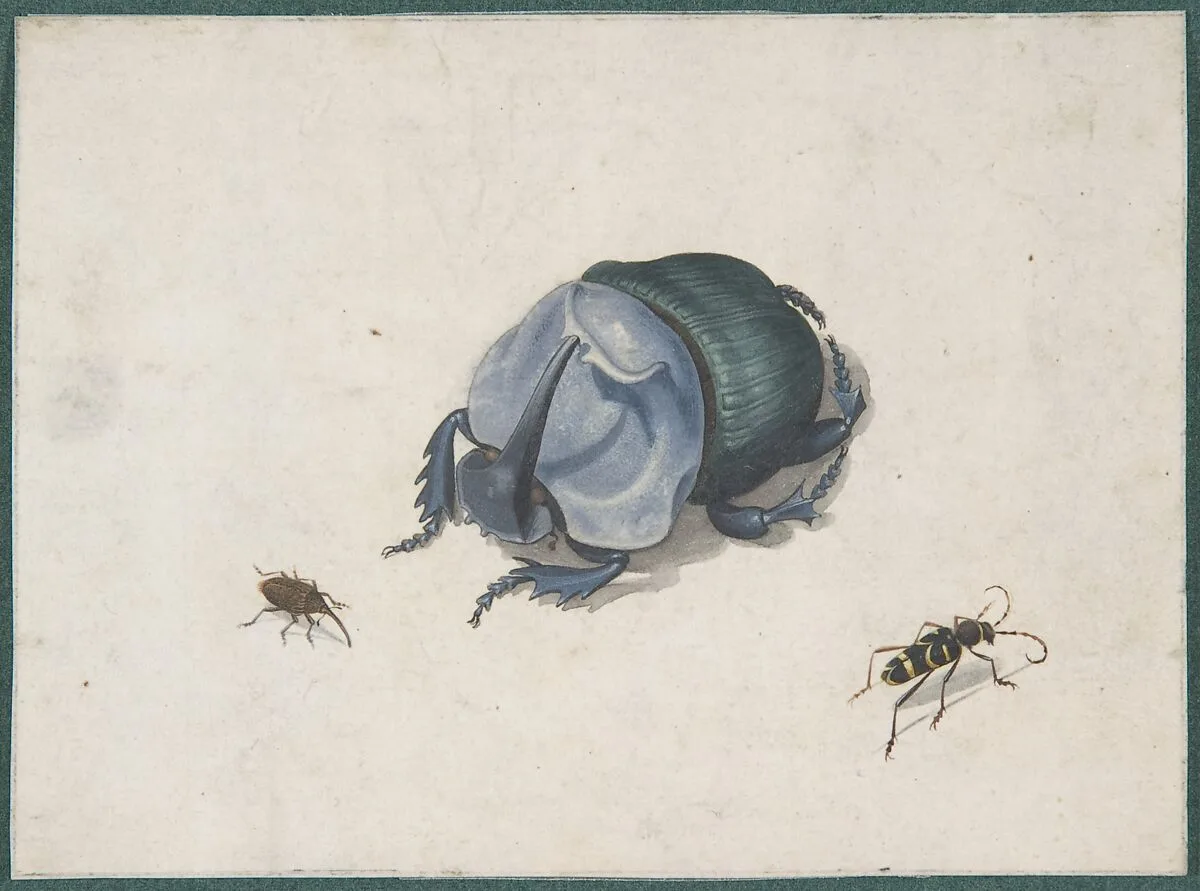
This drawing depicts a blue rhinoceros beetle at center, a chestnut weevil at bottom left and a wasp beetle at bottom right. Despite appearing pale blue, the rhinoceros beetle at center is the Coprophanaeus lancifer, a vibrantly colored, shiny and iridescent species native to Brazil and surrounding areas in South America. X-ray Fluorescence spectroscopy and Raman spectroscopy found that the artist may have recreated aspects of the insect’s dramatic appearance with pigments [1]. Smalt, a pigment made of crushed potash-glass tinted blue by the addition of cobalt, was identified in regions of the insect's pale blue head. Smalt’s translucent glassiness gives the drawing a very subtle glitter when moved in sunlight. Touches of shell gold, gold leaf ground to a fine pigment, have been added to the beetle's back legs, likely also to mimic its metallic finish. The artist of this drawing was long unknown, however recent research discovered that the blue beetle at center ties the drawing to the workshop of Haarlem-born watercolorists and stained-glass painters Pieter Holsteyn the Elder (1580 - 1662) and Pieter Holsteyn the Younger (1614 - 1683). The Holsteyn workshop was a prolific producer of the kind of carefully observed studies of insects, often executed in watercolor on paper or vellum, which became common in Dutch art of the mid to late seventeenth century. Drawings of insects, often destined for albums of drawings, and stored or viewed in dialogue with collections of real specimens became widely popular during the seventeenth century. The proliferation of the genre testifies to the increased engagement of artists and scientists with optical technologies like the microscope but this drawing is an important document of the entanglement of scientific interests with the growth of systems of global trade and colonialism The blue beetle at the center of the sheet was native to Brazil a territory that was a Dutch colony from 1630 to 1654, and would have been one of countless specimens that came from foreign lands into the Dutch republic over the long seventeenth century. Olivia Dill, 8/20/24 [1] X-ray fluorescence spectroscopy was conducted by the author and Research Scientist in the Department of Scientific Research, Silvia Centeno. Raman Spectroscopy was conducted by the author.
- Artist
- Anonymous, Dutch, 17th century|Rochus van Veen
- Date
- 17th century (?)
- Medium
- Gouache and watercolor
- Department
- Drawings and Prints
- Credit line
- Bequest of Catherine G. Curran, 2008