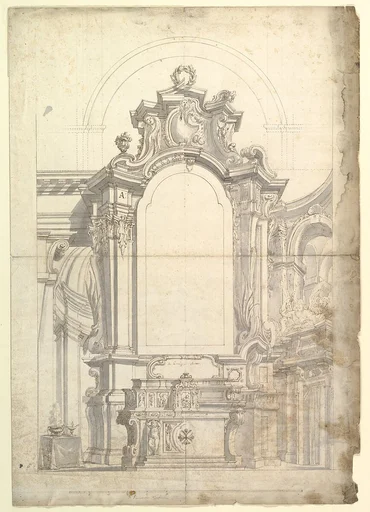
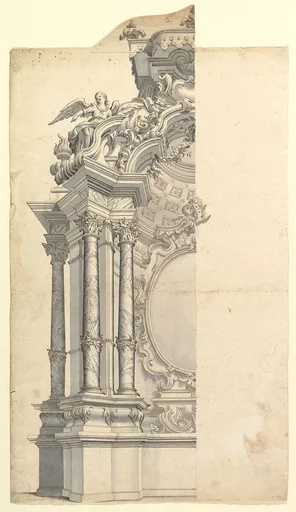
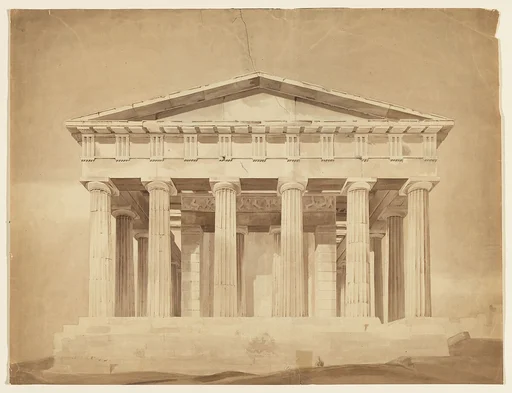
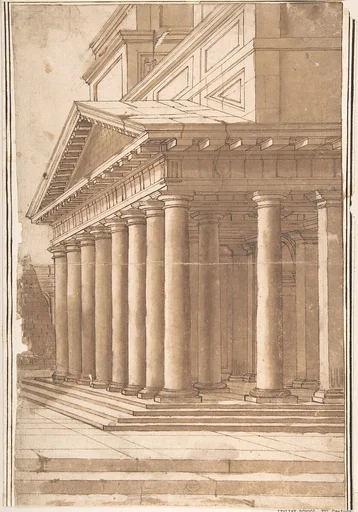
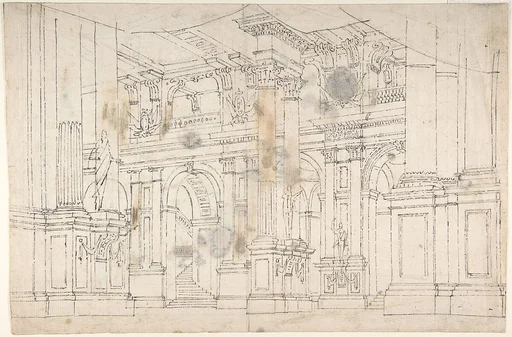
Recto: Front Elevation of a Roman Temple in Ruins (inspired by Giuliano da Sangallo); Verso: Elevation of the Nave of a Roman Basilica in Ruins (? the Basilica Giulia, inspired by Giuliano da Sangallo).
Sangallo family|Marcus Pollio Vitruvius
1530–45 · Pen and dark brown ink · Drawings and Prints
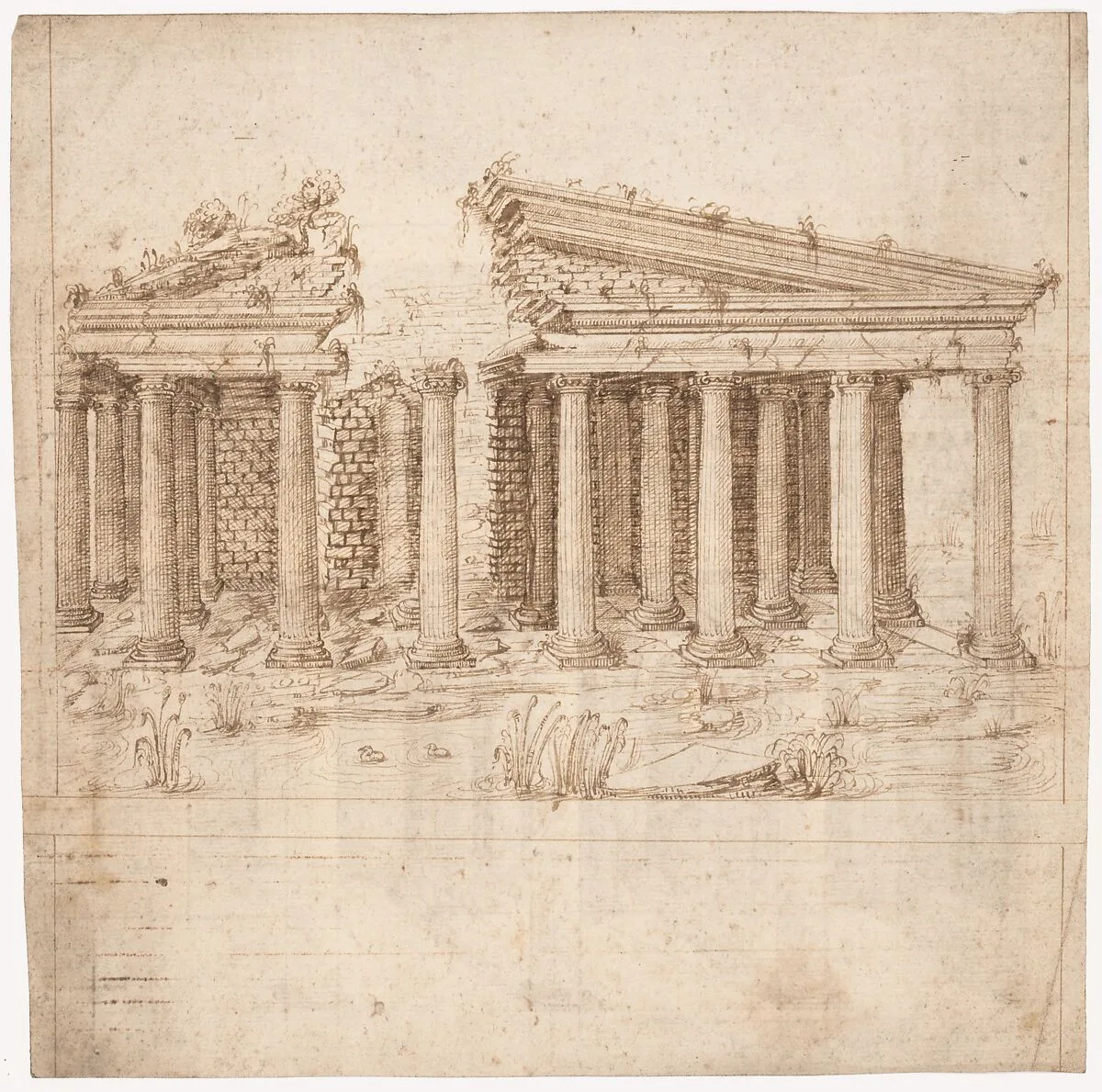
A recent discovery, this sheet and seven others (acc. nos. 2008.105.1-8) comprised a manuscript draft for an Italian edition of the sole surviving architectural treatise of Roman antiquity, Ten Books on Architecture by Marcus Pollius Vitruvius (late first century B.C.). Had the project been completed, it would have ranked among the brilliantly imaginative works of Renaissance interpretive architectural theory. The drawings also exhibit a beautifully expressive handling of the pen. Comparisons of style as well as of the shorthand notation in the sketching of human figures suggest a close kinship with drawings by Bastiano "Aristotile" da Sangallo (Florence, 1481 – Florence 1551) and the collaborators that helped him draw and write the motifs of marginalia in a printed 1486 edition of Vitruvius (Biblioteca Corsiniana, Accademia Nazionale dei Lincei, Rome) that was reworked in the 1530s. By all accounts a virtuoso stage set designer, Bastiano da Sangallo-the cousin and closest collaborator of Antonio da Sangallo "The Younger" and Giovanni Battista da Sangallo "Il Gobbo"-was Michelangelo's assistant in the Sistine Chapel and took the surname of "Aristotile" for his love of antiquity. Members of the Sangallo family had been deeply interested in Vitruvius for at least two generations.
- Artist
- Sangallo family|Marcus Pollio Vitruvius
- Date
- 1530–45
- Medium
- Pen and dark brown ink
- Department
- Drawings and Prints
- Credit line
- Purchase, Bequest of W. Gedney Beatty, by exchange, 2008
![The Amphitheater in Bordeaux [Teatrum Bordeos; Transitorium Caesaris], from the series 'Ruinarum variarum fabricarum delineationes pictoribus caeterisque id genus artificibus multum utiles'](https://d2pvxr3eb77vb4.cloudfront.net/assets/v1/55/55f66e2d90e5da4a6c3b56dea54a0ad3e1db8c8f1606ef6db26bd42f08ac4a04/graph.webp)