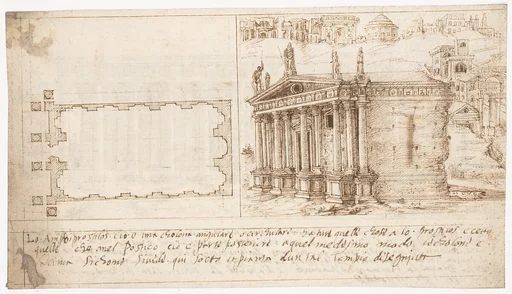
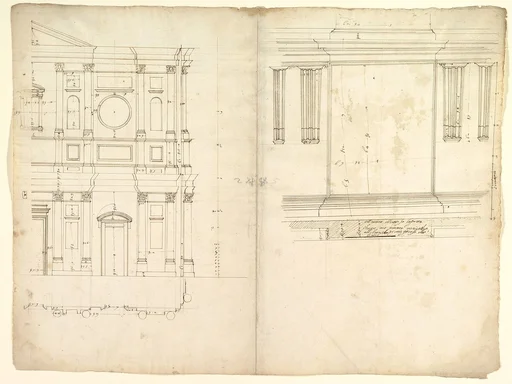
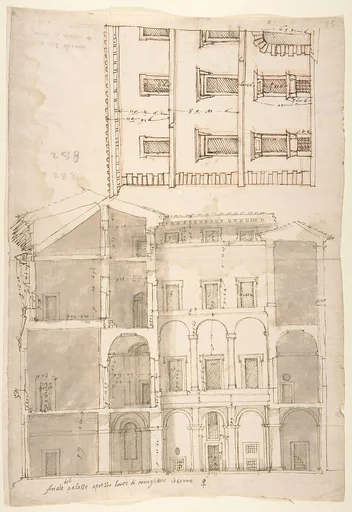
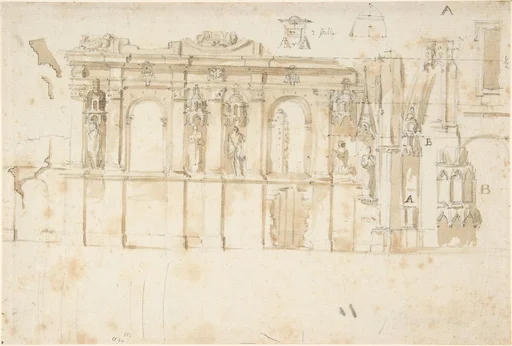
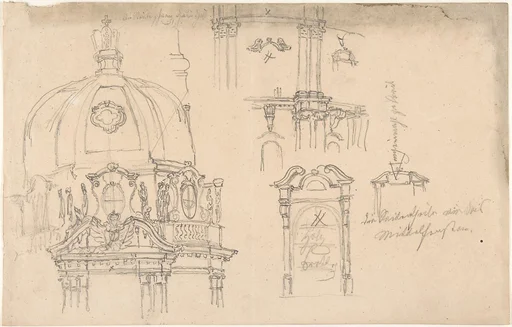
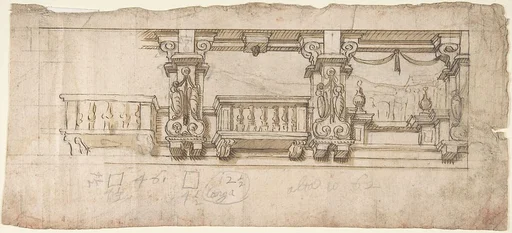
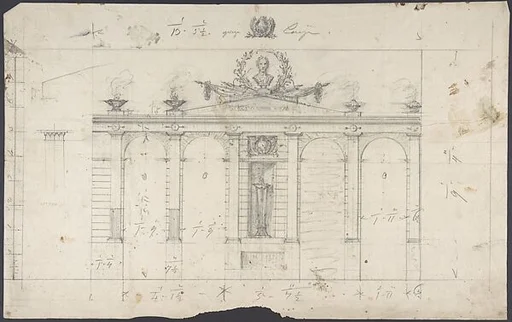
Recto: Temple Types: in Antis and Prostyle (Vitruvius, Book 3, Chapter 2, nos. 2, 3); Verso: Temple Types: Peripteral (Vitruvius, Book 3, Chapter 2, no. 5).
Sangallo family|Marcus Pollio Vitruvius
1530–45 · Pen and dark brown ink · Drawings and Prints
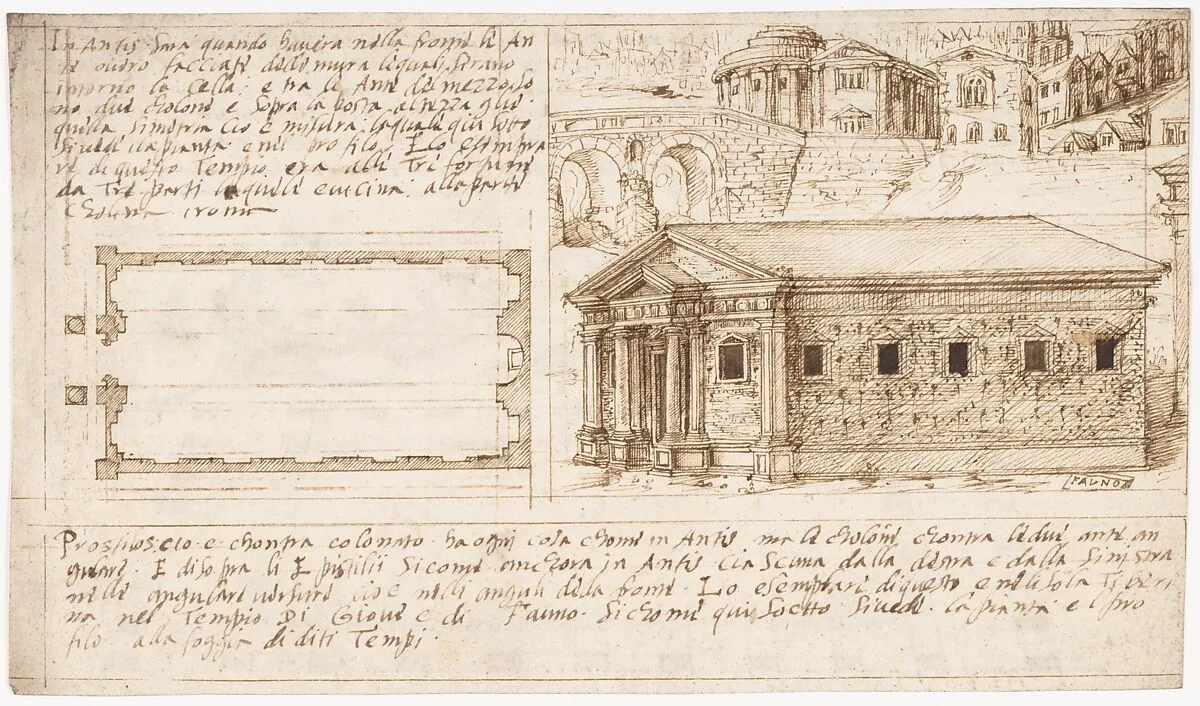
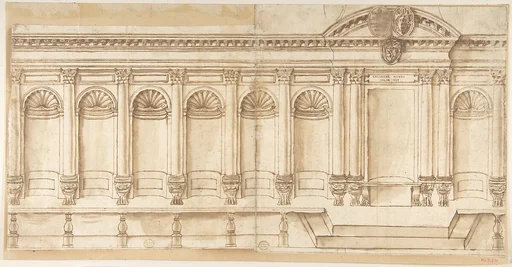
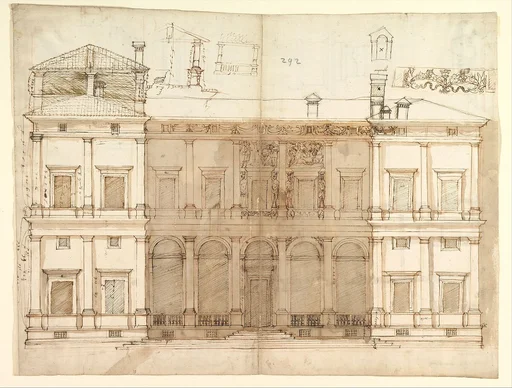
A recent discovery, this sheet and seven others (acc. nos. 2008.105.1-8) comprised a manuscript draft for an Italian edition of the sole surviving architectural treatise of Roman antiquity, Ten Books on Architecture by Marcus Pollius Vitruvius (late first century B.C.). Had the project been completed, it would have ranked among the brilliantly imaginative works of Renaissance interpretive architectural theory. The drawings also exhibit a beautifully expressive handling of the pen. Comparisons of style as well as of the shorthand notation in the sketching of human figures suggest a close kinship with drawings by Bastiano "Aristotile" da Sangallo (Florence, 1481 – Florence 1551) and the collaborators that helped him draw and write the motifs of marginalia in a printed 1486 edition of Vitruvius (Biblioteca Corsiniana, Accademia Nazionale dei Lincei, Rome) that was reworked in the 1530s. By all accounts a virtuoso stage set designer, Bastiano da Sangallo-the cousin and closest collaborator of Antonio da Sangallo "The Younger" and Giovanni Battista da Sangallo "Il Gobbo"-was Michelangelo's assistant in the Sistine Chapel and took the surname of "Aristotile" for his love of antiquity. Members of the Sangallo family had been deeply interested in Vitruvius for at least two generations. Vitruvius sought to classify temples according to type, and the Florentine artist here has translated his text quite closely. The words at the top of the text may be rendered into English more or less as follows: "It will be a temple in antis when it has the antae projecting in front of the walls that enclose the cella, and in the center between the antae, two columns, and over them the pediment, which is built with the kind of symmetrical proportions described later in this work. An example will be found at the Three Fortunes in one of the three that is nearest the Colline Gate." The bottom paragraph describes the prostyle temple as being similar to the temple in antis, but having two columns at its corners. Here, Vitruvius cited the example of the Temple of Jove and Faunus on the Isola Tiberina in Rome.
- Artist
- Sangallo family|Marcus Pollio Vitruvius
- Date
- 1530–45
- Medium
- Pen and dark brown ink
- Department
- Drawings and Prints
- Credit line
- Purchase, Bequest of W. Gedney Beatty, by exchange, 2008