The Entombment of Christ
Andrea Mantegna
before 1475 · Engraving and drypoint; second state of two · Drawings and Prints
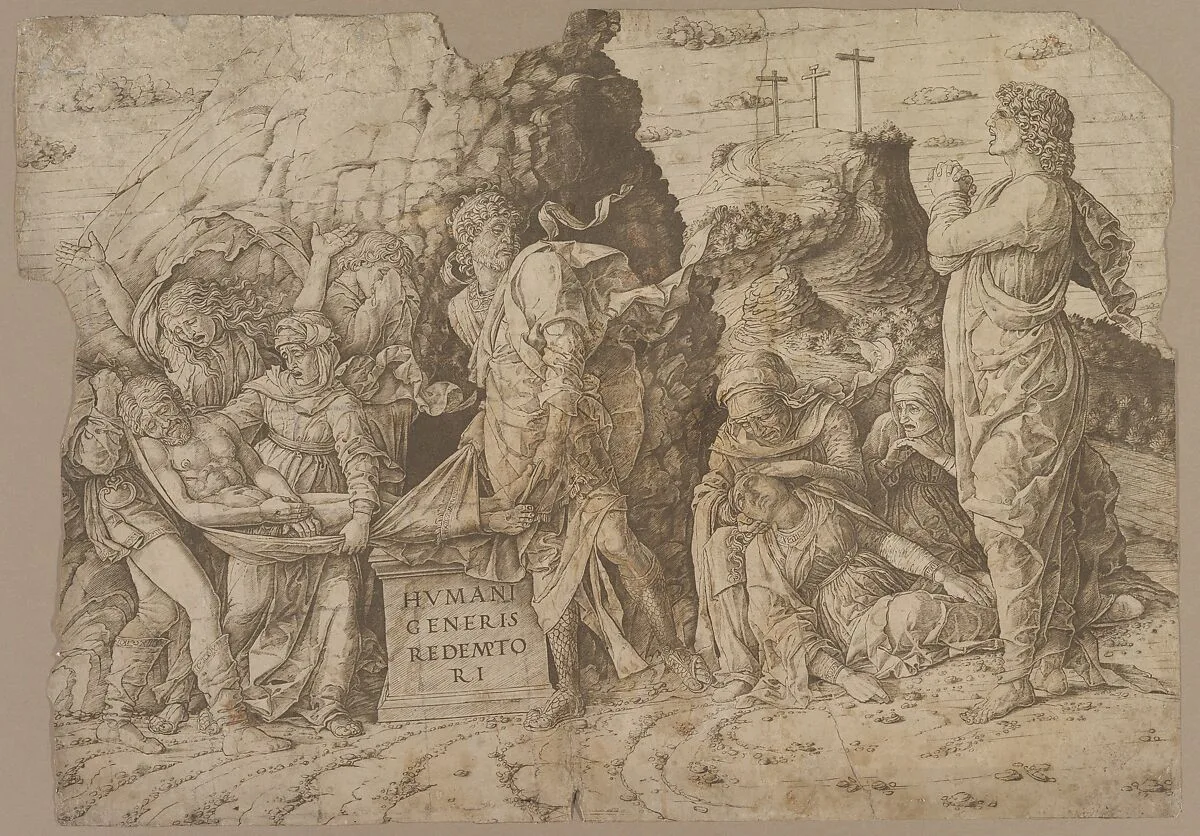
This impression was formerly mounted on top of a facsimile that filled in the losses. Either the facsimile was printed on gauzy fabric or the gauzy fabric lay on top of the print and served to blur the distinction between the engraving and the facsimile. At the time of the Mantegna exhibition in 1992, the print was removed from its mount and the beauty of the impression recognized., in spite of its fragmentary condition. It was included in the exhibition in its New York venue but was not discussed in the catalogue. Watermark: crown in circle. Vasari suggested that it was Baldini's engravings that inspired Mantegna to take up the medium. Recent scholars are also of the opinion that Florentine examples provided Mantegna with a starting point for the development of his own technique. In what is believed to be one of his earliest prints, we can see the profusion of fine lines with which Mantegna builds up areas of tone, from the transparent shadows of the Virgin's mantle to the impenetrable darkness of the cave. His shading is systematic, with all lines following the same diagonal slant, and his contours vary subtly in depth and thickness, creating a sense of volume through their modulations. In this beautifully rich-if damaged-early impression, we can appreciate the full intensity, drama, and ambition of one of the artist's first efforts in the new medium of engraving.
- Artist
- Andrea Mantegna
- Date
- before 1475
- Medium
- Engraving and drypoint; second state of two
- Department
- Drawings and Prints
- Credit line
- Harris Brisbane Dick Fund, 1937