The Cumaean Sibyl
The Printsellers' Association, London|Charles-Albert Waltner|Sir Edward Burne-Jones|Thomas Agnew & Sons, Ltd.
November 1, 1882 · Etching and drypoint; proof before edition of 250 · Drawings and Prints
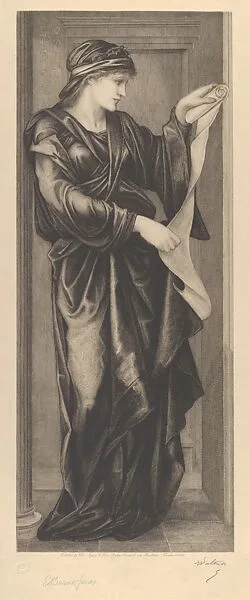
This etching conveys Burne-Jones’s severe conception of the Apollonian priestess at Cumae—a Greek colony near Naples—and belongs to a series he devoted to ancient prophetesses who foretold the coming of Christ. Enveloping dark drapery, bound about the head with a thorny vine, underscores the sibyl’s character while her niche-like setting recalls Renaissance frescoes. This print was the first one based on a Burne-Jones oil painting and points to a significant turning point in his career. Before he became associated with the Grosvenor Gallery, founded by Sir Coutts Lindsay and his wife Blanche in 1877, the artist favored watercolor and gouache. Once assured of a sympathetic exhibition venue, he turned more consistently to oil. The leading Victorian art dealers Thomas Agnew & Sons often published prints of his compositions, providing him with a significant income.
- Artist
- The Printsellers' Association, London|Charles-Albert Waltner|Sir Edward Burne-Jones|Thomas Agnew & Sons, Ltd.
- Date
- November 1, 1882
- Medium
- Etching and drypoint; proof before edition of 250
- Department
- Drawings and Prints
- Credit line
- Gift of Mrs. Alice G. Taft, Mrs. Marianna F. Taft, Miss Hope Smith, Mrs. Helen Bradley Head, and Brockholst M. Smith, 1945