Design for a "Quarantore" Decoration
Federico Zuccaro (Zuccari)
1540–1609 · Pen and brown ink, brush and brown wash, highlighted with white, over traces of black chalk · Drawings and Prints
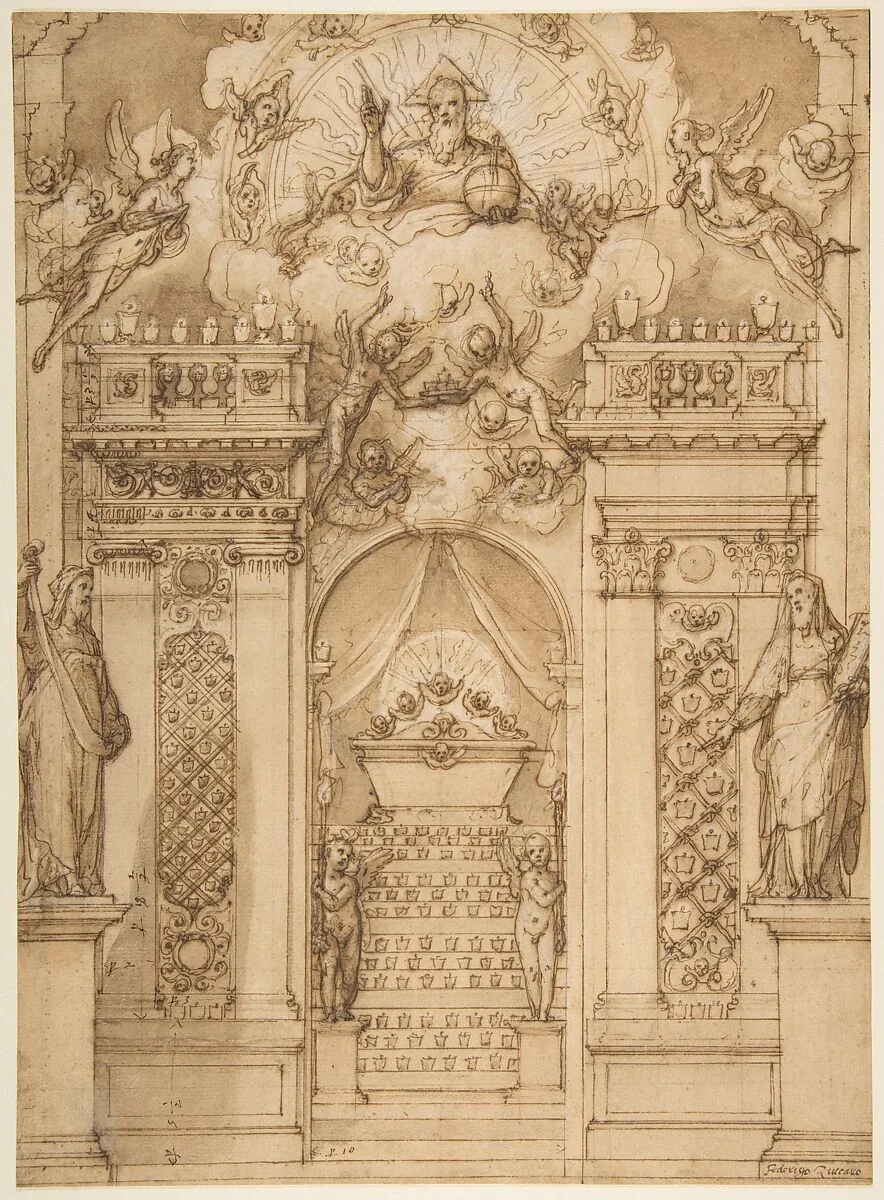
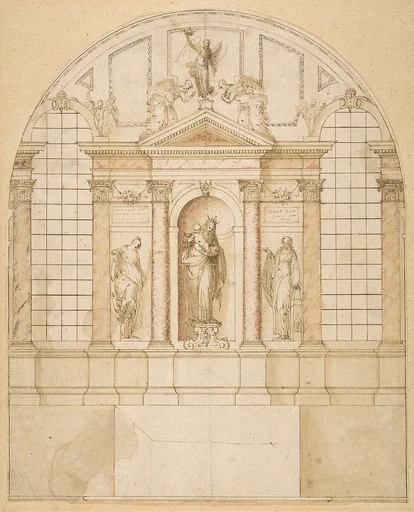
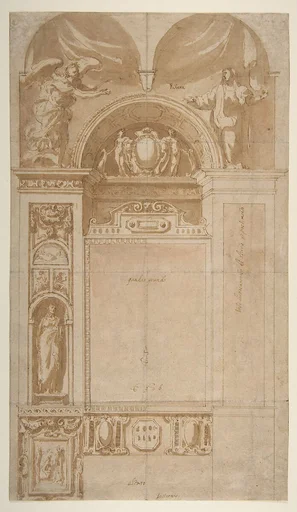
This carefully drawn scale model provides a design for a liturgical practice that came to be widely celebrated in the late sixteenth century. As shown here, the Eucharist was placed in a small sepulcher where it remained, and was worshiped, for the same forty hours that Christ's body lay in the tomb prior to the Resurrection. Federico has added another level of significance by alluding to the moment of the Transfiguration, when the apostles saw Christ conversing with the Old Testament prophets Elijah and Moses-seen here in the guise of statues-and the voice of God the Father spoke from a cloud, identifying Christ as his "beloved son." This tableau, particularly the illumination and fictive clouds of the celestial realm, anticipates the elaborate theatrical "machines" that would mark the Devotion of the Forty Hours in the seventeenth century. This detailed presentation drawing offers a design for a temporary structure erected for a devotion of "Quarent' Ore" (Forty Hours). The host was continuously adored for forty hours, reflecting the time between Christ's death and his Resurrection. As seen in the drawing, the host lay in a casket or sarcophagus placed on a temporary structure in a side altar or chapel. Probably originiating in Milan, this liturgical practice became common during the second half of the sixteenth century as a formal plea for intercession in times of danger or calamity. It is still practiced, though with changes, in the Roman Catholic Church today.
- Artist
- Federico Zuccaro (Zuccari)
- Date
- 1540–1609
- Medium
- Pen and brown ink, brush and brown wash, highlighted with white, over traces of black chalk
- Department
- Drawings and Prints
- Credit line
- Purchase, Lord Palumbo, David T. Schiff, Drue Heinz and W. Mark Brady Gifts, in memory of Jacob Bean, and Harry G. Sperling Fund, 1993