Plate 36 from "The Disasters of War" (Los Desastres de La Guerra): 'Not [in this case] either' (Tampoco)
Goya (Francisco de Goya y Lucientes)
1810 · Etching, burnished aquatint, drypoint · Drawings and Prints
![Plate 36 from "The Disasters of War" (Los Desastres de La Guerra): 'Not [in this case] either' (Tampoco) — Goya (Francisco de Goya y Lucientes)](https://d2pvxr3eb77vb4.cloudfront.net/assets/v1/b2/b2652d1a3a337ee66f5dded279044bdb5d6542db08c0e7552109f1c02c8ea8ea/full.webp)
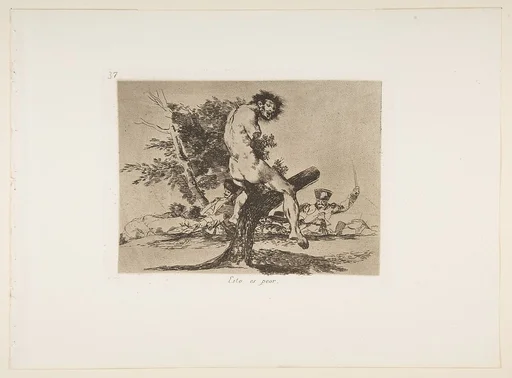
The empty roads of the Spanish countryside became the improvised setting for summary executions by both sides during the Peninsular War. Shooting or, as illustrated in this print, hanging from trees was carried out on the spot. Here, Goya created a triangular composition, with the body of the hanged prisoner falling at its central axis. The victim’s pants have slipped down his legs, emphasizing both the effect of gravity and the haphazardness of the execution, in all likelihood carried out with his own belt. A Napoleonic soldier leans on a stone bench, contemplating the scene with indifference. The caption relates to the scene of garroting that immediately precedes it: "One can’t tell why."
- Artist
- Goya (Francisco de Goya y Lucientes)
- Date
- 1810
- Medium
- Etching, burnished aquatint, drypoint
- Department
- Drawings and Prints
- Credit line
- Purchase, Derald H. and Janet Ruttenberg, Dr. and Mrs. Goodwin M. Breinin, Arthur Ross Foundation, and Peter H. B. Freylinghuysen Gifts, and The Elisha Whittelsey Collection, The Elisha Whittelsey Fund, 1987
![Plate 36 from "The Disasters of War" (Los Desastres de La Guerra): 'Not [in this case] either' (Tampoco)](https://d2pvxr3eb77vb4.cloudfront.net/assets/v1/21/219817f841188d5ccb22db0c5966061c9f39f2a2dff086ee1c8386f696baf56c/graph.webp)