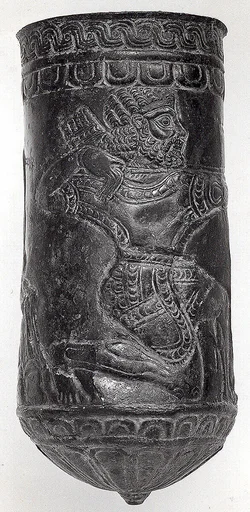
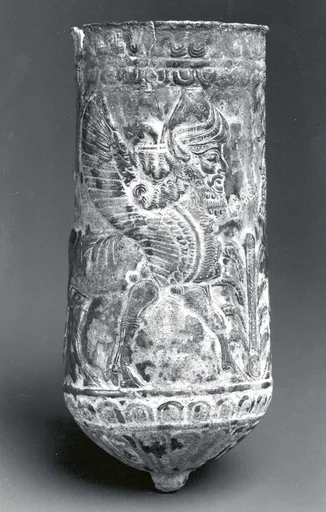
Vase with a handle in the form of a human-headed bull protome
Unknown
ca. 8th–7th century BCE · Faience · Ancient Near Eastern Art
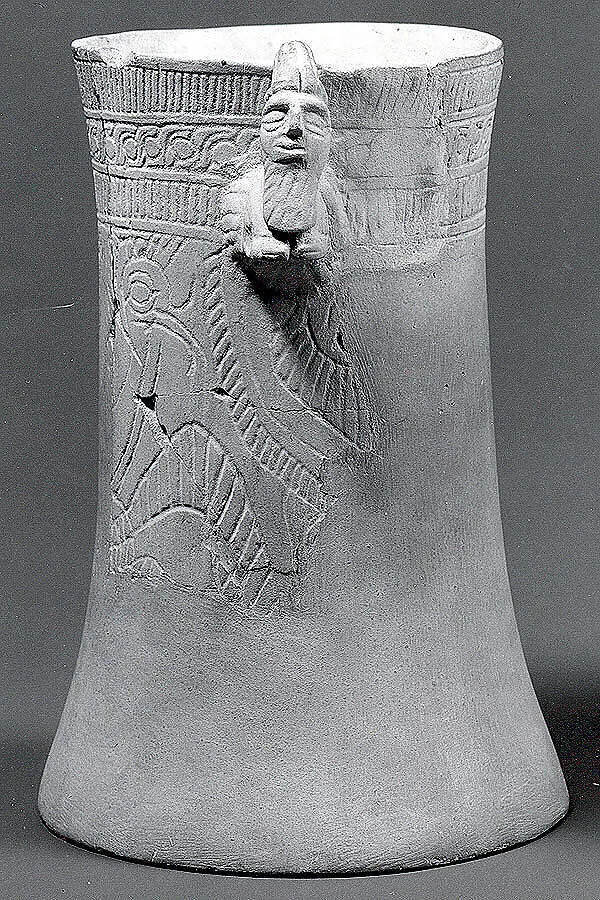
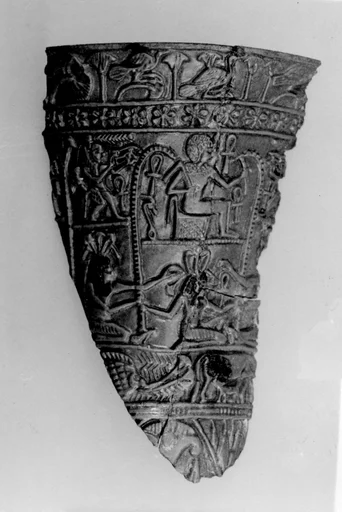
This faience vessel has incised decoration on the outside, including two rows of vertical lines with a guilloche pattern between them below the rim. The body of the vessel has a stylized human figure facing forward, with a large bird on the right. A protome, possibly a handle, emerges from the rim of the vessel in the form of a kneeling human-headed bull creature. He has a long beard and a bulbous hat with two horns at the front, indicating divinity. His eyes are seemingly closed. This vessel was excavated at Surkh Dum, a settlement site in Luristan in the Zagros Mountains of western Iran. It was found in a structure interpreted as a sanctuary and was thus probably an offering to a god. Other faience vessels with similar designs but different shapes have been found at Susa, suggesting that it was made in Elam. The human-headed bull is a well-known feature of ancient Near Eastern art. Often called a ‘lamassu,’ the creature is generally understood to be a protective entity, which is why colossal bull-men are represented in the doorways and gateways of Assyrian and Achaemenid palaces.
- Artist
- Unknown
- Date
- ca. 8th–7th century BCE
- Medium
- Faience
- Culture
- Elamite
- Department
- Ancient Near Eastern Art
- Credit line
- Rogers Fund, 1943